






A woman in Maiduguri, northeastern Nigeria, sold her furniture to buy a herbal remedy from a traditional healer promising a permanent cure after free ART became unavailable.
The treatment, she said, left her weaker and out of pocket.
The woman, identified only as Aisha to protect her anonymity, told SciDev.Net that she had depended on ART from a clinic funded through the US President’s Emergency Plan for AIDS Relief (PEPFAR).
The treatment kept her HIV suppressed until January 2025, when US President Donald Trump ordered a halt to PEPFAR funding. Although the programme partially resumed in February 2025, it faced significant budget cuts.
According to a study by the AIDS research foundation amfAR, at least 1,714 HIV service sites globally closed entirely after terminated or delayed PEPFAR payments, and almost none could replace the lost funding.
In Nigeria, PEPFAR has disbursed over US$7.8 billion to provide more than 1.9 million people with access to ART.
Facing donor stockouts and financial barriers, Aisha and other patients across northern Nigeria, Niger and Chad have been abandoning ART for unregulated alternatives marketed as “Islamic medicine,” according to SciDev.Net reporting.
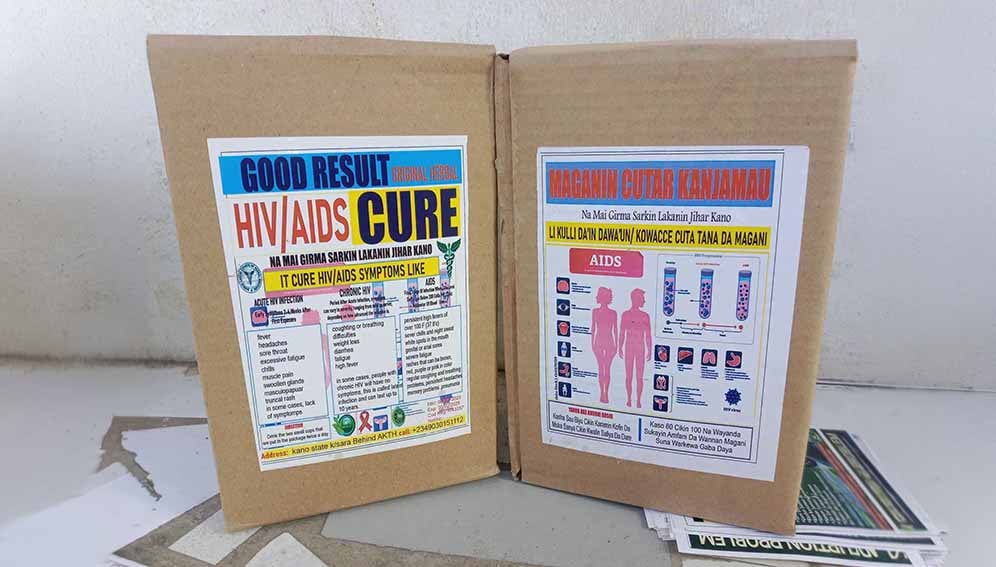
The trend is visible in urban centres such as Kano, Bauchi, Gombe and Maiduguri, where practitioners operate through offline community networks and social media, selling herbal concoctions that promise a total cure in a few months for a one-off purchase.
In Kano, traditional healer Yusuf Muhammad Sufi, known as Sarkin Lakanin Jihar Kano, claims his products have “cured” most patients who used them. He sells HIV treatment for N45,000 (US$33) and advanced AIDS regimens for up to N250,000 (US$183).
Similarly, Abdullahi Yunus Umar, who runs the Kashful Aleel Islamic Medicine Centre in Kano and Borno states, says his remedies have reportedly “cured” people living with HIV across Sokoto, Kano, Bauchi and Maiduguri.
Medical experts dispute these claims. Abubakar Ibrahim, senior registrar in the Department of Internal Medicine and Infectious Disease Unit at the University of Maiduguri Teaching Hospital, told SciDev.Net that “scientifically, there’s no cure to HIV using medication.
The ART we use in Nigeria cannot cure HIV.” ART works by preventing HIV from multiplying, reducing the viral load in the body and allowing the immune system to recover.
“The ART only suppresses the viral load to undetectable levels to prevent it from circulating in the body,” Ibrahim explained.
The remedies promoted by Umar and Sufi are often framed within a religious context. Practitioners cite a Hadith, a saying attributed to the Prophet Muhammad, which they interpret as meaning God created no disease without also creating its cure.
In predominantly Muslim northern Nigeria, invoking this teaching can make their claims more persuasive. Research on therapeutic choices in Kano shows how passages from classical texts on prophetic medicine are cited by both traditional healers and patients.
Mainstream Islamic scholars, however, condemn the practice as commercial exploitation. Muhammad Mahmud Mustapha, an Islamic scholar based in Kano, told SciDev.Net that “selling ineffective remedies that don’t perform the functions claimed is an act of deception strictly forbidden by Allah.”
He added that “anyone who falls victim to this fraud has a religious right to demand accountability for their stolen wealth and their endangered health.”
Mustapha stressed that the Hadith is a mandate for formal scientific research, not a license for unregulated commercialism.
“There is a big difference between the existence of a cure in nature and the human knowledge of where that cure is,” he said.
Aisha, who saw no improvement after two months on the herbal remedies, said her symptoms began to return and her body grew weaker.
“I realised I had spent everything I owned on empty promises while the virus was multiplying inside me,” she said.
She now faces paying out of pocket for consultations, routine viral load tests and clinic administration fees that were previously covered.
Source: Sub-Saharan Africa