







Enugu West’s 2027 Choice: Performance, Continuity, and the Strategic Value of Senator Osita Ngwu’s Return
The Report
As reported by Leadership News journalist Anayo Agu, a detailed editorial argument has been published making the case for the re-election of Senator Osita Ngwu (Enugu West) in the 2027 Nigerian Senate elections. The piece, dated June 7, 2026, frames Senator Ngwu’s political trajectory as a “hero’s journey,” tracing his path from a 2019 political setback to his current role as Senate Minority Whip and Chairman of the Senate Committee on Air Force.
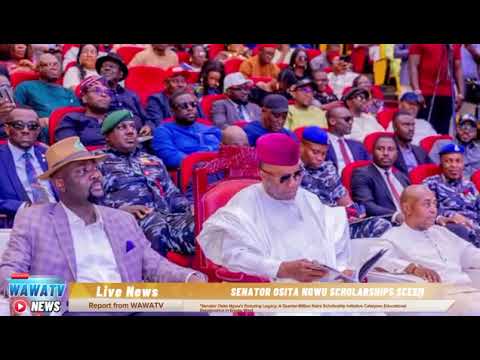
The article highlights several key achievements during his first term (2023–2026): the establishment of the Enugu West Academy, free JAMB learning centres, a ₦250 million scholarship and bursary programme (complemented by a ₦100 million donation from Senate President Godswill Akpabio), and constituency projects including roads, solar streetlights, boreholes, and market infrastructure. The piece also notes his youth empowerment initiatives, including minibus donations that sparked community celebrations. The author argues that Senator Ngwu’s performance—rather than sentiment, party affiliation, or ethnic loyalty—constitutes the strongest case for his return.
“The strongest case for Senator Osita Ngwu’s re-election is not sentiment, Ngwo’s population and political strength, Agbaja leadership endorsement, party affiliation, or emotional attachment. It is performance.”
WANA Regional Analysis
This editorial, while focused on a single senatorial district in Enugu State, carries implications that resonate across Nigeria’s broader political landscape and the West African region. The case for Senator Ngwu’s re-election is not merely a local political argument; it reflects a growing trend in Nigerian and West African politics where performance-based incumbency is increasingly valued over traditional patronage networks, godfatherism, or ethnic arithmetic.
ECOWAS Relevance and Democratic Consolidation: Across the ECOWAS region, from Ghana to Senegal to Sierra Leone, voters are demanding tangible dividends from their elected representatives. The emphasis on educational investment, infrastructure, and youth empowerment in Senator Ngwu’s record mirrors a regional shift toward constituency-focused governance. If re-elected, his model could serve as a case study for other West African legislatures seeking to strengthen the link between parliamentary representation and grassroots development. Conversely, a failure to reward such performance could discourage similar efforts by other legislators, potentially weakening democratic accountability in the region.
Political Risk and Governance Trends: The article’s framing of Senator Ngwu’s journey—from being underestimated to becoming a key Senate leadership figure—highlights a broader governance trend in Nigeria: the rise of younger, technocratic politicians who are bypassing traditional political hierarchies. This is significant for West Africa, where many legislatures remain dominated by older, established figures. If Senator Ngwu’s trajectory is replicated, it could signal a generational shift in political leadership across the region, with implications for policy innovation, legislative efficiency, and public trust in democratic institutions.
Economic and Infrastructure Impact: The reported ₦250 million scholarship programme and ₦100 million donation from the Senate President underscore the economic multiplier effect of effective representation. In a region where education remains a critical pathway out of poverty, such investments can reduce youth unemployment, improve human capital, and stimulate local economies. The constituency projects—roads, solar lighting, boreholes—address basic infrastructure deficits that are common across West Africa. If sustained, these interventions could serve as a replicable model for other legislators in Nigeria and neighbouring countries.
Diplomatic and Strategic Consequences: Senator Ngwu’s role as Senate Minority Whip and Chairman of the Senate Committee on Air Force places him at the intersection of national security and legislative oversight. The Air Force committee is particularly relevant given the ongoing security challenges in Nigeria’s North-East and North-West, which have regional spillover effects into Niger, Chad, and Cameroon. A legislator with growing influence in this domain could shape Nigeria’s defence policy and regional security cooperation. His re-election would ensure continuity in this strategic oversight role, which is critical for ECOWAS’s collective security architecture.
Historical Context and Ethnic Balancing: The article’s reference to Senator Ngwu’s Ngwo and Agbaja Land heritage, and the historical legacy of figures like C.C. Onoh, highlights the delicate ethnic and sub-regional balancing that underpins Nigerian politics. In Enugu West, the emergence of a representative who transcends his immediate ethnic base to become a symbol of broader aspirations is a positive sign for national integration. For West Africa, where ethnic and regional tensions often fuel political instability, such examples of inclusive representation are valuable. They demonstrate that effective governance can bridge communal divides and build cross-cutting coalitions.
Strategic Forecasting: As the 2027 elections approach, the Enugu West contest will be closely watched by political analysts across Nigeria. If Senator Ngwu secures re-election on a platform of performance, it could embolden other first-term legislators across the country to prioritise constituency service over political manoeuvring. This would represent a positive shift in Nigeria’s political culture, with potential ripple effects for legislative effectiveness and democratic consolidation in West Africa. Conversely, if he is defeated despite his record, it could signal that performance alone is insufficient in a system still dominated by money, godfathers, and ethnic loyalty—a sobering lesson for reformers across the region.
Regional Backdrop
Nigeria’s National Assembly has historically been criticised for its distance from constituents, with many legislators focusing on personal enrichment rather than community development. The emergence of a senator like Osita Ngwu, who has invested heavily in education and infrastructure, represents a departure from this norm. Across West Africa, similar experiments in constituency development funds and legislative oversight are being tested in Ghana, Sierra Leone, and Liberia. The outcome of the Enugu West election could influence how these experiments are evaluated and whether they are scaled up regionally.
Furthermore, the role of the Senate Minority Whip in Nigeria’s bicameral system is not merely procedural; it is a position of influence that can shape legislative priorities, especially in a divided chamber. Senator Ngwu’s ability to hold this position as a first-term senator is unusual and speaks to his political acumen and cross-party appeal. For West African democracies, where opposition parties often struggle to maintain cohesion, his example offers lessons in how to build influence within a legislative minority.
Original Reporting By:
Leadership News