WANA Deep-Dive: PDP Factional Crisis Threatens to Undermine Nigeria’s Opposition Unity Ahead of 2027
The Report
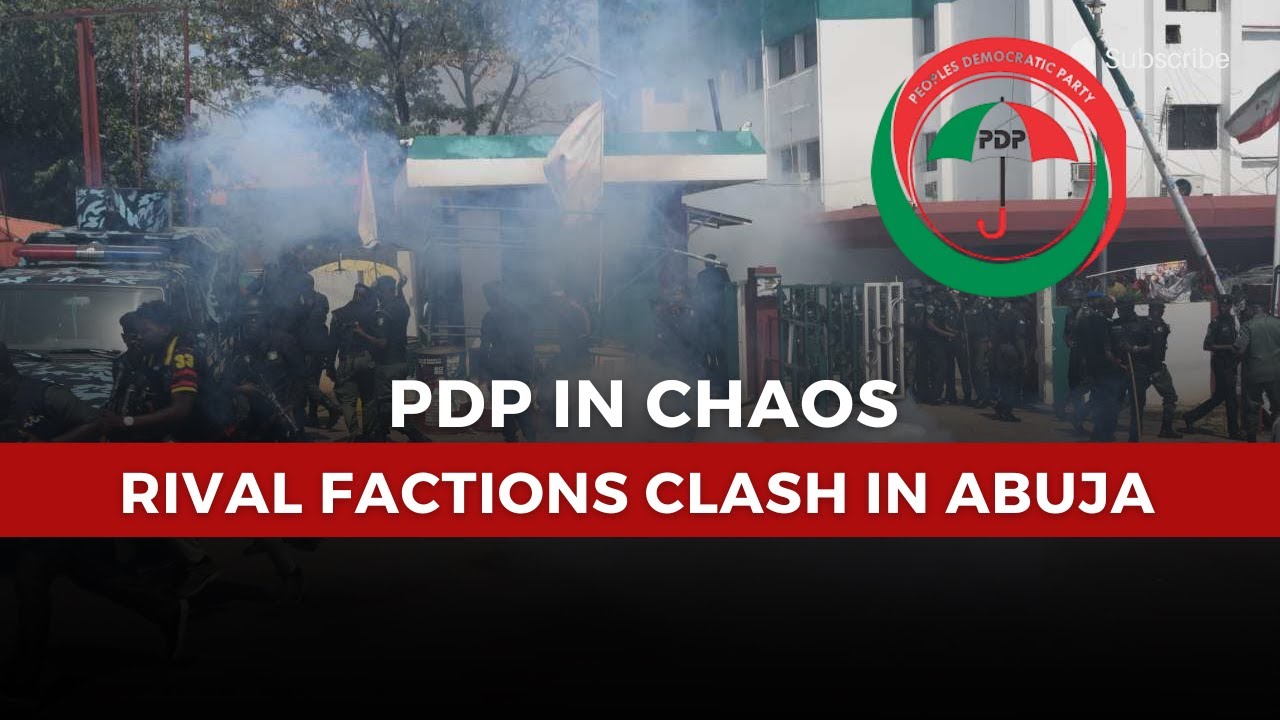
As reported by an unnamed source, a deepening rift within Nigeria’s main opposition party, the Peoples Democratic Party (PDP), has escalated into a public confrontation between two rival factions. The Tanimu Turaki-led faction has announced plans to hold a special convention in Abuja on 30 May 2026 to ratify former President Goodluck Jonathan as the party’s presidential candidate for the 2027 elections. The faction alleges that the Minister of the Federal Capital Territory, Nyesom Wike, has threatened to shut down the venue for the event.
“We have been informed by the proprietors of the Event Centre of the threat by the Minister of the FCT, Nyesom Wike, to shut down their business premises if the Peoples Democratic Party is allowed to use their hall for our presidential candidate ratification ceremonies.”
In response, the faction loyal to Wike, led by Abdurahman Mohammed, has dismissed the planned convention as unauthorised and called on former President Jonathan to publicly distance himself from the exercise. The Wike-backed faction insists that all party primaries have been concluded and that no such convention has been approved by the party’s recognised leadership structures.
WANA Regional Analysis
This internal crisis within the PDP carries significant implications for Nigeria’s political landscape and, by extension, the broader West African region. Nigeria, as the largest economy and most populous nation in the ECOWAS bloc, often sets political and governance trends that ripple across neighbouring states. A fractured opposition in Nigeria weakens democratic accountability and reduces the pressure on the ruling All Progressives Congress (APC) to deliver on governance reforms, which in turn affects regional stability and economic integration efforts.
From a regional policy perspective, the PDP’s disarray undermines the party’s ability to present a coherent alternative to the APC in 2027. This could lead to a less competitive electoral environment, potentially reducing voter turnout and public trust in democratic processes. Historically, West African governments have struggled with electoral credibility, and a weakened opposition in Nigeria could set a negative precedent for other ECOWAS member states where opposition parties are already under strain.
The involvement of Nyesom Wike, a former governor and current FCT Minister, highlights the intersection of political ambition and state power. Wike’s alleged use of ministerial authority to block a political event raises questions about the separation of party and state in Nigeria. If confirmed, this would represent a concerning trend for governance norms in the region, where the line between political competition and state coercion is often blurred.
Economically, prolonged political uncertainty within Nigeria’s opposition could deter foreign investment, as investors typically favour stable political environments. The 2027 elections are already a focal point for regional economic forecasts, and any sign of instability or lack of credible opposition could exacerbate capital flight and reduce investor confidence in West Africa’s largest market.
Furthermore, the Turaki faction’s push to ratify Goodluck Jonathan—a former president who left office in 2015—signals a potential return to old-guard politics. This move may alienate younger voters and reform-minded party members, further fragmenting the opposition. For ECOWAS, which has been promoting youth inclusion and democratic renewal, a return to past leadership figures could be seen as a step backward.
The security implications are also noteworthy. Political factionalism in Nigeria has historically led to violence, especially during election cycles. The PDP’s internal feud, if left unresolved, could escalate into physical confrontations between supporters, placing additional strain on Nigeria’s security apparatus, which is already stretched by insurgencies in the northeast and banditry in the northwest. A destabilised Nigeria would have direct consequences for regional security, as the country is a key partner in ECOWAS counter-terrorism and peacekeeping efforts.
Regional Backdrop
The PDP has been Nigeria’s dominant opposition party since losing the presidency in 2015. Internal divisions have plagued the party for years, with factions often aligning around powerful individuals rather than policy platforms. The current crisis echoes similar splits in 2014 and 2018, which weakened the party’s electoral performance. In the West African context, opposition fragmentation is a recurring theme, with parties in Ghana, Senegal, and Côte d’Ivoire also experiencing internal strife that reduces their effectiveness as checks on executive power.
ECOWAS has consistently advocated for strong, democratic institutions and internal party democracy. The PDP’s inability to resolve its leadership dispute through established mechanisms undermines these principles and may prompt the regional bloc to issue statements of concern, though direct intervention is unlikely given Nigeria’s sovereignty and size.
Original Reporting By:
Unnamed Source