
Faso Loto Nekre Draw: Routine Results or a Window into West Africa’s Informal Economy?
The Report
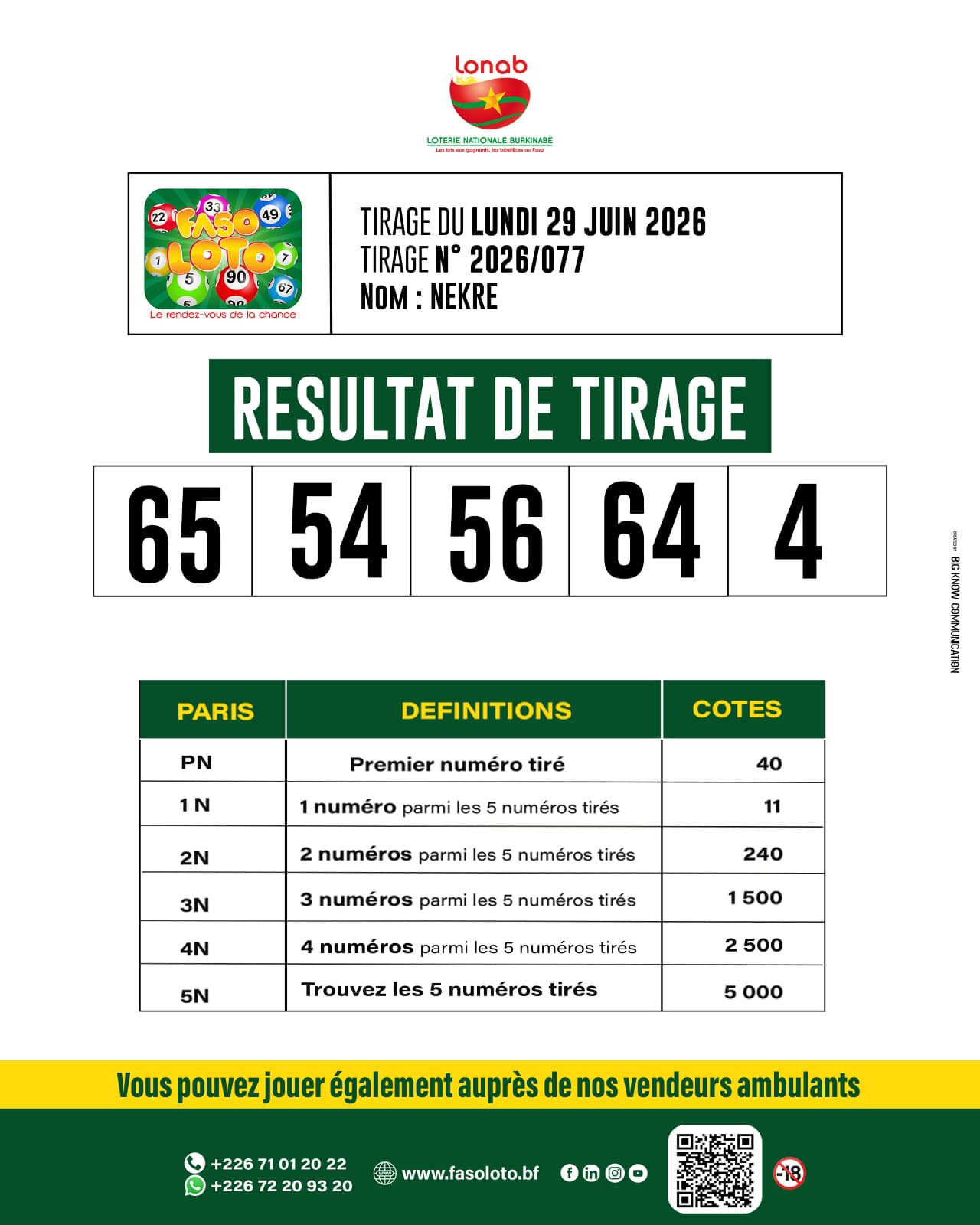
As reported by Faso Loto’s official communications, the results for the “Nekre” draw (5/90) were published for Monday, June 29, 2026, corresponding to Draw No. 2026/077. The winning numbers drawn were 65, 54, 56, 64, and 04. The announcement, disseminated via the operator’s website and authorized street vendors, included standard promotional language encouraging participation and reminding players of the legal age restriction and responsible gaming guidelines.
“Every draw is a fresh chance to try your luck… What if today is your day?”
The report also directed players to the official website, www.fasoloto.bf, and to authorized street vendors for ticket purchases. The draw is part of the regular schedule for Faso Loto, a state-licensed lottery operator in Burkina Faso.
WANA Regional Analysis
While the publication of lottery draw results may appear as a routine administrative update, its significance within the West African context warrants closer examination. The Faso Loto “Nekre” draw is not merely a game of chance; it is a deeply embedded feature of the informal economy and a barometer of public sentiment in a region grappling with economic uncertainty, security challenges, and limited formal financial inclusion.
Economic Implications and the Informal Sector: Lotteries like Faso Loto serve as a primary, and often the only, accessible form of speculative investment for millions of West Africans who operate outside the formal banking system. The reliance on “authorized street vendors” underscores the critical role of informal distribution networks. These vendors are often micro-entrepreneurs themselves, and the lottery provides a low-barrier entry point for small-scale capital accumulation. From a regional policy perspective, the steady operation of such draws, even amid broader instability, signals a degree of economic resilience and a persistent demand for low-cost, high-reward financial instruments. However, it also raises governance questions about consumer protection, the potential for regressive taxation on lower-income populations, and the lack of robust regulatory oversight across the ECOWAS region.
Security and Governance Context: The fact that Faso Loto continues to operate and publish results is, in itself, a noteworthy data point. Burkina Faso has been at the epicenter of the Sahel security crisis, with large swathes of territory under the influence of non-state armed groups. The ability to conduct a national lottery draw, even if only in government-controlled areas, suggests a functional, if constrained, state apparatus. For regional analysts, this is a subtle but important indicator of state capacity and the resilience of public-facing institutions. The draw’s regularity provides a small but consistent thread of normalcy in a volatile environment.
Regional Trade and Cross-Border Dynamics: While the draw is national, the lottery’s appeal often transcends borders. In the ECOWAS region, where porous borders and shared cultural ties are the norm, lottery tickets and results frequently circulate informally across countries. This creates a minor but real cross-border financial flow and a shared cultural touchpoint. The “Nekre” draw, with its specific branding, contributes to a regional lottery culture that, while fragmented, is a significant part of the entertainment and informal financial landscape from Dakar to Niamey.
Strategic Forecasting: The continued operation of Faso Loto, despite the challenging security environment, suggests that the Burkinabe government views the lottery as a stable source of non-tax revenue. Should the security situation deteriorate further, the lottery’s distribution network could be disrupted, impacting both state revenue and the livelihoods of thousands of street vendors. Conversely, a successful stabilization effort could see the lottery expand, potentially integrating digital payment systems that would offer a bridge to formal financial services for a previously unbanked population. The draw results, therefore, are not just numbers; they are a small but telling piece of the larger puzzle of West African economic and political resilience.
Regional Backdrop
Lotteries have a long and complex history in West Africa, often originating from colonial-era state monopolies. In the post-independence era, they have been used by governments as a tool for revenue generation, funding social programs, and, in some cases, as a form of patronage. The informal lottery sector, including private “banker” games, is even more pervasive. The formalization of games like Faso Loto represents an attempt by the state to capture a portion of this informal market, regulate it, and derive public benefit. The “Nekre” brand is part of this strategy, aiming to build trust and brand loyalty in a market often characterized by suspicion of official institutions.
Original Reporting By:
Faso Loto Official Communications

Comments