










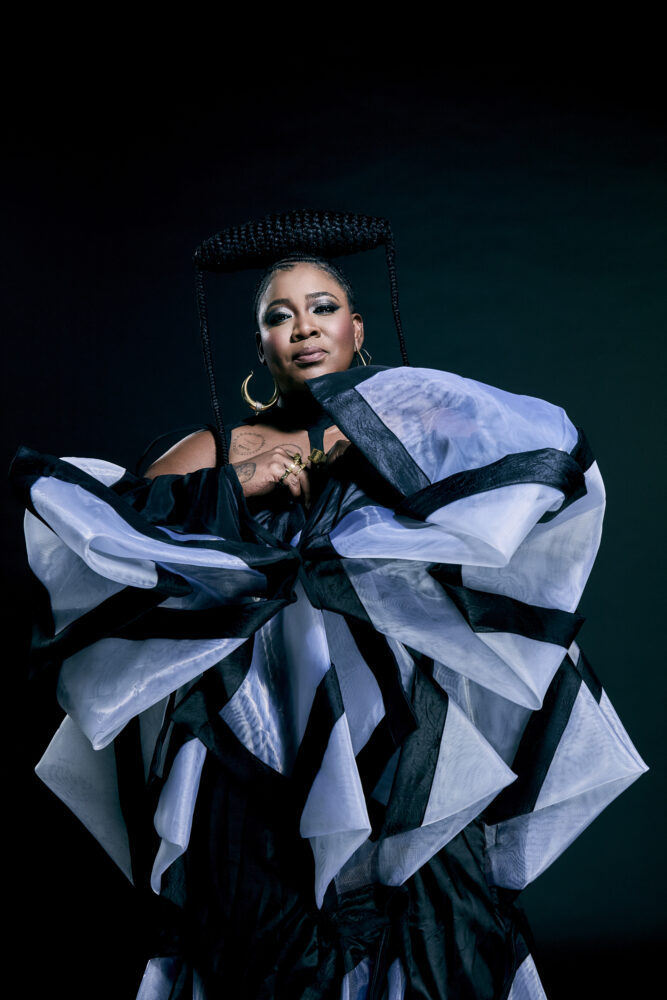
One in a long line: Songbird Thandiswa Mazwai says she’s merely a conduit in the tradition of using their
voices that was started by her forebears and will continue into posterity. Her upcoming Sankofa Music Fest
will showcase this tradition. Photo: Supplied
When Thandiswa Mazwai reveals the tattoo on her chest—a constellation of symbols from Credo Mutwa’s seminal work Indaba, my children—she isn’t just sharing body art. She’s revealing her artistic and spiritual operating system. The four carefully selected symbols form a declarative sentence: “We speak for future generations.em>
“This isn’t just ink,” she explains, her voice carrying the weight of three decades in music. “It’s a daily reminder that I stand at the intersection of time. The generations before me—Miriam Makeba, Busi Mhlongo, Brenda Fassie—they created the blueprint. My work is to honor that blueprint while adding new patterns for those who will come after.”
This philosophy of cultural stewardship becomes particularly poignant as Mazwai approaches two significant milestones: her 50th birthday and 30 years in an industry that has consumed many of her contemporaries. The statistics are sobering—Brenda Fassie, the iconic “Madonna of the Townships,” was only 39 when she passed. Many kwaito pioneers, the architects of post-apartheid youth culture, never reached this vantage point.
“We never thought we’d grow up,” Mazwai reflects, the nostalgia tempered with survivor’s wisdom. “The kwaito kids were frozen in perpetual youth. I’m still that girl in Converse and long skirts, but the context has shifted. The play has become purpose.”
This evolution from playful creativity to purposeful artistry represents what cultural theorists might call the “eldering” of a generation—the moment when cultural rebels become cultural custodians. For Mazwai, this doesn’t mean abandoning her revolutionary spirit but rather understanding its place in a longer continuum.
“I’ve come to understand that my voice isn’t just mine,” she says. “It’s part of a chorus that includes my great-grandparents’ struggle songs, my parents’ freedom chants, and my daughter’s future anthems. I’m a temporary vessel in this river of sound.”
This awareness crystallizes in the Sankofa Heritage Festival, her ambitious project scheduled for February 28, 2026, at Carnival City. The name itself—Sankofa—comes from the Akan people of Ghana, symbolized by a bird looking backward while moving forward, carrying an egg representing the future.
“Sankofa isn’t about nostalgia,” Mazwai clarifies. “It’s about strategic retrieval. We go back to fetch what we need to move forward. In a time of cultural amnesia, we’re gathering the fragments to build something new.”
The festival’s conceptual architecture revolves around what Mazwai calls “the drum as main character.” She explains this choice with anthropological precision: “The drum predates language. It’s the original heartbeat of African civilization. When you hear certain rhythms, your body remembers what your mind has forgotten. It opens portals to ancestral knowledge and future possibilities simultaneously.”
This isn’t merely theoretical. The festival design includes pre-event workshops where participants will literally build drums, learning not just to play them but to understand their cultural significance across various African traditions. “We’re moving beyond passive consumption to active creation,” Mazwai emphasizes. “The audience becomes co-creator in this ritual of cultural continuity.”
Her approach to curation reflects what Nigerian writer Chimamanda Ngozi Adichie calls “the danger of a single story.” The lineup deliberately spans generations and genres, creating dialogues between traditional maskandi, contemporary amapiano, and pan-African jazz. “Amapiano is heritage in the making,” Mazwai insists. “Heritage isn’t frozen in rural villages—it’s happening in Soweto nightclubs and Johannesburg studios right now.”
This living heritage concept manifests powerfully in her song Emini, written in 2021 but achieving prophetic relevance during South Africa’s 2024 elections. “Art operates on multiple timelines,” she observes. “I place a spark in the studio, but it only becomes fire when it meets the right social conditions. The artist plants seeds whose harvest they may never see.”
This long-term perspective informs the festival’s mentorship component, where emerging artists will receive not just performance opportunities but holistic career development. “We’re building ecosystems, not just events,” Mazwai explains. “The makeup artists, designers, stage managers—they’re all part of this cultural web. If we nurture the entire ecosystem, we create sustainable creative economies.”
Her social consciousness remains sharply critical, particularly regarding South Africa’s persistent inequalities. “How do we reconcile extreme wealth with desperate poverty?” she asks, her question hanging in the air like the unresolved chord in her classic Nizalwa Ngobani. “Art must provoke these uncomfortable conversations while offering visions of alternative possibilities.”
Yet for all this weighty responsibility, Mazwai insists on joy as revolutionary practice. “Look at traditional dances—they’re physically demanding, ecstatic, transcendent. The body knows truths the mind struggles to articulate. At Sankofa, we want people to come in their full splendor, to move, to feel, to remember through their bodies.”
As she approaches 50, Thandiswa Mazwai embodies what anthropologist Margaret Mead called “the grandmother hypothesis”—the idea that elders serve as living libraries for their cultures. But she’s no dusty archive; she’s a dynamic bridge connecting ancestral wisdom with futuristic imagination.
Through the Sankofa Heritage Festival, she’s creating what might be called a “temporal commons”—a space where past, present and future generations can convene to renegotiate what it means to be African. It’s her living response to the tattooed promise on her chest: not just speaking for future generations, but creating the conditions for them to find their own voices.
Tickets for the Sankofa Heritage Festival are now available on Computicket