









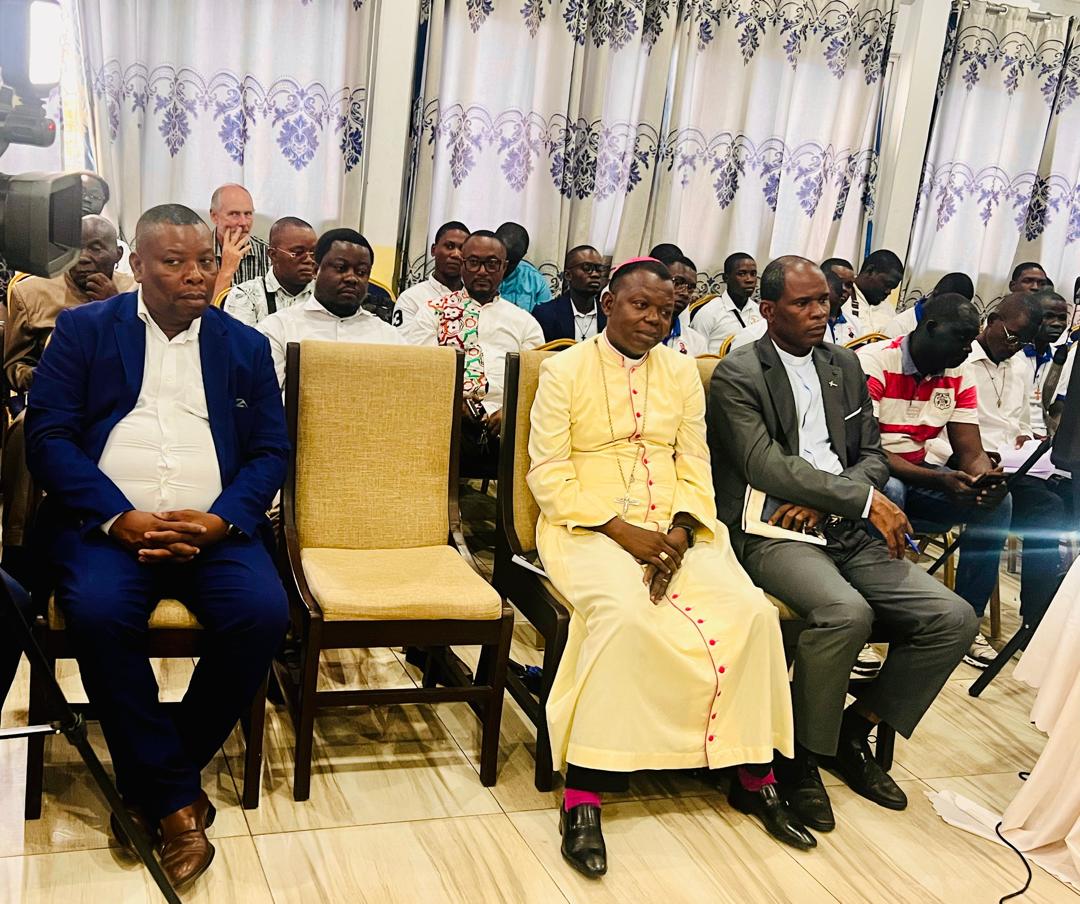
The presentation of Bishop Daniel Mizonzo’s philosophical work “L’entente de la mort” (The Agreement with Death) at the Church and Society Interdisciplinary Research Group (CERC) represented more than a typical book launch—it was a homecoming. As the ceremony’s opening speaker noted on behalf of CERC director Father Médard Sané, “Bishop Mizonzo is no stranger to CERC. Returning here is like returning to family, returning to his first philosophical loves.” This established an intimate, reflective tone for an event that would explore one of humanity’s most universal yet culturally specific experiences: death.
The academic responses to Mizonzo’s work revealed its profound interdisciplinary significance. Professor Stève Gaston Bobongaud from the Catholic University of Central Africa provided the first analysis, emphasizing the text’s conceptual rigor. His observation that “Death is a phenomenon. The phenomenon of death manifests itself by manifesting itself” points to the work’s phenomenological foundation, drawing from Husserl and Heidegger’s tradition of examining how phenomena reveal themselves to consciousness. Professor Bobongaud praised Mizonzo as a “master” who instilled in him “the taste for philosophical passion,” highlighting the author’s role as both thinker and mentor.
Professor Florent Malanda from Marien-Ngouabi University then illuminated the book’s ethical dimensions through an African lens. “A being who lives must die. But for the African, death is not the final stage of life: it surpasses and transforms it,” he explained. This perspective challenges Western binary thinking about life and death, instead presenting death as a transitional state. Malanda demonstrated how Mizonzo skillfully bridges Heidegger’s analytics of Dasein (being-there) with Bantu philosophy’s understanding that “the dead are not dead”—a concept where ancestors remain active participants in the community’s life, creating continuity between visible and invisible realms.
 Professor Auguste Nsonsissa, head of the doctoral program in philosophy at Marien Ngouabi University, offered perhaps the most comprehensive assessment, describing the work as expanding “phenomenology toward a philosophical anthropology of death.” He praised Mizonzo’s unique ability to “bring Heidegger, Levinas, Derrida, and the Bantu symbolic universe into dialogue”—a remarkable intellectual achievement that creates new pathways for cross-cultural philosophy. This interdisciplinary approach allows Mizonzo to examine death not just as an individual experience but as a cultural, spiritual, and social phenomenon with distinct manifestations across philosophical traditions.
Demystifying Death Through Cross-Cultural Dialogue
In his 146-page work, Mizonzo navigates between two profound understandings of mortality. From Heidegger, he draws the concept of death as “the possibility of the impossibility of any existence”—the ultimate limit that defines human finitude and gives meaning to our choices. Yet Mizonzo doesn’t stop at Western existentialism; he shows how Afro-Bantu traditions open an alternative horizon where death appears as passage, relationship, and continuity rather than absolute end. This perspective resonates with practices across many African cultures where elaborate funeral rites, ancestor veneration, and naming ceremonies maintain bonds between living and dead generations.
 The significance of Mizonzo’s contribution was further emphasized by Dr. Father Crépin Gyscard Gandou D’Isseret, head of the interdisciplinary research group, who praised the “high-quality heuristic contribution” and described the work as “this feast of words is worthy of the wise counsel you never cease to give us.” This acknowledgment underscores how the book serves both academic and practical purposes—offering not just theoretical insights but wisdom applicable to how communities understand and navigate mortality.
When Bishop Mizonzo addressed the audience, his invitation was simple yet profound: “My friends, get this book…” His direct appeal signaled the work’s accessibility despite its philosophical depth, encouraging readers to engage personally with its meditation on mortality. The subsequent rich exchange with the public demonstrated the universal relevance of his subject matter, touching on questions that resonate across cultures and belief systems.
The ceremony culminated in a signing session that transformed theoretical discussion into personal connection, allowing attendees to engage directly with the author. This moment embodied the book’s central thesis—that conversations about death need not be morbid but can represent meaningful engagement with what makes us human. Through reading and discussion, participants could extend Mizonzo’s meditation on how death “does not interrupt life, but fulfills it differently”—a perspective that offers comfort and insight regardless of one’s cultural or philosophical background.
Mizonzo’s work arrives at a particularly relevant time, as global crises and ecological concerns have prompted renewed philosophical engagement with mortality across cultures. By creating dialogue between European philosophical traditions and Bantu wisdom, “L’entente de la mort” contributes to the growing field of intercultural philosophy while offering unique insights applicable to psychotherapy, palliative care, theological studies, and everyday life. The book represents not just an academic achievement but an invitation to reconsider one of life’s few certainties through a more expansive, cross-cultural lens.