










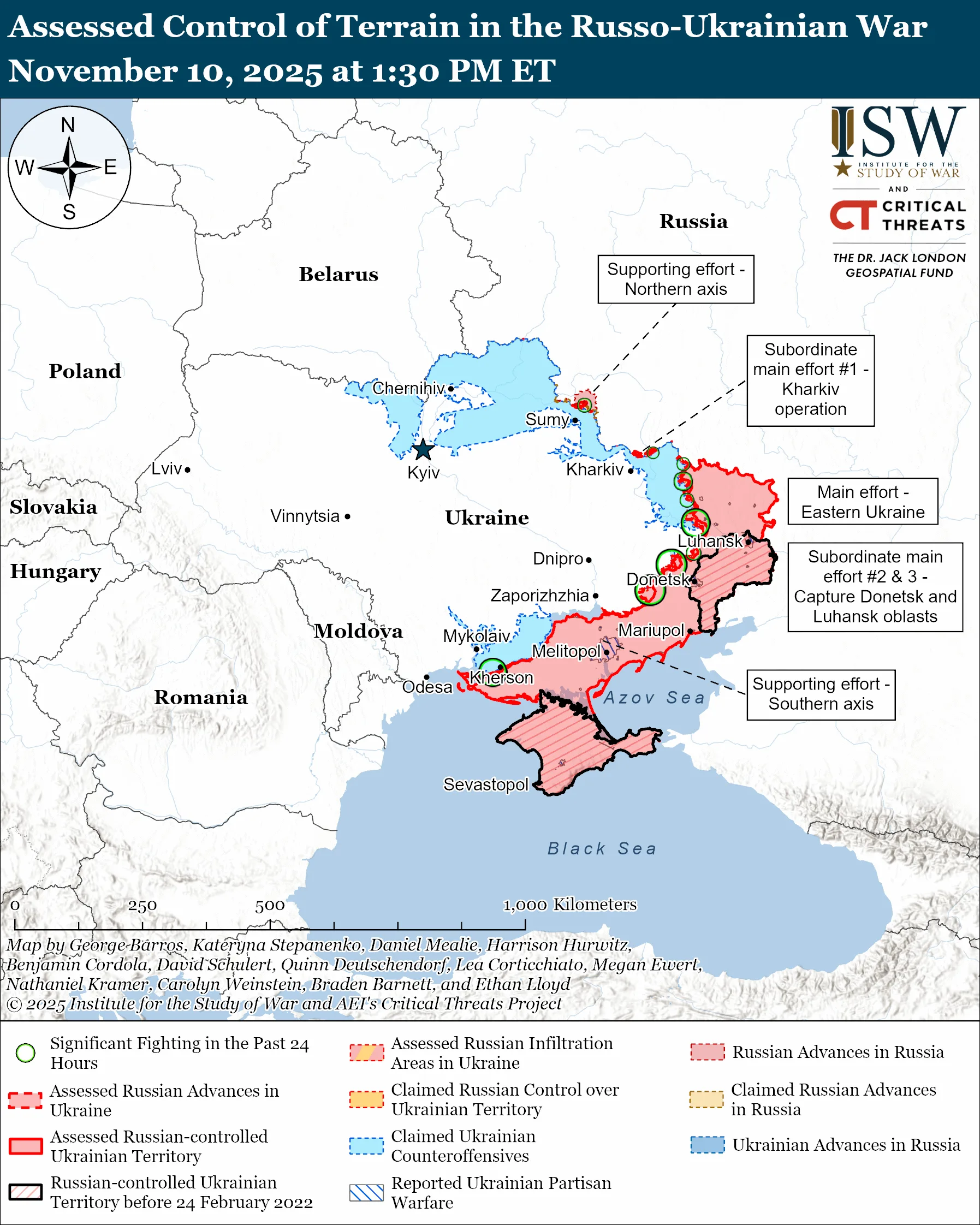
As the war enters its fourth year, December 16, 2025, marked a day of significant tactical escalation and high-stakes diplomatic maneuvering. The developments underscore the conflict’s brutal duality: relentless attrition on the front lines and a fragile, politically charged search for an off-ramp.
Fighting
Frontline Report: Civilian Toll and a Strategic Maritime Claim
The human cost of Russia’s sustained bombardment continued unabated. In the Sumy region, a 62-year-old man became another tragic statistic, killed by a drone while riding a bicycle—a stark illustration of the war’s pervasive danger. The scale of artillery fire remained overwhelming, with 850 attacks reported in Zaporizhia region alone in 24 hours, injuring 14 and damaging critical civilian infrastructure.
However, the day’s most notable military development was Ukraine’s claim of a historic strike. Kyiv asserted that its naval drones had, for the first time, successfully hit a Russian submarine docked at the Black Sea Fleet’s main base in Novorossiysk. This port, further east than Sevastopol in Crimea, had been considered a more secure sanctuary for Russia’s navy after repeated Ukrainian successes with surface drones.
- Strategic Context: If confirmed, this represents a profound evolution in Ukrainian asymmetric warfare. Striking a submerged, high-value target like a submarine requires advanced underwater drone technology and intelligence, signaling a new dimension of threat to Russia’s naval assets. It challenges Moscow’s narrative of secured rear areas and could force further costly dispersal of its fleet.
- Russian Denial: As expected, Russian officials immediately denied any damage. This denial is part of a consistent pattern to downplay Ukrainian successes, but it also serves an internal propaganda purpose, aiming to maintain the illusion of invulnerability to the domestic audience.
Ceasefire talks
Diplomatic Front: The Berlin Talks and the Shadow of Concessions
Parallel to the fighting, a potentially pivotal diplomatic meeting convened in Berlin. Hosted by German Chancellor Friedrich Merz, it brought together US President Donald Trump, Ukrainian leadership, and key European and NATO allies.
President Trump’s statement that a deal was “closer than ever” suggests a heightened pace of back-channel negotiations, likely driven by American pressure. However, the devil lies in the unresolved details, primarily the issue of territory.
- The European Stance: The joint European statement was a crucial diplomatic firewall. By insisting that only Ukraine can decide on territorial concessions, and only after receiving “robust security guarantees,” European leaders sought to prevent a peace deal being imposed on Kyiv by external powers, particularly the US. This highlights a fundamental tension in the negotiations: Washington’s push for a swift settlement versus European (and Ukrainian) concerns over sovereignty and long-term security.
- The Security Guarantee Proposal: The announcement of plans for a European-led “multinational force” to operate inside Ukraine—securing skies and seas—is a monumental shift. It moves beyond training and equipment supply to a potential direct, albeit limited, Allied military presence. This is likely the West’s proposed counterbalance to any Ukrainian territorial compromises, intended to deter future Russian aggression. Chancellor Merz’s mention of “considerable” US guarantees hints at a broader NATO or bilateral security umbrella being discussed.
- The Unanswered Question: Merz’s admission that “territorial settlement remains a key question” is the understatement of the talks. No public framework has been revealed, leaving open whether discussions involve a ceasefire along current lines, a formal partition, or a deferred resolution for occupied territories.
Regional security
Broader Context: Information Warfare and Calls for Readiness
The war’s other fronts—cyber and political—were also active. The suspected cyberattack on the German Bundestag’s email systems during the Berlin talks is a classic example of hybrid warfare, likely aimed at gathering intelligence, causing disruption, or sending a political message about the costs of opposing Moscow.
Meanwhile, Russian Foreign Minister Sergey Lavrov’s rhetoric, labeling the EU as the “main threat in the world,” is designed to fracture Western unity and justify Russia’s militarism to domestic and allied audiences like Iran.
Concurrently, the stark warnings from Western military chiefs, like the UK’s Air Chief Marshal Sir Richard Knighton calling for “national resilience” and readiness to fight, reflect a sobering long-term assessment. These statements indicate that regardless of any near-term ceasefire, Western militaries now view confrontation with a revanchist Russia as a enduring reality, necessitating a societal shift toward greater defense preparedness—a concept once confined to history books.
Bottom Line: Day 1,391 encapsulated the war’s current phase: Ukraine demonstrating growing capability to strike deep at high-value Russian targets, even as its allies negotiate a peace that may freeze those very battle lines. The success of the Novorossiysk strike strengthens Kyiv’s hand at the table, but the Berlin discussions reveal that the most painful political decisions—about land, sovereignty, and future security—are now coming to the fore.