







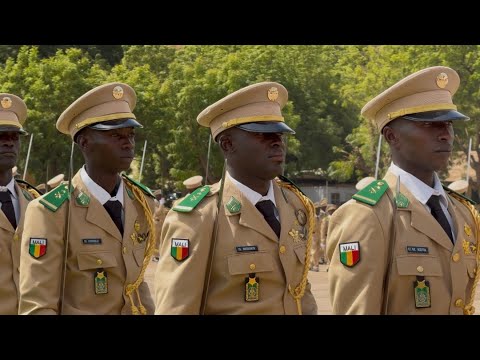
The President of the Transition, General Assimi GOÏTA, Head of State and Supreme Chief of the Armed Forces, presided over a pivotal moment in Mali’s military development—the baptism ceremony of the 47th class of the Inter-Arms Military School (École Militaire Interarmes – EMIA) in Koulikoro this Friday, November 28, 2025. This ceremony represents more than just a graduation; it signifies the reinforcement of Mali’s sovereign defense capabilities at a critical juncture in the nation’s history.
The high-level attendance underscored the strategic importance of this event. The ceremony took place in the presence of the Prime Minister, the President of the National Transition Council, the Minister of Defense and Veterans, the Governor of the Koulikoro region, the Mayor, as well as several members of the Government. The ceremony also saw the participation of the Chiefs of Staff, Directors of Army Services, diplomats accredited to the Republic of Mali, as well as partners and friends of the country, who came to salute this renewed commitment in favor of strengthening the Armed and Security Forces.
Similar Articles
The 47th EMIA class consists of 343 young officers from both the regular cycle and the special cycle—a significant infusion of leadership talent for Mali’s security apparatus. Their oath-taking before the national flag and Supreme Commander represents a sacred covenant with the nation, committing them to serve with loyalty, discipline, and dedication while upholding republican values. This ritual marks their formal transition from cadets to commissioned officers bearing the weight of national security responsibilities.
A Diverse and Technically-Skilled Officer Corps
The regular cycle, comprising 325 officers including 34 women, demonstrates Mali’s commitment to both gender inclusion and regional leadership. The inclusion of nationals from nine brotherly countries highlights EMIA’s growing reputation as a center of military excellence with continental reach. This pan-African approach fosters interoperability and strengthens regional security cooperation—essential elements in combating transnational threats.
Mali’s contingent of 311 officers, including 32 female personnel, represents a strategic blend of recruitment pathways: direct competition, professional path, Special Forces-specific competition, and most notably, a new specialist recruitment scheme. This latter innovation addresses critical capability gaps by providing the various Army directorates with experts in specific fields, particularly in military engineering, communications and telecommunications, military health, equipment and hydrocarbons, as well as institutional communication. This technical specialization reflects the evolving nature of modern warfare, where cyber capabilities, engineering expertise, and strategic communication are as vital as traditional combat skills.
The academic excellence achieved by Second Lieutenant Idrissa TIAMA, who graduated with a remarkable average of 16.600 out of 20, sets a high standard for professional competence. Meanwhile, the special cycle’s 18 officers, all nationals including 3 general practitioners and 15 specialist doctors, represents a crucial investment in military medical capacity—a often overlooked but vital component of operational effectiveness and force protection.
Comprehensive Training for Complex Security Challenges
The training regimen these officers completed reflects the multifaceted nature of contemporary security threats. Beyond traditional tactical training and physical conditioning, they underwent specialized modules including commando hardening—designed to develop the physical and mental resilience required for operations in diverse environments from desert to urban to forest terrain. Combat shooting emphasized precision and operational reactivity, while peacekeeping operations training prepared them for potential deployment in multinational contexts.
The South-South cooperation with Uganda, which saw 19 officers complete training modules there, represents a strategic diversification of Mali’s military partnerships. This exposure to different training methodologies and operational environments enhances the officers’ adaptability and broadens their professional perspectives.
Historical Continuity and Future Leadership
The choice of class patron—the late Brigadier General Pangassy SANGARÉ—represents a deliberate connection to Mali’s military heritage. As the Supreme Commander noted, this constitutes “an act of recognition and merit,” linking the new generation of officers to the values of loyalty, dedication, and sacrifice embodied by their distinguished predecessor. This symbolic gesture reinforces institutional continuity and provides aspirational models for professional conduct.
The Head of State’s tribute to fallen soldiers and civilians served as a sobering reminder of the high stakes involved in their chosen profession. His emphasis on leadership, discipline, competence, and cohesion as the keys to victory in ongoing counterterrorism operations provides a clear framework for the officers’ professional development.
Major General Oumar DIARRA’s address to the graduates emphasized the moral dimensions of military leadership. His focus on international humanitarian law, operational discernment, and the moral responsibility of command highlights the ethical foundations that must underpin military effectiveness. The expectation that these officers will become “field leaders” in Inter-Arms Tactical Groups and Rapid Intervention Battalions reflects the military’s operational philosophy of decentralized command and leadership at the tactical level.
Learn more about Mali 24
Strategic Implications and Future Trajectory
This 47th class represents a transitional generation—the last to complete the two-year training cycle before the return to a three-year curriculum. This extension signals a commitment to deeper professional formation, recognizing that the complexity of modern security challenges requires more comprehensive preparation. The enhanced curriculum will likely incorporate more advanced technical training, leadership development, and strategic thinking components to prepare officers for the evolving nature of conflict in the Sahel region.
The graduation of this class comes at a critical moment for Mali’s security forces, as they continue offensive operations against terrorist armed groups. These newly commissioned officers will immediately be tested in demanding operational environments, where their leadership decisions will have direct consequences for both mission success and the safety of their subordinates.
For the international officers returning to their home countries, they carry with them not only professional military education but also strengthened bonds of cooperation that will facilitate future collaborative security efforts across the region.
Source: Presidency of the Republic
Subscribe to get the latest posts sent to your email.