
Kabila Sanctions: A Warning Shot for Post-ECOWAS Stability in the Great Lakes Region
The Report
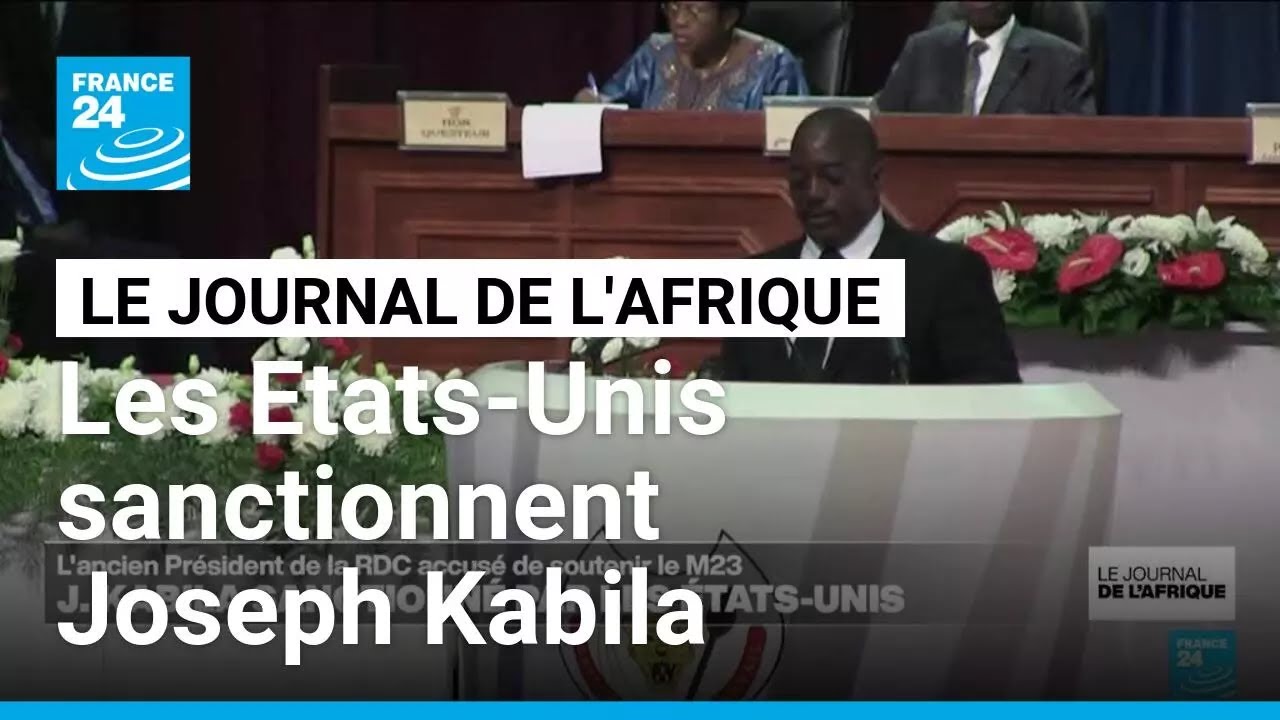
As reported by AFP, former Democratic Republic of Congo (DRC) President Joseph Kabila has denounced as “profoundly unjustified” the economic sanctions imposed on him by the United States. Washington accuses Kabila of providing financial support to the M23 rebel group, which has seized large swathes of territory in eastern DRC and declared its intention to overthrow the government of President Félix Tshisekedi.
“Mr. Kabila learned with astonishment of the decision of the American government targeting him, a decision he considers profoundly unjustified, politically motivated, and based on accusations not supported by irrefutable evidence,” read a statement from the former president’s office.
The sanctions, administered by the U.S. Office of Foreign Assets Control (OFAC), place Kabila on a blacklist of individuals subject to economic penalties. In response, Kabila’s camp asserted his determination to “work tirelessly, against all forms of pressure, to end the dictatorship.” The Kinshasa government, however, welcomed the move as “an important act in favor of the fight against impunity,” arguing it restricts the financial and logistical capacities that fuel the war. This development follows a September 2025 Congolese military court ruling that sentenced Kabila in absentia to death for “complicity” with the M23 and its political wing, the Congo River Alliance (AFC).
WANA Regional Analysis
Against this backdrop, the U.S. sanctions on Joseph Kabila represent more than a bilateral punitive measure; they are a tectonic shift in the geopolitical chessboard of the Great Lakes region, with direct implications for West Africa’s own fragile security architecture. The timing is critical. The sanctions come on the heels of a fragile peace accord signed in Washington in early December between the DRC and Rwanda, brokered under the auspices of President Donald Trump. That accord, as reported, includes an economic quid pro quo designed to secure U.S. access to strategic minerals from the DRC’s mineral-rich subsoil.
The broader implications for the ECOWAS region suggest a dangerous precedent. For years, West African states have grappled with the phenomenon of former heads of state—from Liberia’s Charles Taylor to Côte d’Ivoire’s Laurent Gbagbo—who, after leaving office, have been accused of destabilizing successor governments. The Kabila case now provides a powerful, externally enforced template: the use of U.S. financial sanctions as a tool to neutralize former leaders who are perceived as spoilers. This could embolden current West African leaders to seek similar U.S. action against their own exiled predecessors, potentially escalating regional tensions rather than resolving them.
Furthermore, the sanctions expose a deep fracture in the post-conflict governance model. Kabila’s claim that the decision is “based on the narrative of the Kinshasa power that was unable to support the accusations against him with any evidence before the Congolese military court” highlights a fundamental legitimacy crisis. If the U.S. is seen as bypassing local judicial processes—however flawed—to impose its own geopolitical will, it risks undermining the very sovereignty that ECOWAS and the African Union have long championed. The fact that the U.S. has also recently sanctioned the Rwandan army for its proximity to the M23, provoking Kigali’s anger, suggests a broader, coordinated strategy that treats the entire Great Lakes region as a single theater of operations.
For West African analysts, the key takeaway is the weaponization of financial systems. The OFAC listing is a surgical strike that can cripple a political network without a single soldier being deployed. This is a tool that could be replicated against figures like former Gambian President Yahya Jammeh or other exiled strongmen in the region. The silence from ECOWAS on this matter is telling; it reflects a reluctance to endorse a mechanism that could be turned against its own members. The Kabila sanctions are not just about the DRC; they are a test case for a new era of post-conflict accountability, where the power of the dollar may prove more decisive than the power of the ballot box or the courtroom.
Original Reporting By: AFP

Comments