










Nigeria Grapples with Mass School Abductions as Security Crisis Deepens
More than 200 students and staff were abducted by gunmen from a Catholic school in central Nigeria, marking the second such mass kidnapping from an educational institution within a single week and intensifying pressure on the government to address a spiraling security situation.

 BBC
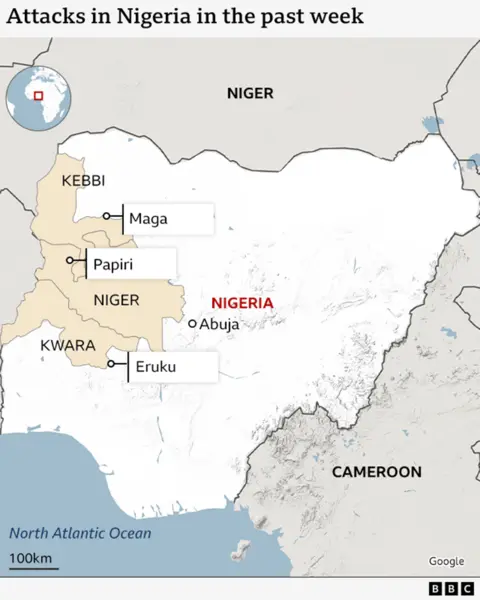
BBCThe early morning raid on St Mary’s School in Papiri, Niger state, occurred around 02:00 local time on Friday, with armed assailants, locally referred to as bandits, storming the student hostel. According to the Christian Association of Nigeria, the assailants seized 215 pupils and 12 members of staff.
This incident follows the kidnapping of more than 20 schoolgirls from a boarding school in the neighboring Kebbi state just days earlier, creating a pattern of attacks targeting educational facilities. The back-to-back abductions have sown fear and uncertainty in affected communities, with families anxiously awaiting news of their loved ones.
Authorities Point to Disregarded Warnings
In a statement, Niger state authorities revealed that the school had reopened despite an official order to temporarily close all boarding facilities due to specific intelligence warnings of heightened security threats. “Regrettably, St Mary’s School proceeded to reopen and resume academic activities without notifying or seeking clearance from the state government, thereby exposing pupils and the staff to avoidable risk,” the statement said. The school has not publicly commented on this allegation.
Local residents expressed their shock and frustration. “Everybody is weak… it took everybody by surprise,” said Dominic Adamu, a local whose daughters attend the school but were not taken. “People are complaining about the state of security in our country.” Another distressed woman tearfully pleaded for the return of her two kidnapped nieces, aged six and 13.
 Africa Independent Television via Reuters
A Broader Wave of Violence and International Scrutiny
The school abductions are part of a wider surge in violence. In a separate incident in Kwara state, further south, a church service being broadcast online was attacked, resulting in two fatalities and 38 kidnappings. Local media reports indicate the kidnappers have already demanded a ransom for the churchgoers.
The deteriorating security landscape has prompted a significant political response. President Bola Tinubu has postponed his foreign travel commitments, including attendance at the G20 summit in South Africa, to focus on the domestic crisis. Nigerian police have stated that security agencies are now “combing the forests with a view to rescue the abducted students.”
These events unfold amid increasing international attention on Nigeria’s internal conflicts. Recent statements from former US President Donald Trump alleging the persecution of Christians in Nigeria were firmly dismissed by the Nigerian government, which maintains that terrorist groups target individuals regardless of faith. This position was reiterated during a meeting between Nigeria’s national security advisor and US Defence Secretary Pete Hegseth, who, according to a Pentagon statement, called for “urgent and enduring action to stop violence against Christians.”
Contextualizing Nigeria’s Multi-Faceted Security Crises
Nigeria, a nation of approximately 220 million people divided roughly evenly between Muslims and Christians, faces several overlapping security challenges. In the north-east, jihadist insurgencies have persisted for over a decade. In the country’s central regions, frequent clashes between predominantly Muslim herders and largely Christian farmers are often driven by competition over scarce land and water resources rather than purely religious motives.
However, the kidnapping of people for ransom by criminal gangs has evolved into a nationwide epidemic. Despite a government ban on ransom payments intended to starve these groups of funds, the practice continues with little deterrent effect. In the earlier Kebbi state kidnapping, two of the abducted Muslim schoolgirls managed to escape, while 23 remain missing.
The repeated targeting of schools echoes the infamous 2014 Chibok abduction and underscores the persistent vulnerability of educational institutions, raising urgent questions about the government’s capacity to protect its youngest citizens and stabilize the nation.
Source: https://www.bbc.com/news/articles/cj4qxvy74qyo?at_medium=RSS&at_campaign=rss
 Getty Images/BBC