










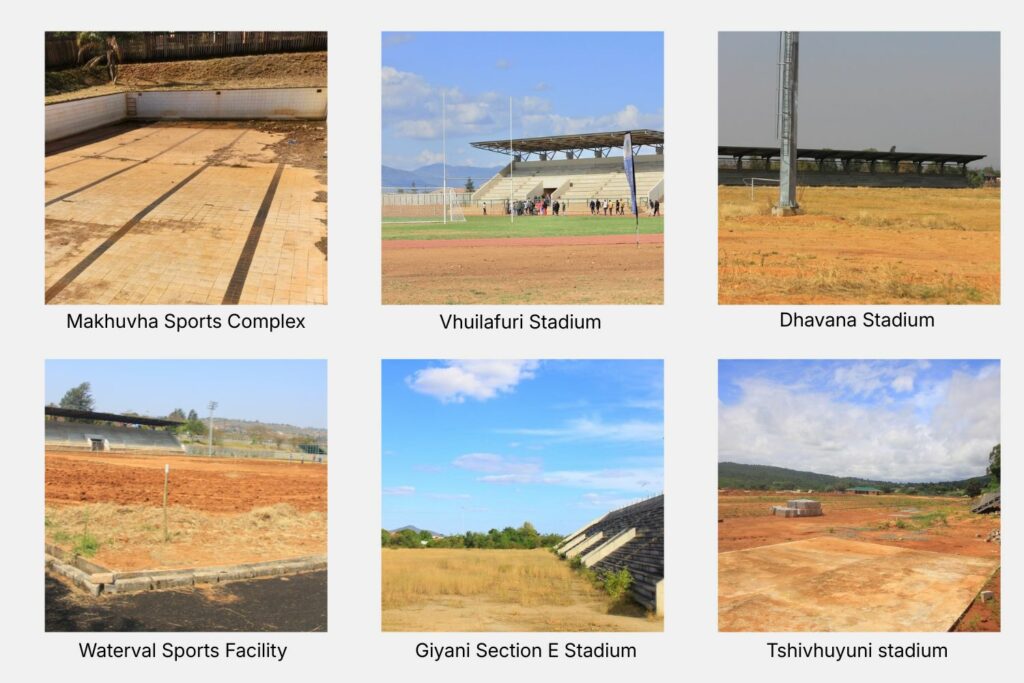
Across Limpopo province, a disturbing pattern of fiscal waste and administrative failure has left communities with crumbling monuments to mismanagement rather than the vibrant sports hubs they were promised. An investigation by GroundUp and the Limpopo Mirror has uncovered a devastating trail of abandoned sports complexes and stadiums—each representing millions in public funds lost to incomplete projects, broken promises, and systemic governance failures that have robbed communities of both resources and opportunity.
The collective cost of these failed projects exceeds R200 million—a staggering sum that represents just the known cases. This figure likely underestimates the true scale of the problem, as these are only the projects that have come to light through investigative reporting. The real total may be substantially higher, representing one of South Africa’s most egregious examples of municipal mismanagement.
The Anatomy of Failure: Case Studies in Municipal Mismanagement
The Makhuvha Sports Complex (R22 million) exemplifies how these projects deteriorate through multiple failures. Located 15km outside Thohoyandou, this facility opened in 2012 with soccer grounds, a stadium, and two swimming pools. Yet the pools never saw a single swimmer, and the pitch now lies overgrown. While the Thulamela Local Municipality blames the theft of an electricity transformer two years ago, the decay clearly began much earlier—highlighting how municipalities often use recent events to explain long-standing neglect. This pattern of deferred maintenance and excuse-making is characteristic of the broader systemic failure.
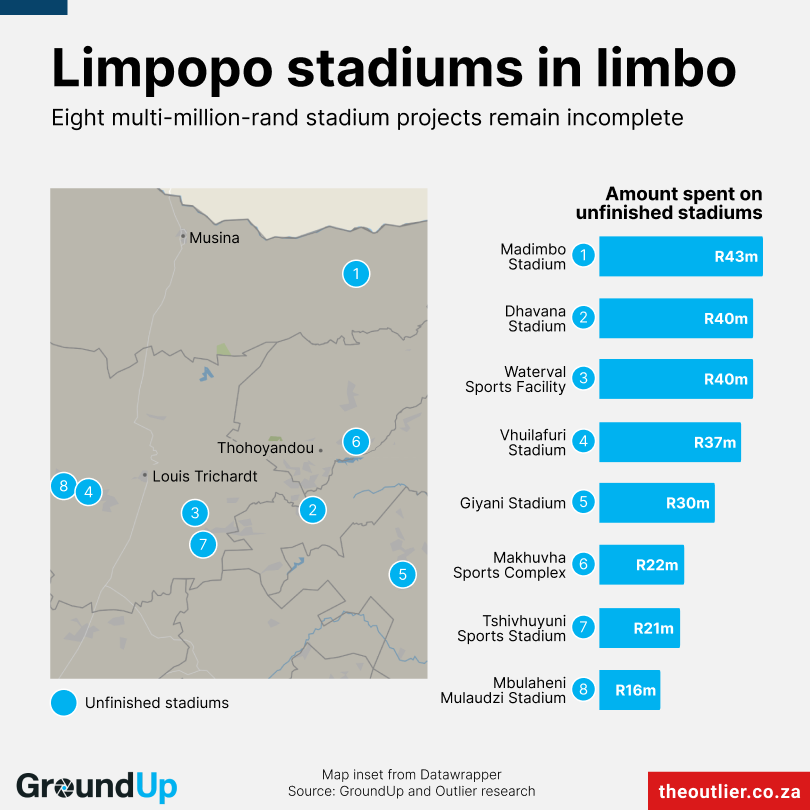
The Vhuilafuri Stadium (R37 million) in Madabani reveals another critical failure point: basic infrastructure planning. Despite the massive investment, the stadium remains incomplete and over two years behind schedule, with an unplayable soccer pitch due to the absence of water infrastructure. This demonstrates how municipalities approve and fund projects without ensuring the most fundamental requirements are in place—a failure in both planning and oversight that renders the entire investment useless.
Perhaps most telling is the response from Collins Chabane Municipality regarding the Dhavana Stadium in Vuwani. When questioned about this six-year unfinished project (with at least R40 million spent of a R60 million allocation), municipal officials responded defensively, asking reporters, “Why are you investigating our stadium?” This reaction speaks volumes about the accountability vacuum in which these failures occur—where public officials view scrutiny as an intrusion rather than their fundamental responsibility to taxpayers.
ADVERTISEMENT
CONTINUE READING BELOW
The pattern repeats across municipalities. The Waterval sports facility (R40 million) near Elim stands incomplete and unused for eight years under Makhado Municipality’s watch. The Giyani Section E stadium (R30 million) began ten years overdue, with municipal funds exhausted and a spokesperson noting there was “no need for security, as nothing remains to be destroyed”—a chilling admission of complete project failure.
ADVERTISEMENT:
CONTINUE READING BELOW
Systemic Roots of the Crisis
These failures are not isolated incidents but symptoms of deeper systemic problems:
Poor Planning and Feasibility Assessment: Municipalities consistently approve projects without proper needs assessments, feasibility studies, or maintenance planning. The result is facilities that communities cannot sustain even if completed.
Contractor Accountability Gaps: The abandoned R21 million Tshivhuyuni sports stadium highlights the lack of consequences for contractors who fail to deliver. Despite the contractor abandoning the project after R10 million was spent, there’s little evidence of meaningful recourse or recovery of public funds.
Maintenance Culture Collapse: Even completed projects like the R43 million Madimbo Stadium (completed 2013) now lie vandalized and unused, demonstrating that municipalities lack both the will and capacity to maintain infrastructure investments.
Broken Oversight Mechanisms: The R16 million Mbulaheni Mulaudzi Stadium—built with National Lotteries Commission money by an NPO and now vandalized and unfinished—shows how funding flows without adequate oversight or sustainability planning. The situation has become so dire that the family of the Olympic medallist for whom the stadium is named wants his name removed.
The Human Cost and Path Forward
Beyond the financial waste, these failures represent stolen opportunities for youth development, community building, and public health. Sports facilities could serve as crucial spaces for talent development, crime prevention, and social cohesion in communities that desperately need these benefits.
Addressing this crisis requires fundamental reforms: independent project feasibility assessments before funding approval, mandatory maintenance budgeting, contractor performance bonds, community involvement in planning, and transparent monitoring systems that allow citizens to track project progress and expenditures.
Until these systemic issues are addressed, Limpopo’s ghost stadiums will continue to stand as expensive monuments to failure rather than the community assets they were meant to be.
Follow Moneyweb’s in-depth finance and business news on WhatsApp here.