
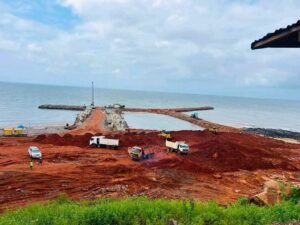
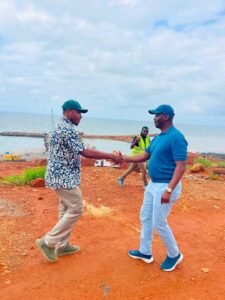
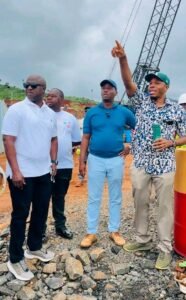
A high-level delegation of Sierra Leonean officials, led by Chief Minister Dr. David Moinina Sengeh, visited the construction site of the Kent Seaport on Saturday, July 25, 2026, to assess progress on what is being described as one of the country’s most ambitious indigenous private sector infrastructure projects. The visit, which included the Minister of Transport and Aviation, Alhaji Fanday Turay Esq., and the Harbour Master of the Sierra Leone Ports and Harbours Authority (SLPHA), Captain Alpha Yayah Bangura, came days after President Dr. Julius Maada Bio called for accelerated implementation of strategic development initiatives under his “Commitment to Transformation” agenda.
The US$75 million Kent Seaport, part of the larger Kent–Banana Island Seaport Project, is being developed by the Gento Group of Companies, a Sierra Leonean firm led by entrepreneur Mohamed Gento Kamara. According to the Chief Minister, President Bio specifically highlighted the Kent Port investment and encouraged him to inspect the project firsthand. Dr. Sengeh described the port as a practical demonstration of how collaboration between government and the private sector can translate development commitments into tangible results, noting that the project had progressed from discussions in his office to Cabinet approval, Parliamentary ratification, and now active implementation.
Financial Strain and Developer’s Appeal
Mohamed Gento Kamara, CEO of the Gento Group, disclosed that the company has already invested US$30 million of the total US$75 million project cost, funded through commercial bank financing. He stated that an additional US$45 million is required to complete the development. Kamara revealed that the commercial loan carries an interest rate of 22 percent, placing enormous financial pressure on the company. “We have taken substantial bank loans to bring this project this far, but the interest rates are very high. Financially, we are struggling, yet we continue because we believe in Sierra Leone,” he said.
Under the concession agreement, the Government of Sierra Leone holds a 10 percent equity stake in the project and is therefore expected to contribute financially. Kamara appealed to the government to provide its agreed support, emphasizing that the contribution is not a grant but an obligation under the agreement. He also urged the government to engage the lending bank to secure a lower interest rate, arguing that such intervention would significantly reduce the financial burden and accelerate construction. The first phase of the project is expected to become operational by December 2026, though Kamara noted that full completion will not be achieved by that date. “We are targeting the arrival of the first vessel before the end of the year. That will happen if Government fulfills its side of the agreement,” he added.
Employment and Local Expertise
Kamara disclosed that the project currently employs more than 600 workers, the majority of whom are Sierra Leoneans serving as engineers, technicians, designers, and skilled construction workers. While the project benefits from technical collaboration with Italian partners, he stressed that local professionals remain at the forefront of implementation. “I feel proud as a Sierra Leonean to undertake this project. The construction work is already employing hundreds of young Sierra Leoneans and, upon completion, it will create even more employment opportunities. This port will contribute significantly to the industrialization of Sierra Leone,” he stated.
Strategic Maritime Context
Chief Minister Sengeh observed that the Kent Port project has become increasingly important as cargo volumes at the Port of Freetown have reportedly increased by more than 170 percent, creating growing congestion at the country’s principal seaport. “Our success must not become our enemy. Expanding port infrastructure is essential to sustaining economic growth, improving trade efficiency and reducing congestion,” he said. He also disclosed that the government is pursuing additional strategic maritime projects, including the Julius Maada Bio Fishing Port at Black Johnson and proposed mining ports, while ensuring environmental protection remains a key consideration.
Minister of Transport and Aviation, Alhaji Fanday Turay Esq., recalled that the Kent Port project received Cabinet and Parliamentary approval in 2024 and expressed satisfaction with the progress achieved since construction commenced. He assured the developers that the government would continue engaging the Ministry of Finance to fulfill its obligations under the concession agreement. “We have all seen the employment opportunities this project has created for our young people. Our responsibility now is to ensure Government delivers the agreed support so that the project can move forward as planned,” he emphasized.
Harbour Master Captain Alpha Yayah Bangura said the SLPHA has remained actively involved in the project since construction began. He emphasized that Sierra Leone should diversify its economy by harnessing the opportunities presented by the blue economy rather than relying primarily on mineral resources. Bangura disclosed that between 30 and 35 percent of containers handled at the Port of Freetown are destined for industrial and commercial centres in rural Sierra Leone, creating significant logistical challenges due to limited road infrastructure. He explained that the Kent Port, together with a proposed bypass linking Kent to Songo and Newton, will significantly improve cargo movement, reduce vessel waiting times, and enhance the efficiency of the country’s maritime transport system.
Natural Harbour Potential
Kamara highlighted that the Banana Island coastline possesses a natural depth of approximately 22 metres, making it one of the deepest natural harbours in West Africa. He noted that countries such as Togo have successfully transformed their deep-water ports into major economic assets and expressed confidence that Sierra Leone could achieve similar success through strategic investment in its coastline. Minister Turay also described Banana Island as one of the deepest natural coastal locations in the West African sub-region, saying its future development could position Sierra Leone as a leading maritime and logistics hub.
The high-level inspection concluded with a guided tour of the ongoing construction works. Government officials expressed confidence that the Kent Seaport Project will become a transformative national asset capable of strengthening maritime infrastructure, boosting trade, attracting investment, creating employment, and accelerating Sierra Leone’s long-term economic development. The Gento Group, meanwhile, renewed its appeal for the government to fulfill its financial obligations under the concession agreement and assist in reducing the high commercial lending costs to ensure that the first phase of the project becomes operational by December 2026.


1 thought on “Sierra Leone’s Kent Port Project: High-Level Delegation Inspects US$75 Million Private Investment as Developer Appeals for Government Funding”