










Sri Lanka has declared a nationwide state of emergency and issued an urgent international appeal for assistance as the catastrophic aftermath of Cyclone Ditwah continues to unfold. The official death toll has risen to 153, with another 191 people reported missing, creating one of the most severe natural disasters to hit the island nation in recent years.
The scale of devastation is staggering. According to the Disaster Management Centre (DMC), the extreme weather system has completely destroyed more than 20,000 homes, forcing approximately 108,000 people into government-run temporary shelters. The humanitarian crisis extends far beyond these numbers, with DMC spokesman Pradeep Kodippili confirming that an additional 798,000 people require immediate assistance after being temporarily displaced by the unprecedented flooding.
President Anura Kumara Dissanayake has invoked emergency powers, granting the government sweeping authority to coordinate disaster response efforts. This legal measure enables accelerated resource allocation, streamlined international aid coordination, and special powers to manage the widespread devastation caused by a week of torrential rains across the island.
The human tragedy extends beyond statistics. Among the confirmed fatalities were 11 elderly residents of a care home in the north-central district of Kurunegala, highlighting the particular vulnerability of institutionalized populations during natural disasters. This incident underscores the critical need for specialized evacuation plans for vulnerable groups during extreme weather events.
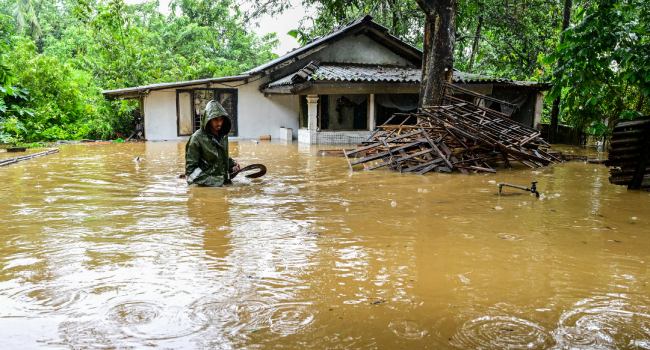
A massive multi-service relief operation is underway, with troops from the army, navy, and air force deployed alongside civilian workers and volunteers. The complexity of these operations was demonstrated in a dramatic 24-hour rescue mission in Anuradhapura district, where military personnel saved 69 bus passengers, including a German tourist, who had been stranded by rising floodwaters.
One survivor, W. M. Shantha, provided a harrowing account from his hospital bed: “We were very lucky… while we were on the roof, part of it collapsed… three women fell into the water, but they were helped back onto the roof.” The rescue operation faced additional challenges when a helicopter had to abort its initial attempt because the downdraft from its rotors threatened to blow away the fragile roof where survivors were perched. They were eventually rescued by naval boats, illustrating the complex decision-making required in disaster response scenarios.
The logistical challenges remain immense. Roads in the central district of Badulla remain completely inaccessible, leaving numerous villages cut off from essential supplies. Saman Kumara from the severely affected village of Maspanna described the dire situation: “We lost two people in our village… others are sheltering in a temple and a house that is still standing. We can’t leave the village, and no one can come in because all roads are blocked by landslides. There is no food, and we are running out of clean water.” This testimony reveals the critical gap between centralized relief efforts and on-the-ground realities in isolated communities.
No clean water
The infrastructure collapse is widespread and severe. Officials report that approximately one-third of the country is without electricity or running water due to collapsed power lines and inundated water purification facilities. Internet connectivity has been significantly disrupted, hampering communication and coordination efforts. This triple failure of power, water, and communications infrastructure creates a cascading effect that complicates rescue operations and prolongs human suffering.
While Cyclone Ditwah has moved away from Sri Lanka and is now heading toward neighboring India, the aftermath will be felt for months. India’s Chennai Airport has already cancelled 54 flights in anticipation of the cyclone’s approach, with meteorological departments forecasting extremely heavy rainfall and strong winds over the next 48 hours.
The Sri Lankan government’s international aid appeal has prompted an immediate regional response. India, demonstrating regional solidarity, has dispatched two plane loads of relief supplies, two transport helicopters, and a 22-member rescue crew. An Indian warship, already in Colombo on a previously planned goodwill visit, has donated its rations to assist victims. Indian Prime Minister Narendra Modi has expressed condolences and indicated New Delhi’s readiness to provide additional assistance as needed.
Flooding in low-lying areas worsened throughout Saturday, prompting authorities to issue evacuation orders for residents living along the banks of the Kelani River, which flows into the Indian Ocean from Colombo. While rainfall has eased in most parts of the country, including the capital, the island’s northern regions continue to experience showers, complicating recovery efforts.
This disaster represents Sri Lanka’s deadliest natural catastrophe since 2017, when flooding and landslides claimed more than 200 lives and displaced hundreds of thousands of people. Historical context reveals that the worst flooding since the turn of the century occurred in June 2003, when 254 people were killed, suggesting a pattern of increasingly severe weather events affecting the island nation with disturbing frequency.
The declaration of emergency powers, combined with the scale of international assistance required, indicates that Sri Lanka faces a long and complex recovery process. The immediate priorities remain search and rescue operations, providing essential supplies to isolated communities, and preventing secondary crises such as waterborne diseases. The medium-term challenges will include rebuilding infrastructure, restoring agricultural land, and addressing the psychological trauma affecting survivors of this devastating natural disaster.