





Long before social media, smartphones, and artificial intelligence reshaped daily life, building a website or putting a database online in West Africa was pioneering work.
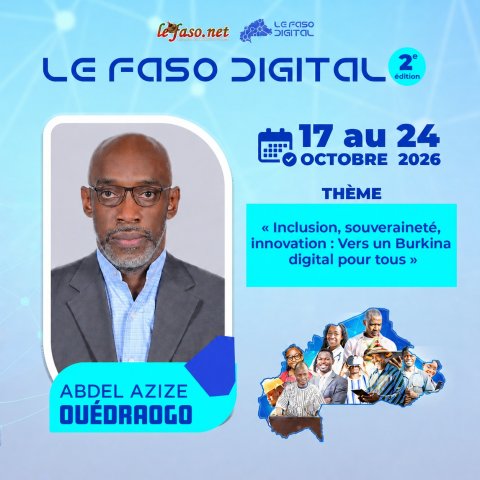
Abdel Azize Ouédraogo belongs to that generation of digital builders.
Over more than two decades, he has moved from writing code to advising governments on digital transformation, leaving his mark on some of Burkina Faso’s earliest online platforms.
Ouédraogo’s technical foundation was laid at the Institut National Polytechnique Félix Houphouët-Boigny in Yamoussoukro, where he earned a DUT in computer science.
He then studied in France, graduating as a computer engineer from EPITECH Paris, with a focus on new technologies, systems, and networks. His early career in France involved software engineering, developing applications, managing databases, and integrating online payment systems.
This hands-on experience gradually shifted his focus from programming to system architecture and eventually to leading teams and projects.
In 2003, while still building his professional career, Ouédraogo became part of another venture: the creation of Lefaso.net. He handled the technical development of the site and later became its technical manager.
At a time when internet access was limited and African media were just beginning to explore the web, Lefaso.net grew into one of the country’s major news portals, connecting Burkinabè at home and in the diaspora with national news.
The project, as described in a profile from the Le Faso Digital 2026 series, illustrates a key chapter in Burkina Faso’s digital history: the gradual move of traditional media online and the emergence of new digital communities.

Ouédraogo’s work soon extended beyond media.
In Burkina Faso, he contributed to the digitalisation of procedures for the Haut Conseil pour la Réconciliation et l’Unité Nationale (HCRUN), including a platform for processing cases related to political human rights violations between 1960 and 2015.
He also helped develop some of the country’s first official government portals, including those for the Initiative for Transparency in Extractive Industries, the Sourou Valley Development Authority, the Transport Sector Program, and the CONASUR flood victim support portal, as well as the website for Burkina Faso’s embassy in Paris.
His expertise also took on a regional dimension in Côte d’Ivoire.
He worked on a mining information system and a national database of mining titles for the ministry in charge of mines, developed a banking information system for the Caisse Nationale des Caisses d’Épargne (CNCE), and built a system for electronically tracking beneficiaries of the National Community Rehabilitation and Reinsertion Program (PNRRC), which included biometric solutions.
In 2011, he served as project manager for the digital system that secured access to the inauguration of the President of Côte d’Ivoire in Yamoussoukro, involving participant registration, personalised badges, and digital access control.
In 2009, Ouédraogo founded MANOD Technologie, a company that became the base for his consulting and technology integration work with public and private organisations.
His role evolved from developer to team leader, making technology choices, managing budgets, and guiding decision-makers through transformation projects.
Since 2023, he has also served as Associate Director at CGA SA (Compagnie Générale Africaine), where he applies his expertise to digital transformation projects for ministries and national agencies.
Today, his focus has expanded to include data protection, cybersecurity, interoperability, and standardisation, as well as the challenges posed by generative AI and process automation.
His career, as the profile notes, reflects the broader evolution of digital technology in West Africa, from the first lines of code to the complex systems that now underpin government and business.
Source: leFaso.net