
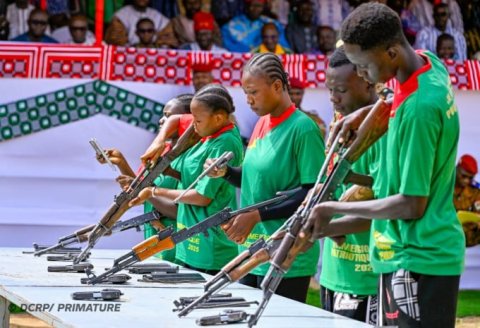




Burkina Faso’s patriotic immersion initiative is yielding measurable improvements in student behavior, according to Dr. Ali Toé, a Principal Education Advisor.
In a mid-term assessment, Toé argues that the program’s most significant beneficiary may be the school life officer, whose role is being transformed from disciplinarian to educator.
Toé observes that before the initiative, school life officers frequently dealt with students exhibiting behavioral difficulties such as repeated lateness, indiscipline, defiance of instructions, disrespect toward authority, peer conflicts, neglect of cleanliness, and damage to school property.
Managing these situations consumed a large portion of their time and energy.
Patriotic immersion, he says, has helped gradually redirect these behaviors. Students are now more aware of the importance of respecting rules, people, and national symbols.
They are also developing a better ability to live and act within a collective framework, follow instructions, take on responsibilities, and preserve shared property.
The change is especially visible in behavioral skills.
Toé lists specific improvements: students are progressively led to respect rules without waiting for punishment, respect authority and school community members, be punctual and diligent, control their behavior and emotions, cooperate with classmates, care for their school environment, respect public property, accept consequences of their actions, and develop a sense of belonging to the school and national community.
Toé acknowledges that not all behavioral problems have disappeared. Rather, he frames the shift as a gradual move toward student accountability.
This is precisely where the main benefit lies for school life officers, he argues.
When students become more disciplined, responsible, and respectful, the school life officer is no longer constantly engaged in confrontation, supervision, and punishment.
They can devote more time to their true educational mission: preventing issues, listening, advising, supporting, and building a culture of responsibility with the student.
Thus, patriotic immersion benefits not only the student but also the school and the overall school climate.
But the biggest winner, Toé contends, may well be the school life officer, because improved student behavior directly transforms their working conditions and restores a fully educational dimension to their role.
Toé summarizes the transformation: “Yesterday, it was often necessary to monitor the student to achieve the expected behavior. Today, the challenge is to train a student who can behave properly even when not being watched.”
It is this shift—from supervision to self-discipline, from obedience to accountability, and from the individual to the collective—that gives patriotic immersion its full meaning, he concludes.
Source: leFaso.net