
Nigeria’s Digital Switch Over: A Satellite Gamble with Regional Consequences
The Report
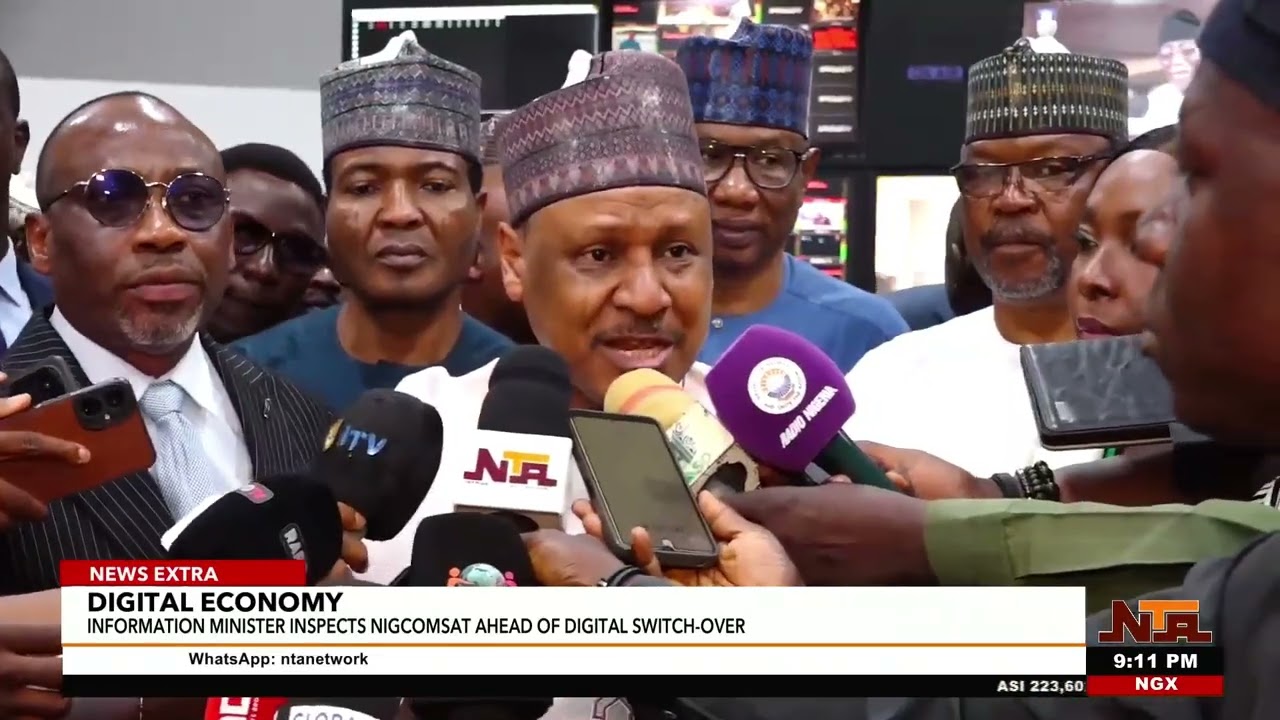
As reported by an open letter published by an unnamed source, industry stakeholder Ladi Yakubu has issued a detailed warning to Nigeria’s Minister of Information and National Orientation, Mohammed Idris, regarding the planned Digital Switch Over (DSO) scheduled for June 17, 2026. The letter, also copied to the Minister of Communication and Digital Economy, the Director-General of the National Broadcasting Commission (NBC), and the CEO of NIGCOMSAT, outlines critical technical, legal, and logistical risks.
Yakubu’s primary concerns centre on the reliance on the NigComSat-1R satellite, commissioned in December 2011 with a 15-year design lifespan. He notes that the satellite is expected to exhaust its fuel by December 2026, creating a potential 24- to 36-month gap before successor satellites (NigComSat-2A and 2B) are launched in 2028 and 2029. He also highlights an acute shortage of Set-Top Boxes (STBs), estimating a national requirement of 32 million units, and ongoing litigation between the NBC and local manufacturers under the Set Top Box Manufacturers Association of Nigeria (STBMAN). The letter further questions the ownership of the FreeTV platform, the compatibility of the GARB audience measurement system with unidirectional satellite broadcasts, and the affordability of satellite equipment for poor households.
“The shift to satellite represents a departure from the original Digital Terrestrial Transmission (DTT) plan, leaving existing analogue terrestrial broadcasts of over 50 state and private stations operational for now.”
WANA Regional Analysis
Nigeria’s DSO is not merely a domestic technical transition; it is a bellwether for digital broadcasting ambitions across West Africa. The ECOWAS region has long struggled with harmonising digital migration timelines, with many member states still operating analogue systems. Nigeria’s pivot to a satellite-based model, if successful, could set a precedent for landlocked and rural-heavy neighbours like Niger, Chad, and Burkina Faso, where terrestrial infrastructure is sparse. Conversely, a failure—particularly one involving a satellite gap or mass consumer blackouts—would severely undermine confidence in satellite-first strategies across the subregion.
From a regional policy perspective, the reliance on NigComSat-1R raises questions about sovereign satellite capacity in West Africa. The potential 24- to 36-month gap in Nigerian sovereign capacity could force the government to lease commercial satellite capacity from operators like Eutelsat, which operates on different orbital slots. This would require millions of households to manually reposition their dishes—a logistical and financial burden estimated at N100 billion. For neighbouring countries that may have been considering similar satellite partnerships, this scenario serves as a cautionary tale about the risks of over-reliance on ageing national assets.
The legal dimension is equally significant. The ongoing litigation between the NBC and STBMAN, specifically Suit No. FCT/HC/GAR/CV/442/2024, highlights a broader tension in West African governance: the conflict between national industrial policy (the “Nigeria First” policy favouring local manufacturing) and the urgent need for mass hardware deployment. This mirrors similar disputes in Ghana and Côte d’Ivoire, where local content requirements have clashed with the speed of digital transition. The outcome of this case could influence how other ECOWAS states balance local manufacturing mandates with the practicalities of meeting international migration deadlines.
The economic implications are substantial. The Nigerian television market is valued at N605.2 billion, and the GARB audience measurement system’s claimed 94% accuracy is called into question by its reliance on return-path data incompatible with unidirectional DVB-S2 satellite broadcasts. If millions of rural viewers without broadband or smart TVs are excluded from data collection, advertising valuations will skew toward urban, affluent demographics. This distortion could reduce advertising revenue for broadcasters serving rural audiences, potentially destabilising local media economies across the region. For West African advertisers and media buyers, this raises the risk of misallocated marketing spend and reduced trust in audience metrics.
Security and governance concerns also emerge. The DSO’s success is tied to the ability to deliver emergency alerts and public information via the Electronic Programme Guide. If the satellite platform fails or experiences signal dropouts, the government’s capacity to disseminate critical information during crises—such as floods, insurgencies, or health emergencies—would be compromised. This is particularly relevant for the Lake Chad Basin and the Sahel, where Nigeria’s broadcasting infrastructure is a key tool for counter-insurgency messaging and regional coordination.
Against this backdrop, the DSO represents a high-stakes test of Nigeria’s institutional capacity to manage complex, multi-stakeholder infrastructure projects. The lack of transparency around the FreeTV platform’s ownership—whether it resides with the NBC, the Broadcasting Organisations of Nigeria (BON), the Ministry, or NigComSat—undermines investor confidence and regulatory clarity. For ECOWAS, which is promoting cross-border media integration, such ambiguity could hinder efforts to create a unified digital broadcasting market.
Regional Backdrop
West Africa’s digital migration journey has been uneven. Ghana completed its switchover in 2015, while countries like Sierra Leone and Liberia remain in early stages. Nigeria’s original DTT plan was abandoned in favour of satellite, a shift that reflects broader global trends toward Direct-to-Home (DTH) platforms. However, the region’s experience with satellite projects—such as the failed RASCOMSTAR initiative—highlights the risks of over-reliance on single-satellite solutions. The NigComSat-1R’s design lifespan and fuel constraints are reminiscent of the challenges faced by other African satellites, including the Ethiopian ETRSS-1 and the South African SumbandilaSat, which experienced premature failures.
Historically, West African governments have struggled to balance ambitious infrastructure projects with fiscal constraints. The N100 billion cost of a potential nationwide dish repointing exercise is equivalent to a significant portion of Nigeria’s annual capital budget for information technology. This raises questions about contingency funding and the government’s ability to absorb cost overruns without diverting resources from other critical sectors like education or health.
Original Reporting By:
Unnamed Source

Comments