




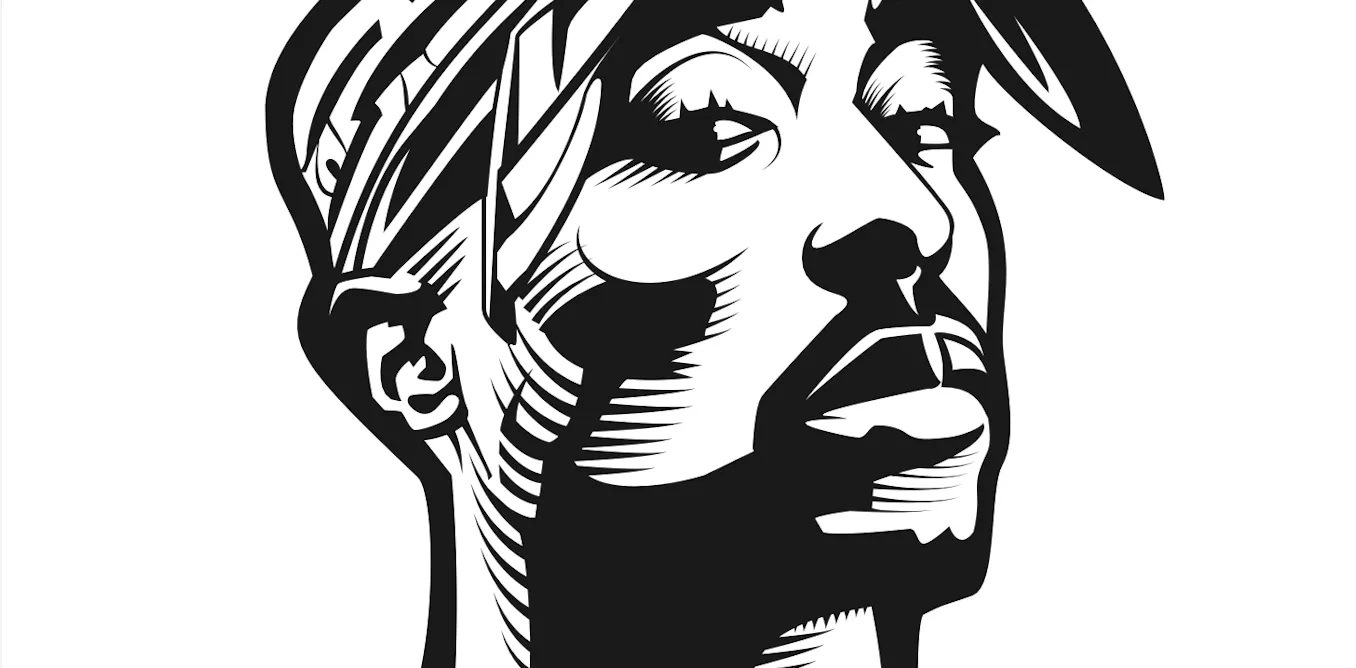


Thirty years after Tupac Shakur was killed at 25, his music and image remain a constant presence in parts of Africa.
A criminologist who spent five years researching street culture in Cape Town’s Cape Flats argues that the rapper’s legacy has become a complex symbol for people living in some of the city’s most marginalised communities.
Dariusz Dziewanski, whose research is published in the journal Ethnography, found that for residents of the Cape Flats, Shakur is more than a musician.
He is a figure they draw on for dignity and resilience in the face of physical threats, material insecurity, and social disempowerment. The area is home to an estimated 100,000 people involved in some 130 gangs, according to the research.
Dziewanski’s fieldwork included hundreds of hours of interviews with people in communities marked by poverty and insecurity. He observed that the rapper’s influence is not limited to one group.
While poor young men often connect to the militant energy of his gangsta rap, seeing him as a street outlaw who gains power through crime, female gang members also draw on his image as a “street soldier” for protection, income, and status, as well as in response to threats of sexual violence.
For those resisting gangs, Shakur serves as a “ghetto prophet” and a template for positive change.
His music and legend provide a shared symbolic language for marginalised young people to resist oppression and reclaim control over their identities, with fans hearing their own struggles in his lyrics.
Gang girls
The rapper’s legacy on gender is not straightforward, Dziewanski notes. His music could honour women in one song and demean them in the next.
Tracks like Keep Ya Head Up criticised the mistreatment of Black women, while Dear Mama was a tribute to his mother, Afeni Shakur, a political activist and Black Panther Party member.
Yet he also used derogatory language towards women and degraded rivals by feminising them.
Dziewanski’s research includes the story of Kelly, who began calling herself “Tupac” at 14 after fleeing an abusive father.
She cut her hair, wore a bandanna, and got a nose ring in the style of her idol, starting fights and robbing to prove herself a “badass bitch” and a “real west-sider”.
She was eventually noticed by and joined the 28s gang that ruled her community.
Another woman, Meryl, who never joined a gang but survived an abusive father and her own addiction, told Dziewanski she saw her own story of hardship and resilience mirrored in Shakur’s.
“His music speaks to different parts of my life, even up until today,” she said.
More than a decade sober and working as a counsellor, she said his music tracked her transformation, from Hit ‘Em Up in her partying years to Changes as she found sobriety.
Ghetto gospel
Gavin first thought Tupac was a cartoon character after his older brother played him the animated video for Do For Love. That brother was a member of the Mongrels and 28s prison gangs, which Gavin would eventually join.
“I see the big boys, they always moving Pac-style … And I’m just a little motherf—er, moving with my brother and them,” he recalled.
While serving 10 years in prison for a gang-related murder, Gavin tattooed himself with the words “Life Goes On”, the title of a well-known Tupac song, as a reminder that “life had to go on in prison”.
In his cell, warders allowed him only a Tupac poster and a bible. Converted by what he called Tupac’s ghetto gospel, Gavin decided to leave gangs to pursue a career in hip-hop.
“He was like a ghetto prophet … I want to be the Pac of the Cape Flats. To be an inspiration like Pac, for another kid like me, that is coming from the gutter,” he said.
Lasting legacy
To follow that vision, Gavin leaned into the politically charged parts of Shakur’s discography, including songs that tackle issues like teen pregnancy and police harassment in Black communities.
It is this more conscious side of the music that helped cement his status as a symbol of Black Power in the US, as well as a conduit for broader pan-African struggles.
For Kelly, Meryl, Gavin, and others, Tupac is proof that being young, marginal and Black does not necessarily mean being powerless. All names in the research have been changed.
Source: The Conversation