


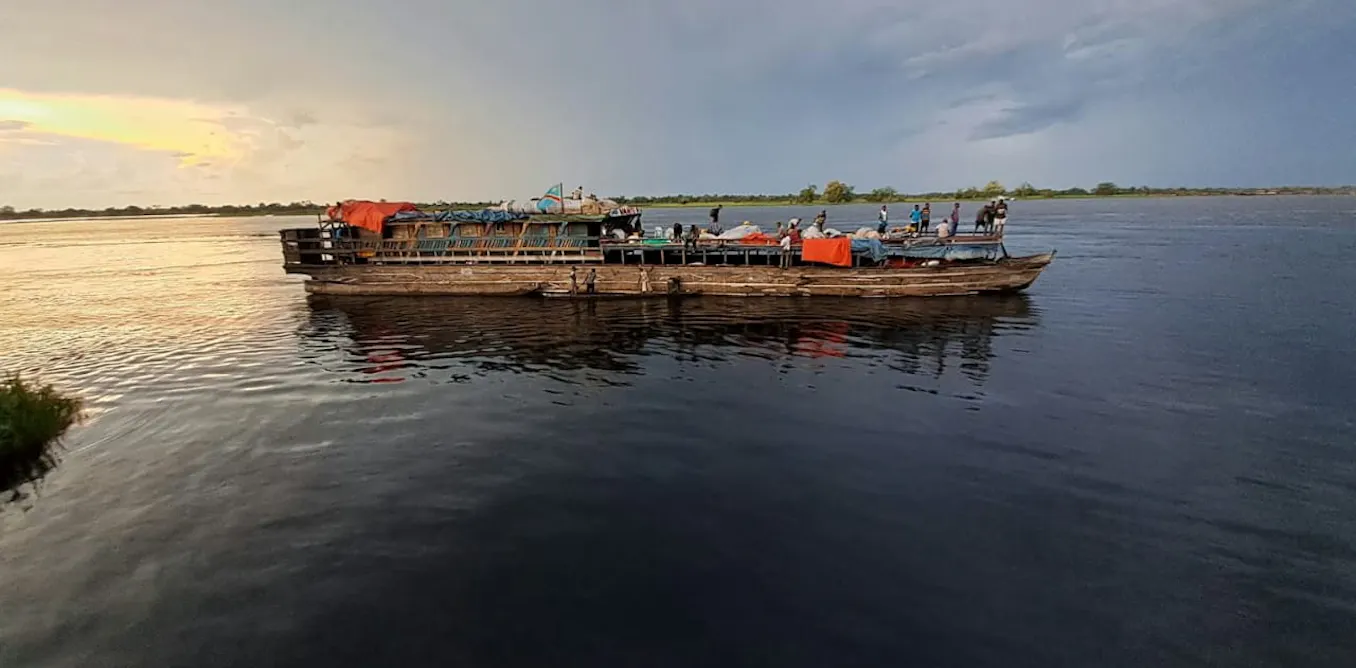





In Democratic Republic of Congo, wooden cargo boats called ‘baleinières’ have become a lifeline for riverside cities, moving food and people along the Congo River and tributaries.
These locally built vessels, measuring between 20 and 40 meters long, connect expanding urban centers with agricultural communities deep in the tropical forest.
According to research by Peter Lambertz, a scholar whose work focuses on Kisangani in Tshopo province, the boats are a product of necessity and local ingenuity.
They emerged in the early 1960s, but since the 1990s they have played a crucial role in reshaping transport across the Congo Basin, a region where road networks have deteriorated and long-distance links have fragmented.
The name “baleinière” harks back to colonial-era vessels: nine-meter, deckless steel boats, riveted from prefabricated Belgian steel and towed behind steamers to carry construction materials. Today, only the name survives.
The first wooden prototypes were built in the early 1960s by André “Bibeyi” — a Congolese craftsman whose nickname means “barge” in Lingala — who combined colonial carpentry techniques with traditional local knowledge.
Bibeyi built the frame from local hardwoods and the hull from soft tola wood, the same wood favored for pirogues. He waterproofed it with bitumen, n’kasa ya kwanga leaves, and strips of recycled aluminum sheet.
In the 1980s and 1990s, his colleagues and their descendants opened shipyards on nearly all the main waterways.
In 2007, boatbuilders from Lake Kivu in eastern DRC introduced Indian Ocean shipbuilding traditions to Tshopo province. The coexistence of these two construction and caulking styles on the upper navigable Congo stimulated creativity among young Congolese builders.
Around 2010, the boats were further improved when local mechanics converted cheap Chinese-made diesel engines into a new propulsion system. They modified the cooling system and added more engines, allowing the boats to grow larger.
The advantage: if one engine failed, others kept running, so there were no more real breakdowns. What began as a stopgap for occasional trips gradually became a regular, reliable transport service.
Today, the baleinières are one of the very few technologies developed locally and exported from the DRC. Congolese shipbuilders have opened mobile yards in neighboring countries, including the Republic of Congo, the Central African Republic, and Cameroon.
Réinvention d’un système de transport
Reliable figures are scarce, but data from Kisangani — a city of two million people on the upper navigable Congo — show about 80 different baleinières arriving each month at private secondary ports, often on a biweekly or weekly basis.
Each boat carries on average 150 tonnes of goods and about 150 passengers. Kinshasa, a city of 17 million, is estimated to receive several hundred baleinières each month.
The boats are essential for food security in riverside cities.
They carry rice, cassava, palm oil, poultry, caterpillars, local alcohols, livestock, bushmeat, and fish toward urban centers, and return to villages with manufactured goods such as roofing sheets, furniture, motorcycles, mattresses, medicines, mosquito nets, phones, flip-flops, and clothing.
They also carry the traders themselves. Because profit margins are thin, people travel with their goods rather than entrust them to others.
The economy they serve allows small traders to earn a modest living with little or no starting capital, offering a glimpse into the daily economic reality of most Congolese, who live hand-to-mouth in a popular survival economy.
Origines, matériaux et propulsion
The boats are notorious for frequent, devastating accidents, with hundreds of lives lost each year.
Lambertz notes that key factors include structural weaknesses of the vessels, lack of professional training for crew, and insufficient safety measures in a context of economic urgency.
He also points out that officials often blame nighttime navigation, but if boats could not travel at night, only half the commercial trips could be made, leaving local traders with little chance to make ends meet.
The system’s resilience lies in its ability to overcome infrastructure challenges. Without fortified ports, cranes, or quays, loading and unloading happens in constantly changing water levels.
One ingenious solution is the “kotindika”: when a loaded boat runs aground, porters wade into the water and push it toward deeper channels.
Because crew members always double as porters, a baleinière equipped with two pirogues serving as mobile gangways effectively carries its own port, able to load or unload wherever needed.
This flexible system is more inclusive than rigid transport infrastructure, supporting hundreds of porters, sailors, and their families. It is also cheaper and more adaptable.
Local river markets appear and disappear according to changing stopover points, the annual production cycle of the forest, and the fluctuating purchasing power of itinerant traders.
Favoriser une économie de survie
However, the weekly rhythm imposed by passengers leaves crew members little time or money for training, maintenance, or rest. The boats thus operate on a knife’s edge, balancing efficiency and risk.
The vastness of the Congo Basin makes governance difficult. Operating largely outside state control, the baleinières’ success is linked to their ability to escape strict bureaucratic oversight — it is hard to set up roadblocks on water.
At the same time, local state services profit from this economy through taxes and administrative formalities at river ports.
Some development initiatives have tried to address accidents by regulating boat design and construction according to foreign standards, but their impact has been limited because they often ignore local operational realities — a phenomenon known as the “revenge of contexts.”
Infrastructure artisanale
Lambertz argues that the baleinière phenomenon has grown so large, and the need for transport is so pressing, that the system can no longer be left to itself.
Any future initiative, he says, must anchor itself in the local communities that run it and build on their existing ways of acting, communicating, and organizing.
The boats, he suggests, are floating microcosms of life in the DRC today.
They embody what French anthropologist Marcel Mauss called a “total social fact”: their material constitution integrates different layers of the country’s history, while their operation reveals the geographical, economic, political, infrastructural, and cultural dimensions of the nation.
Une gouvernance en marge de l’État
Source: The Conversation