
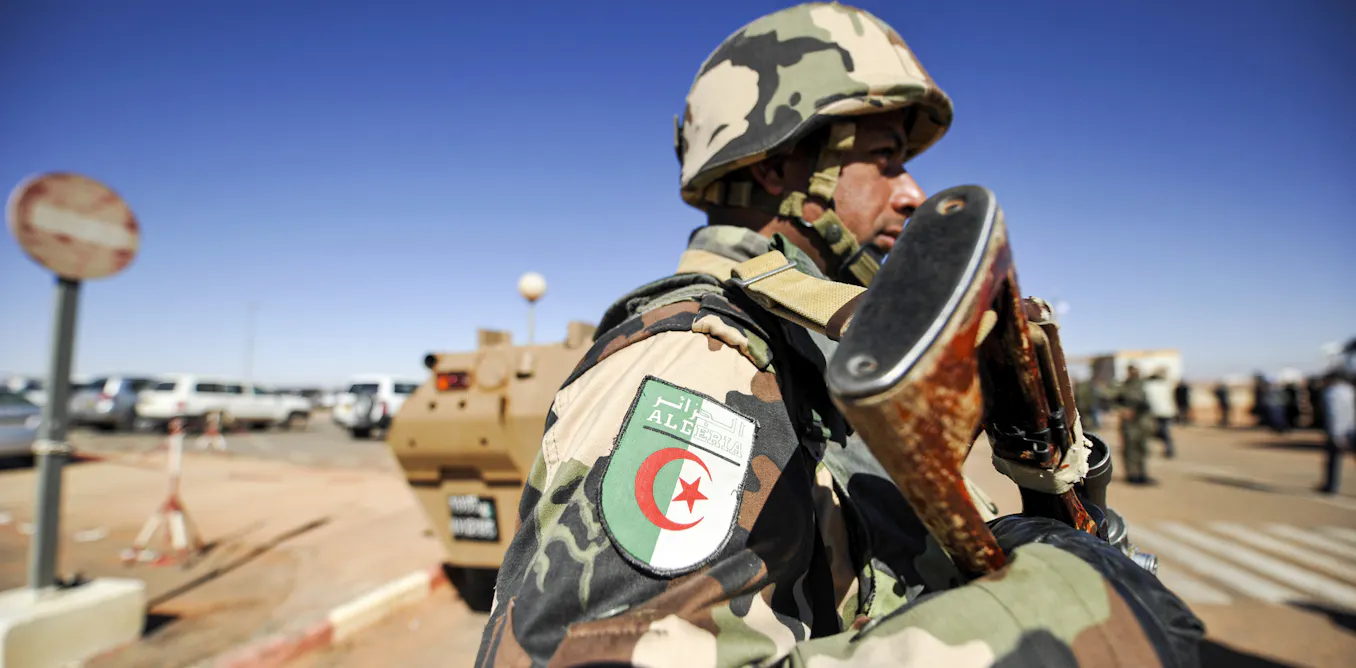
Algeria’s Parliament approved deploying Armée nationale populaire units to Niger, with President Abdelmadjid Tebboune deciding to send troops less than 24 hours after the vote.
The Council of the Nation, the upper chamber, adopted the presidential notification unanimously, while the People’s National Assembly approved it by absolute majority.
The decision was taken under Article 91 of the Constitution, which authorises military projection abroad, though the operational details of the mission have not been publicly established. The press has cited the protection of Algerian energy interests as a motivation.
Four days before the parliamentary vote, Algiers and Niamey had signed a military cooperation protocol whose contents remain confidential.
In a report from The Conversation, researcher Lotfi Sour argues the sequence suggests a shift: that Algiers no longer wants Saharan insecurity alone to determine its regional presence, and intends to weigh more directly on the Sahel’s security balances by combining bilateral military cooperation with the defence of its strategic interests.
Sour, who has studied Algerian diplomacy and its positioning in regional and international power relations, contends that the significance of the decision lies in the evolution of a doctrine long reluctant to accept foreign military engagement.
The 2020 constitutional revision permits the dispatch of units abroad under parliamentary conditions.
Energy interests and the question of mission creep
Securing energy interests provides an immediate justification but does not fully explain the strategic stakes, according to the analysis.
Sonatrach, the national hydrocarbons company, through its subsidiary Sonatrach International Petroleum Exploration & Production Corporation (SIPEX), is exploring the Kafra oil block in the Agadez region, near the Algerian border.
Niger is also a link in the trans-Saharan gas pipeline project connecting Nigeria to Algeria.
In north-eastern Niger, these projects sit in an area crossed by armed groups, trafficking and regional rivalries, where the securing of economic activity overlaps with that of borders and strategic axes.
Protecting a site does not secure the roads leading to it, the neighbouring populations or its operational environment, and the wider the perimeter of protection becomes, the more the mission risks exceeding its initial definition.
Sour describes this as a classic mechanism of foreign intervention: a limited objective demands additional means and creates new obligations, so that protecting an investment can lead to a lasting presence.
He argues Algiers must distinguish three objectives — protecting installations, guaranteeing economic continuity, and weighing on the regional security environment — each carrying different costs and risks.
The possible location of forces at Madama, in northern Niger, was raised by former Algerian diplomat Amar Belani.
Its proximity to Libya could facilitate surveillance of the Saharo-Sahelian space, though the hypothesis confirms neither the stationing location nor an expanded mandate.
A fragmented regional order
Coups in Mali, Burkina Faso and Niger have profoundly reshaped the Sahel’s security architecture. The French withdrawal, the end of the UN mission in Mali and the creation of the Alliance of Sahel States weakened former frameworks without eliminating threats.
Military authorities claim sovereignty but remain confronted with armed groups, governance deficits and rivalries between states.
Niger occupies a pivotal position between the Maghreb, Libya and the heart of the Sahel.
Instability affects cross-border flows, economic interests and Algeria’s southern strategic depth, so supporting Nigerien capabilities is a matter of prevention as much as bilateral solidarity, the analysis argues.
But this rapprochement does not by itself constitute a regional architecture.
Bilateral cooperation can improve capacities for action but also accentuate fragmentation if it replaces consultation, with each capital risking the pursuit of its own guarantees without sufficient coordination against shared threats.
The Mali file illustrates the contradiction. After strong tensions, Algiers and Bamako began a rapprochement in 2026.
No durable Sahel policy can ignore Mali, which links several centres of instability, and the partnership with Niamey cannot replace broader regional dialogue or militarily compensate for the absence of political trust between states.
Neither an Algerian bloc nor a simple protection operation
The role of outside powers is another unknown. Russia has strengthened its security presence in the Sahel while other actors extend their influence.
Nothing allows the Algerian-Nigerien rapprochement to be reduced to a manoeuvre directed against Moscow, nor to be seen as the automatic birth of a bloc competing with the Alliance of Sahel States.
Algiers’ room for manoeuvre will depend on its ability to avoid a logic of camps and preserve its strategic autonomy, according to the analysis.
A military presence can increase diplomatic weight but also expose Algeria to the partner’s expectations, local contestation and reprisals.
A sovereignty discourse does not resolve this contradiction: an intervention that has been requested can be legally framed and politically legitimate without being free of risk.
What remains to be defined
The double parliamentary approval, followed by the presidential decision of 26 October to send Algerian army units to Niger, marks a political threshold.
The units’ effective deployment, the numbers engaged and the duration of the mission remain to be specified, as do the mandate, the stationing location and the rules of engagement.
Results will need to be assessed against the evolution of threats, the security of populations and regional cooperation.
Sour frames the situation as a paradox: to prevent Saharan instability from penetrating more deeply into its strategic space, Algeria may have to intervene beyond its borders, yet its engagement risks making it accountable for crises no outside force can resolve alone.
Durable security also depends on legitimate institutions, accessible public services and renewed political relations with marginalised territories.
The test, he writes, will be Algiers’ capacity to turn this authorisation into a lever for stabilisation without taking charge of the Sahel war.
Between withdrawal and intervention without horizon, a third path remains to be built: a strictly mandated presence, politically controlled and articulated with regional cooperation.
Source: The Conversation

Comments