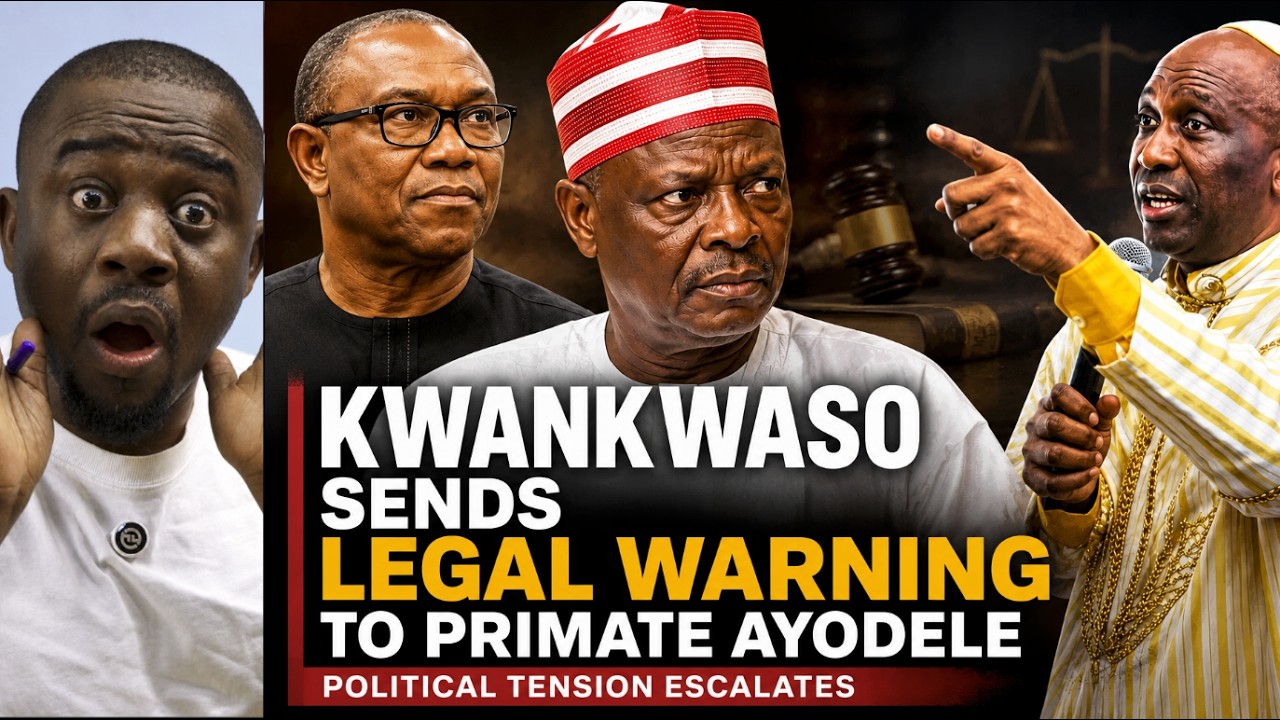
Kwankwaso’s N10bn Defamation Threat: A Test of Political Accountability and Clergy Influence in West Africa’s Electoral Landscape
The Report
As reported by Nigeria Democratic Congress (NDC) media channels, Senator Rabiu Musa Kwankwaso, the NDC vice-presidential candidate and former governor of Kano State, has issued a 24-hour ultimatum to Primate Babatunde Elijah Ayodele of the INRI Evangelical Spiritual Church. Through his legal team, Kwankwaso demands a full retraction and apology over comments allegedly made by the cleric during a livestreamed sermon. The cleric is said to have described Kwankwaso as “fake to Obi” and claimed the politician was paid to accept the vice-presidential slot on the NDC ticket.
“Our client’s attention has been drawn to your viral publication which is trending on all social media platforms and in international and local news outlets, wherein you published malicious and defamatory contents against him geared toward tarnishing his long-earned reputation in Nigeria and beyond.”
The legal notice, dated June 11, 2026, warns that failure to comply will result in a N10 billion lawsuit for damages, legal costs, and other reliefs. Kwankwaso’s media aide, Hon. Saifullahi Hassan, made the notice public, underscoring the political weight behind the threat.
WANA Regional Analysis
This legal confrontation between a prominent West African political figure and a high-profile religious leader carries implications far beyond personal reputation. It touches on the delicate balance between freedom of speech, religious authority, and political accountability in a region where clerics often wield significant influence over public opinion and electoral outcomes.
Political Risk and Electoral Integrity: Kwankwaso, a former presidential candidate and now vice-presidential candidate under the NDC, is a major player in Nigeria’s evolving political landscape. The allegation that he was “paid” to accept a ticket strikes at the heart of voter trust in the electoral process. If such claims go unchallenged, they could erode confidence in the NDC’s internal democracy and its candidates’ integrity. Conversely, a high-profile lawsuit could deter other religious figures from making unsubstantiated claims about politicians, potentially reducing the spread of disinformation during election cycles.
ECOWAS and Regional Precedent: Across West Africa, the intersection of religion and politics is a recurring flashpoint. In Ghana, Liberia, and Sierra Leone, clerics frequently endorse candidates or issue prophecies that influence voting behaviour. This case could set a regional precedent: if Kwankwaso succeeds in court, it may embolden other politicians to seek legal redress against religious leaders, thereby redefining the boundaries of acceptable commentary. ECOWAS protocols on democratic governance and freedom of expression may be tested, as member states observe how Nigeria’s judiciary handles the tension between defamation law and religious speech.
Economic and Governance Implications: A N10 billion lawsuit is not merely symbolic. It signals that Kwankwaso’s camp views the cleric’s remarks as a direct threat to his political capital and, by extension, the NDC’s electoral prospects. The financial stakes could deter other clerics from making similar claims, but it also raises questions about the cost of political defamation in a region where legal systems are often overburdened. From a governance perspective, this case highlights the need for clearer legal frameworks around online speech and religious commentary, especially as social media amplifies unverified claims.
Historical Context: Nigerian political history is replete with examples of politicians suing media houses and individuals for defamation, but lawsuits against clerics are less common. The last notable case involved former President Olusegun Obasanjo and a pastor in 2007, which ended in an out-of-court settlement. Kwankwaso’s approach—publicly issuing a 24-hour ultimatum—suggests a strategy of maximum pressure, likely calculated to generate media coverage and rally his political base.
Strategic Forecasting: Given the 24-hour deadline, a swift retraction and apology from Primate Ayodele appears unlikely, as such a move could be seen as an admission of guilt and damage his own credibility. More probable is a protracted legal battle that will dominate headlines in the lead-up to the 2027 elections. For the NDC, this could serve as a rallying point, but it also risks distracting from policy messaging. For the broader West African political class, the outcome will be closely watched as a barometer of how far religious figures can go in shaping electoral narratives without legal consequence.
Regional Backdrop
The role of religious leaders in West African politics has deep historical roots. In Nigeria, the 2023 election saw numerous prophecies and endorsements from prominent clerics, some of which were later disputed. The region’s high levels of religious adherence—combined with weak media literacy and low trust in institutions—create an environment where unverified claims can spread rapidly. ECOWAS has previously called for self-regulation among religious bodies, but binding legislation remains elusive. This case may accelerate calls for a regional framework to address the intersection of faith, free speech, and electoral integrity.
Original Reporting By:
Nigeria Democratic Congress (NDC) Media Channels

1 comment