
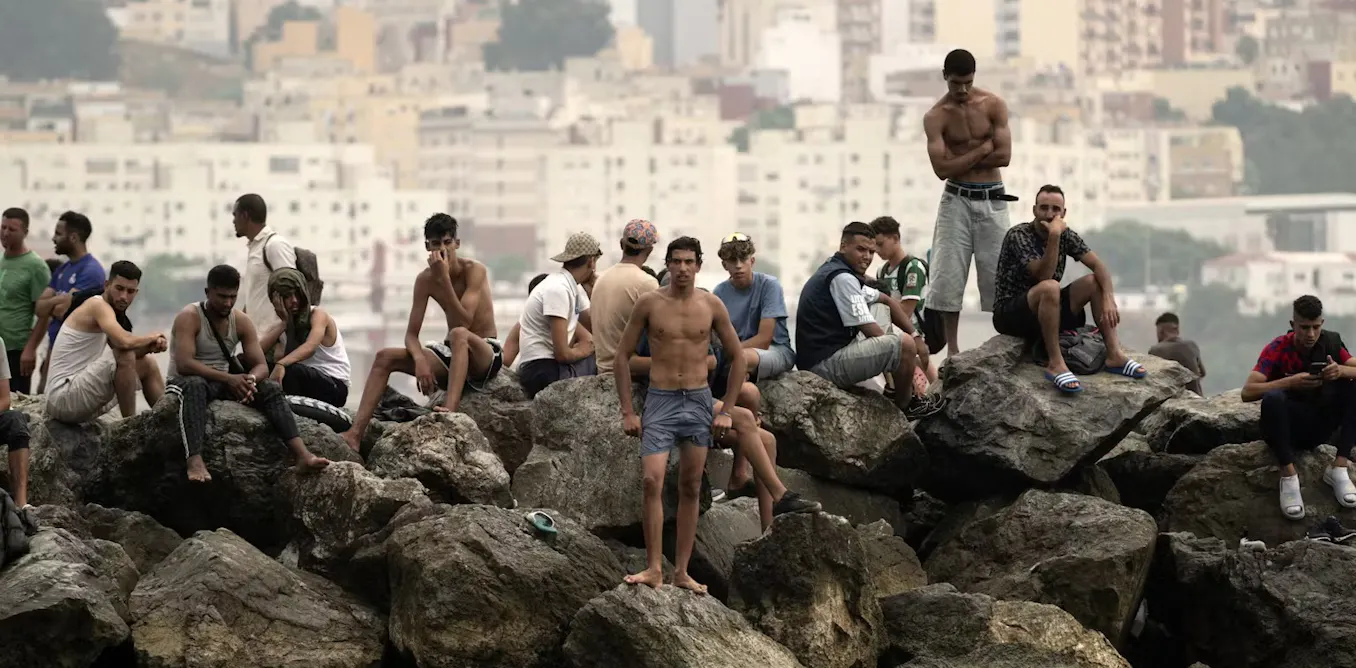







More than 70,000 people entering Spain’s Ceuta enclave over 48 hours in July 2026 exposed fragile EU-Morocco migration politics.
The event, which resulted in an estimated 57 deaths, mostly by drowning, has become a case study in the consequences of the European Union’s reliance on external partners to manage its borders.
Ceuta, which sits on the African continent and borders Morocco, has a population of about 83,600, with 40% of Moroccan origin. The city’s reception system was already strained, with around 1,500 people having arrived in the preceding week.
Facilities for unaccompanied minors were reportedly operating at 2,400% of their capacity before the latest surge.
In an analysis for The Conversation, Moha Ennaji, a researcher on north African migration issues, argues that the Ceuta situation is about more than migration itself.
He contends it reflects the complicated political relationship between Spain, Morocco and the European Union, as well as deep structural inequalities.
The international dimension
Ennaji points to a concept from political scientist Kelly M. Greenhill, describing migration as a source of political leverage. This dynamic, he says, is part of a broader pattern.
He cites the example of May 2021, when more than 5,000 people entered Ceuta after Morocco eased border controls.
That incident followed a diplomatic crisis triggered by Spain’s decision to allow Brahim Ghali, the leader of the Polisario Front, to receive medical treatment in the country.
The Polisario Front seeks independence for the Sahara, a territory Morocco has claimed and recovered since 1975.
Morocco viewed Spain’s decision as support for its political adversary, leading to a sharp deterioration in relations. Morocco subsequently relaxed controls on its border with Ceuta, allowing thousands to cross.
Spain accused Morocco of using migration to apply political pressure.
Ennaji argues that Morocco’s leverage has been amplified by Europe’s outsourcing of migration control.
Rather than managing migration only at its own borders, the European Union has increasingly relied on countries like Morocco to prevent people from reaching Europe in the first place.
In 2023, the European Commission allocated 152 million euros to strengthen Morocco’s border management. This dependence, Ennaji suggests, creates a dilemma for the European Union, potentially making it harder for European governments to challenge Morocco on other matters.
The domestic dimension
A Spanish supreme court ruling may have played a role in the July 2026 crossings.
The court ruled out the use of the exceptional u201crejection at the borderu201d procedure for people intercepted at sea trying to enter Ceuta and Melilla by swimming.
The court found that this procedure applies to people crossing physical border barriers, such as the fences surrounding the enclaves, rather than those intercepted while swimming.
Ennaji writes that this decision was misinterpreted by many in Morocco, and its simplified interpretation may have encouraged crossings by creating the impression that those arriving by swimming would not be sent back.
According to the Spanish prime minister, smuggling networks exploited the court ruling.
Large-scale border crossings can also change the way migration is discussed. Ennaji cites one study into the 2021 Ceuta crisis that found a hardening of political rhetoric and a growing normalisation of racist language.
The far-right Spanish party Vox devoted more than 70% of its social media posts to Ceuta and migration during that period.
He notes that the current crisis has revived similar rhetoric, with far-right politicians using words like u201cinvasionu201d and u201cmen of fighting ageu201d, contributing to portraying migrants as a collective threat.
The media are not necessarily the source of this rhetoric, he says, but they can help normalise it by repeating alarmist narratives without sufficient context.
Human rights as limit and response
Ennaji argues that human rights are not an obstacle to border management but rather set the legal and ethical limits.
Finding more than 50 bodies in the waters off Ceuta, he writes, shows the human cost of turning a border into a zone of extreme danger.
He states that Spain has a duty to protect human lives and ensure effective rescue operations, and must assess each case individually, with particular attention to minors, asylum seekers and victims of human trafficking.
The primary victims remain the migrants themselves, Ennaji concludes.
He argues that the response should not pit the rights of Ceuta’s residents against those of the people arriving there, but should protect both groups, while giving particular attention to the most vulnerable.
Source: The Conversation