

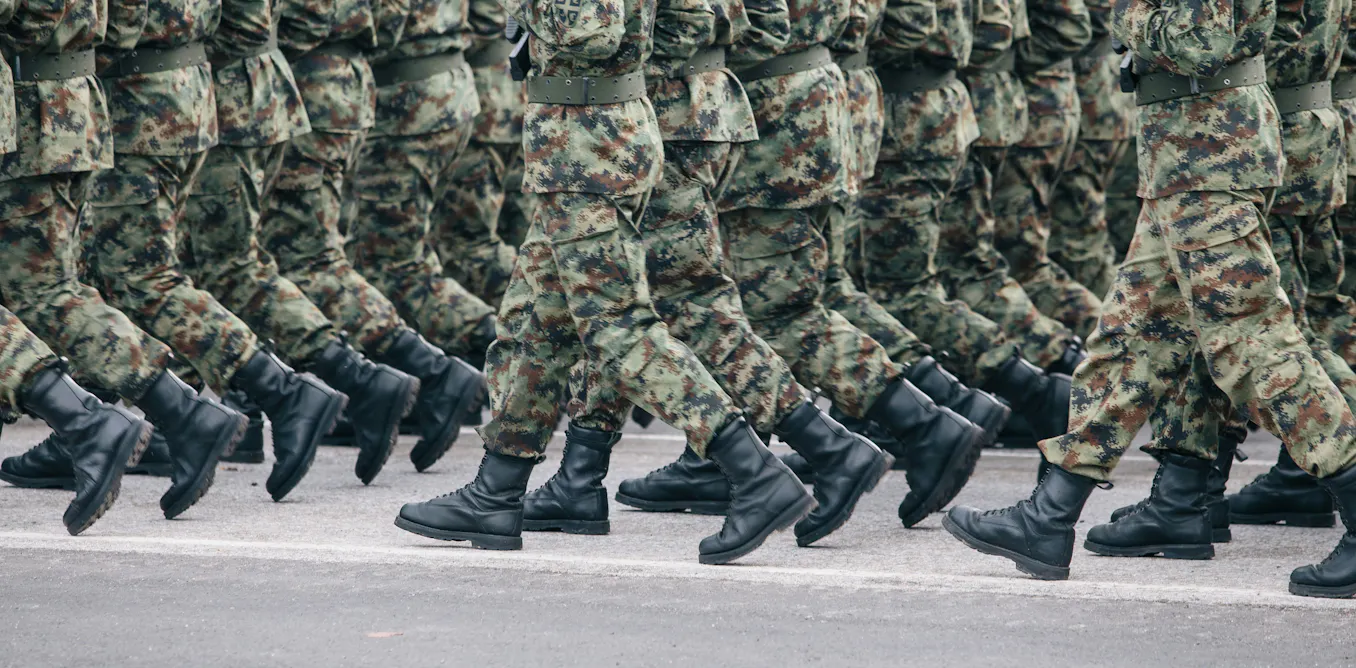
A military coup d’état is the removal of an elected president or head of state, usually through the use or threat of force.
In a piece for The Conversation, economist and legal scholar John Mukum Mbaku argues that the justifications coup leaders offer — economic mismanagement, falling living standards, political instability — do not hold up against what his research finds happens afterward.
Mbaku, who studies political economy and human rights in Africa, draws on his studies of military and constitutional takeovers in Egypt, Nigeria, Sierra Leone, The Gambia and Sudan.
From that work he identifies four consequences he says coups produce: they worsen intergroup conflict and threaten peaceful coexistence; they undermine entrepreneurship and the creation of wealth needed to confront poverty and inequality; they encourage the abuse of vulnerable groups, including women and children and ethnic or religious minorities; and they destroy efforts to deepen democracy and the rule of law.
His argument is his own, published as an opinion piece, and the four claims below are his conclusions rather than findings this publication has independently verified.
Ethnic stacking and the risk of wider conflict
Most African countries are ethnically and religiously diverse, and Mbaku writes that most post-independence governments have failed to build an institutional environment that helps people live together in peace.
That failure, in his account, has allowed majority factions to dominate minorities.
Ethnicity shapes political mobilisation, patronage and coalition building across much of the continent, and ruling elites use ethnic identity to build voting blocs and secure power.
Military elites do something similar: they fill top military and security positions with officers from their own ethnic group, a practice known as ethnic stacking. Mbaku cites Kenya, Ethiopia and Nigeria as examples.
When a coup concentrates power within a specific military faction, he writes, the result can be intense security crises. Marginalised minorities may take up violence to protect themselves, their resources and their political representation.
Coups can also dismantle power-sharing arrangements or democratic frameworks that previously allowed people to live in peace and gave them a voice in governance.
Investment, courts and the cost of unpredictability
A coup tends to destabilise the legal system and make life less predictable, which Mbaku says discourages investment and entrepreneurship.
Investors want to know that tax rules, environmental standards and laws governing operations will not change overnight, and courts must be reliable, accessible and able to settle disputes.
Clear, predictable legal frameworks are what allow long-term trade contracts to be enforced.
He points to a 2026 International Monetary Fund report estimating that coups “can reduce GDP growth by around 2.3 percentage points in the same year,” and that coups in Africa reduce investment by 14.3%.
Those economic effects, the report says, can persist in the years that follow.
Human rights under military rule
Mbaku argues that recognising and protecting human rights is a foundation for economic and human development, enabling peaceful coexistence, long-term economic growth and sustainable development.
Constitutional democracies, in his framing, protect human rights, respect the rule of law and place limits on government power.
A military coup, he writes, usually creates an environment in which human rights are routinely violated, because leaders no longer account to either the constitution or the people.
He notes that in 2023 Freedom House, an American non-governmental organisation that advocates for democracy, warned that a surge of coups in Africa was threatening human rights and the rule of law.
Coup leaders often suspend or discard the constitution and its bill of rights, and military regimes are known for serious abuses including arbitrary detentions and torture.
Destroying constitutional order
One of the first things coup leaders do, according to Mbaku, is destroy constitutional order. They place executive, legislative and judiciary powers in military hands, depriving people of the right to choose their leaders through elections.
Coup leaders typically ban peaceful protests, censor the media and jail critics of the regime without trial, he writes. Post-coup military elites usually rule by decree rather than through an elected legislature or an independent judiciary.
Forceful regime changes, he adds, often invite counter-coups, civil conflict and further political violence and instability — a pattern he says has been seen in Egypt and Sudan.
What Mbaku says should happen instead
Mbaku’s prescription is that African states need to develop a democratic culture underpinned by civilian control of the military. Citizens who believe a government has failed, he writes, can have their say through regularly scheduled elections.
Armed forces should be professional and accountable to the constitution and elected civilian leaders, with military education covering human rights law and the duty to defend the constitution.
Coup leaders should not be allowed to contest elections held to restore democratic order, nor hold positions of responsibility in the state’s political institutions.
The African Charter on Democracy, Elections and Governance provides for this, Mbaku writes, but the African Union has not made sure it happens.
He cites two cases. In Egypt, Abdel Fattah el-Sisi overthrew the democratically elected president Mohamed Morsi in 2013 and became the country’s president a year later.
In Gabon, Gen. Brice Oligui Nguema led the 2023 coup, then won the April 2025 presidential election and was installed as the country’s new president.
African states, in his view, must also ban military coups and make it a crime to change the government unconstitutionally, with mechanisms for prosecuting perpetrators.
He points to Afrobarometer surveys showing respondents in Zambia (90%), Uganda (87%), Eswatini (85%) and Seychelles (85%) are highly opposed to military coups.
Countries that have avoided coups, Mbaku writes, have generally developed strong constitutions and institutions, credible elections and professional armed forces accountable to civilian authority.
In South Africa and Namibia, new governments brought armed forces together under civilian oversight, while Botswana and Mauritius have combined good governance with economic development.
When political, military and economic institutions provide effective peaceful ways to resolve grievances, he concludes, it is harder to stage a coup.
Source: The Conversation


Comments