

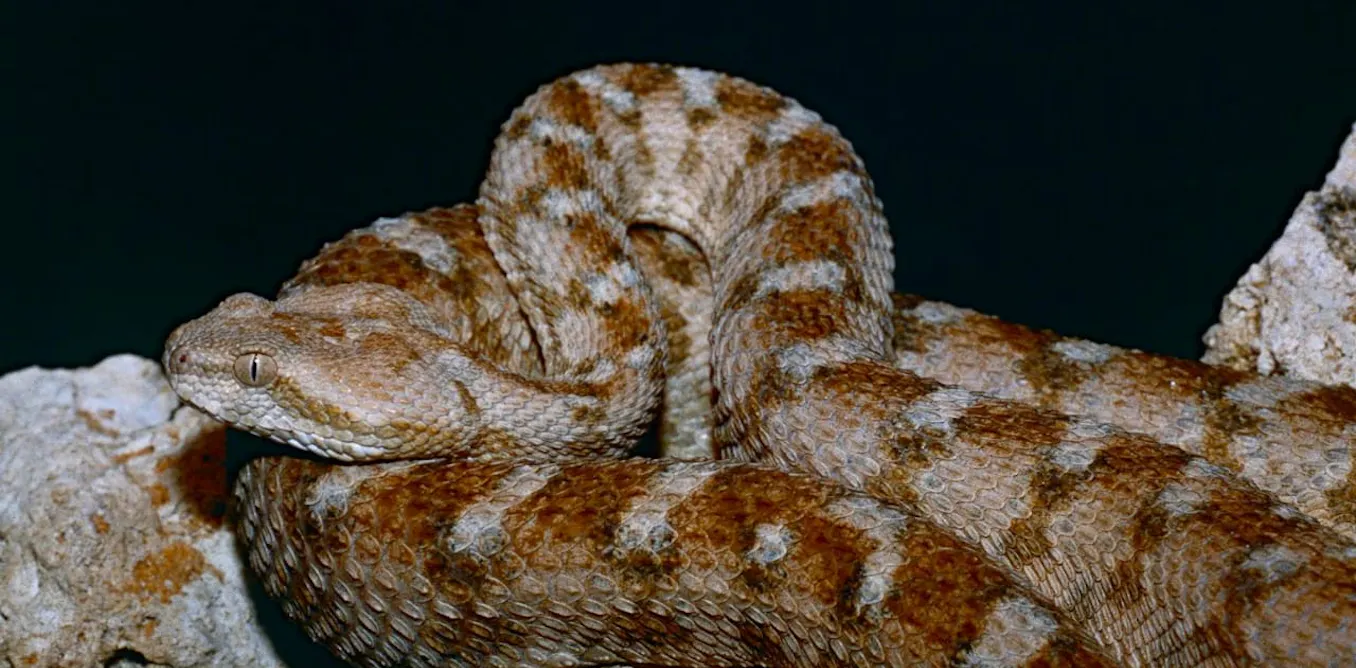
At least 2.1 million people worldwide are victims of snakebite envenoming each year, and the true figure could reach 7 million, according to a new study mapping the global burden and resulting deaths.
The research, which examined data from 79 countries, puts annual deaths at between 274,000 and 513,000.
The authors, researchers with decades of combined experience in the epidemiology of snakebites and tropical diseases, describe a severe shortage of data on the problem.
More than half of the countries where venomous snakes pose a threat do not record the number of people bitten or of envenoming victims, they write in a report for The Conversation.
Not every snakebite results in an injection of venom.
When venom does enter the body, it can cause snakebite envenoming, a potentially fatal condition that mainly affects disadvantaged rural communities in tropical and subtropical regions with limited access to medical care.
In rural areas of sub-Saharan Africa and South Asia, many victims live several hours from the nearest clinic, lack means of transport or turn to traditional healers, so their cases never reach national health statistics.
To fill the gap, the researchers reviewed studies published up to 31 March 2025 and built a geostatistical model that combines observed data with local environmental and socio-economic factors.
The model was fed data including climate, snake species diversity and socio-economic indicators, and calculated the probability that snakebites occur in specific places even where official health records contained no data.
By comparing hospital-reported and regional statistics with field surveys conducted within communities, the framework accounted for unreported envenoming and produced both a minimum and a maximum estimate.
Updating the hidden burden
The geographical distribution of the burden is uneven. Sub-Saharan Africa alone accounts for 45% of all envenomings and deaths worldwide, and the researchers say this burden has probably been underestimated for decades.
In the region, the envenoming rate and resulting mortality are nearly three times higher than in South Asia.
Nigeria, the Democratic Republic of the Congo and Ethiopia face a high burden, owing to high rural population density and significant exposure in agricultural fields.
Why sub-Saharan Africa is more affected
The researchers attribute the disproportionate harm in sub-Saharan Africa to structural factors.
The continent is home to a rich diversity of medically important venomous snake species, including saw-scaled vipers (Echis spp.), puff adders (Bitis arietans), African cobras (Naja spp.) and mambas (Dendroaspis spp.), which are responsible for considerable morbidity and mortality.
In rural areas, millions of farmers work in their fields without protective boots and use unlit paths at night.
After a bite, fragile health systems, long distances to regional facilities and the high cost or total absence of effective antivenom can turn a treatable emergency fatal. Similar conditions exist in some regions of Asia.
The researchers estimate that more than 800,000 survivors are left each year with long-term physical disabilities, including amputations and other permanent impairments.
These disabilities can reduce household incomes, increase health care costs and push already vulnerable farming families further into poverty.
Outlook
The World Health Organization has set a goal of halving the mortality and disability associated with snakebites by 2030.
The researchers argue that reaching it requires abandoning approximations in favour of spatial risk data to guide policy: identifying high-risk areas so that governments and global health partners can stock antivenom where it is most needed, train first-line health workers in heavily affected rural areas and improve rapid transport infrastructure.
Better data cannot solve the problem on its own, the researchers write, but it can help ensure that antivenom, health services and prevention efforts reach the communities that need them most.
The study received support from the Medical Research Council under grant MR/P024513/1, as disclosed in the report.
Source: The Conversation

Comments