

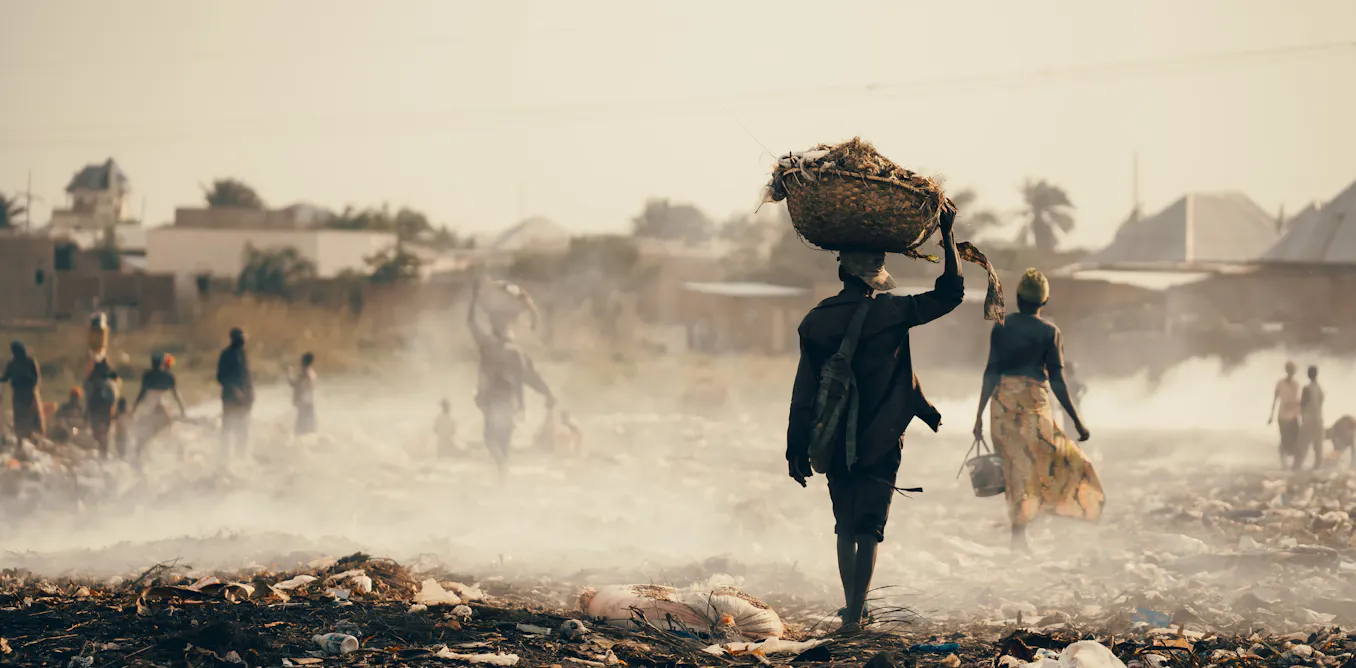
Acting on air pollution and climate change as one problem could deliver returns of roughly US$26 per dollar spent in parts of southern Africa, research by Chris Malley, Kevin Hicks and Caroline Sawe finds.
The three researchers, writing for The Conversation, set out the economic and health case for combining the two agendas across the continent.
The health toll is the starting point.
The 2025 State of Global Air report, which analysed air quality and health impacts for countries worldwide in 2023, found that nearly 1 million people died prematurely across sub-Saharan Africa that year because of the polluted air they breathed.
That places air pollution second only to malnutrition among public health risks across Africa.
How big is the air pollution problem in Africa?
Children carry a disproportionate share of that burden. The same report found that while only 12% of all air pollution deaths globally occur in sub-Saharan Africa, more than half of all child-related air pollution deaths occur on the continent.
The elderly and children are generally the groups most affected by polluted air.
Most human-made air pollution in sub-Saharan Africa comes from homes burning wood, charcoal and other polluting fuels for cooking. The remainder comes from industries, electricity production, transport, agriculture and waste management.
Those same sources are also the largest emitters of greenhouse gases, which is why the researchers argue that climate action and clean air action can be pursued through the same measures.
Their first study, Hidden assets: the economic and health case for climate and clean air action, evaluates a package of 25 proven solutions spanning energy and fossil fuel systems, industry, transport, agriculture and food systems, residential cooking and heating, and waste management.
The headline finding is that in parts of southern Africa, every dollar spent cutting pollution could deliver about US$26 in economic benefits.
The calculation compares the cost of the measures with the estimated monetary value of the damage they could prevent.
For comparison, the researchers note that childhood vaccination can deliver about US$16 in economic benefits for every dollar spent.
Putting all 25 actions into practice across southern Africa would cost about US$11 billion by 2035, according to the research, with the benefits far outweighing the costs.
The financial returns come from money saved when fewer people are hospitalised for pollution-related illnesses and fewer work days are lost to sickness.
Lower pollution levels cut illness and lift productivity, and reduce the school days children miss because of conditions such as asthma.
Avoiding those costs amounts to real savings for governments, and the researchers say the savings grow larger when the solutions are implemented as a coordinated package rather than individually.
What are the best ways for African countries to cut air pollution and greenhouse gas emissions?
The second study, Integrated assessment of air pollution and climate change for sustainable development in Africa, identifies 37 areas where African countries could improve air quality and health while cutting greenhouse gas emissions.
They range from cleaner cooking and better public transport to renewable electricity, shifting freight from roads to rail, and making factories more energy efficient.
The measures also include stopping the burning of crop leftovers on farms, making waste collection more environmentally friendly in towns and cities, turning food scraps into compost or biogas, and capturing warming gases from dumps and sewage plants.
Two measures illustrate the dual benefit. Switching households from charcoal and wood to cleaner cooking fuels cuts both the indoor and outdoor pollution behind many child deaths in Africa, and reduces the short-lived climate pollutants that drive global warming.
Investing in affordable, reliable public transport reduces vehicle emissions and urban smog while lowering the cost of getting to work, school and healthcare.
Some African countries are already testing these approaches.
In Ghana, the proportion of households cooking with wood and charcoal fell from 75% to 54% between 2000 and 2021, while the number of households cooking with the less polluting fuel LPG doubled over the same period.
The death rate from household air pollution in Ghana is estimated to have dropped by about 30% across those two decades.
The absolute number of deaths from household air pollution in Ghana has still risen, but by a much lower degree than would have been the case without the shift away from polluting fuels.
Why is it so important to connect managing air quality with managing climate change?
Air pollution and climate change have tended to be treated as separate problems with separate solutions, even though both come from many of the same sources.
The researchers’ assessment compared the cost of each emissions-reduction action with its expected benefits for air quality, health, the climate and the economy, setting out the full value of each measure.
The work also moved from general statements about how Africa could cut pollution to specifying what each sector in different countries could do.
Nigeria, Côte d’Ivoire and Ghana have already used this approach, and the research indicates that fully implementing their national climate plans would prevent thousands of premature deaths as reduced emissions improve air quality.
Calculating costs and benefits country by country helps development banks and other funders see how much money is needed, what it would pay for and what improvements it could deliver.
What needs to happen next?
Funding remains a constraint. Only around 1% of international development finance goes towards air pollution, and only a fraction of that reaches African countries.
The researchers point to how development banks decide what to fund: their lending rules often overlook the combined benefits of cutting air pollution and slowing climate change, air pollution rarely has its own funding category, and projects that address both problems can fall between departments.
The research argues that development banks should direct low-cost finance to places where it could do the most good and where affordable funding is scarce, and that funding decisions should weigh expected benefits against costs rather than favour projects that are easiest to fund.
Multilateral climate funds, the researchers add, should recognise the benefits of cutting air pollution and greenhouse gases together. Taking early action on both at once, they conclude, brings greater economic benefits than addressing each separately.
Source: The Conversation


Comments