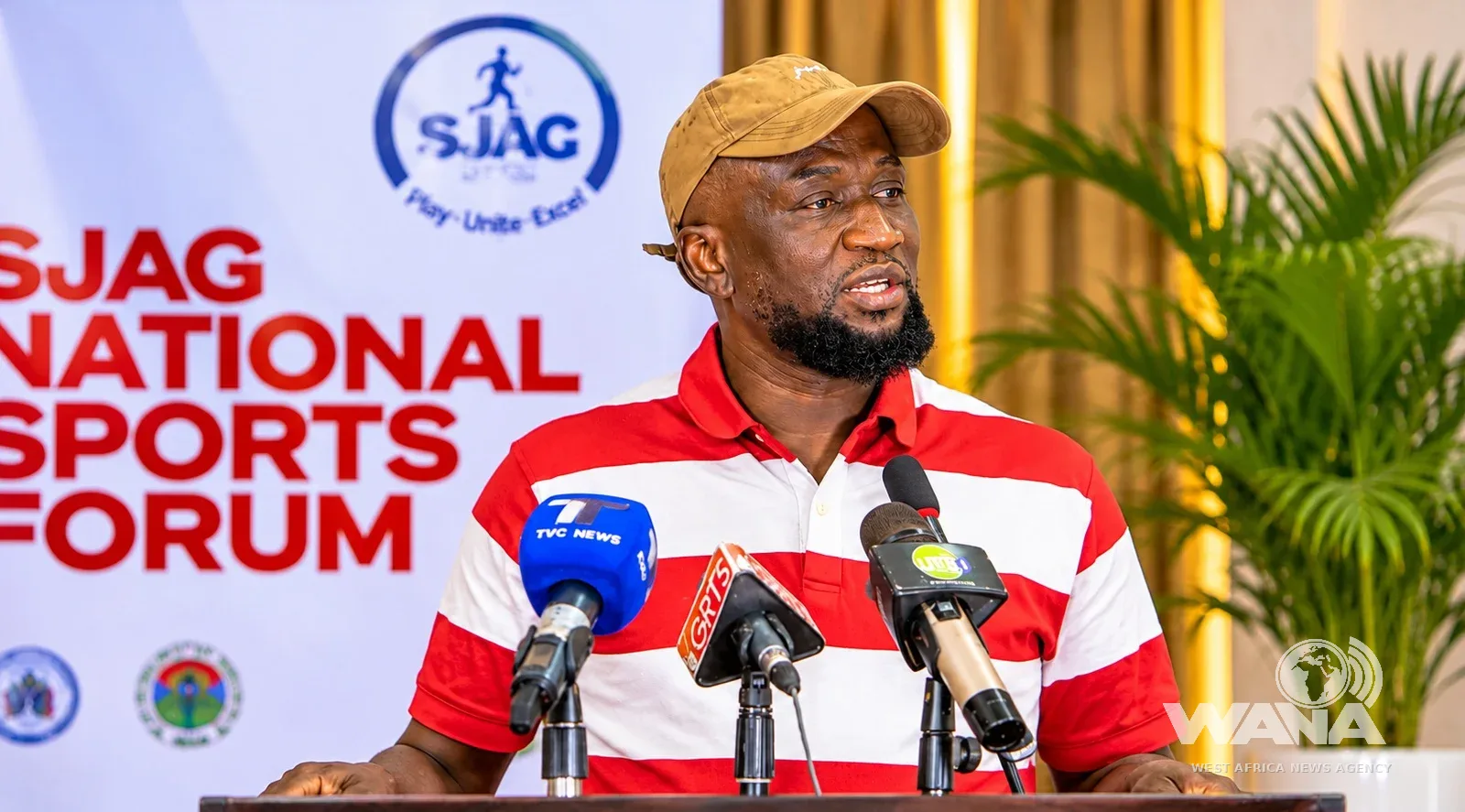
Sports Journalists Association of The Gambia urged autonomous development funds, transparent accountability portals for federations and public-private partnerships at its first National Sports Forum on Saturday at the Bakadaji Hotel in Kololi.
The forum, held under the theme of modernising sports funding and infrastructure for sustainable development, brought together the Ministry of Youth and Sports, the National Sports Council, association and federation presidents, private-sector leaders, athletes and the media.
SJAG President Omar Jarju told the gathering that journalists must now help shape the environment that enables excellence, arguing that talent requires modern infrastructure and sustainable funding to grow.
He said sport is too often treated as leisure or luxury in national budgets, with stadium renovations delayed and grassroots grants trimmed in tough economies.
Properly funded and smartly built sport, he said, is one of the highest-yielding investments a nation can make.
Jarju put the global sports market at $480 billion in 2024, projected to surpass $630 billion by 2028, and said Africa contributes only 0.5% of that market.
He cited The Gambia’s hosting of the CAVB Beach Volleyball Championship, the WAFU Women Qualifiers and the ECOWAS Wrestling Championships as proof that sport can drive economic development.
He called for autonomous sports development funds, transparent accountability portals for federations and public-private partnerships.
Jarju said November 28th, 2026 should be remembered as the day The Gambia stopped talking about potential and started building its sports future.
What the proposals would require
The three proposals Jarju advanced — autonomous funds, accountability portals and private partnerships — each carry distinct implications for how the sector is governed.
An autonomous development fund could, in principle, separate sports financing from the annual budget cycle that Jarju says trims grassroots grants in tough economies.
Accountability portals for federations suggest a public reporting mechanism through which associations would disclose how funds are used.
Public-private partnerships imply a formal role for the private-sector leaders present at the forum in financing and building sports infrastructure.
The hosting record
The three championships Jarju cited — the CAVB Beach Volleyball Championship, the WAFU Women Qualifiers and the ECOWAS Wrestling Championships — were presented as evidence that hosting can drive economic development.
His market figures place the global sports economy at $480 billion in 2024, rising to more than $630 billion by 2028, with Africa at 0.5% of that total.
Who was in the room
Jarju’s charge to journalists — that they help shape the environment that enables excellence — places the media within the reform agenda rather than outside it.
His closing date, November 28th, 2026, was offered as a marker for when The Gambia would stop talking about potential and start building its sports future.

Comments