

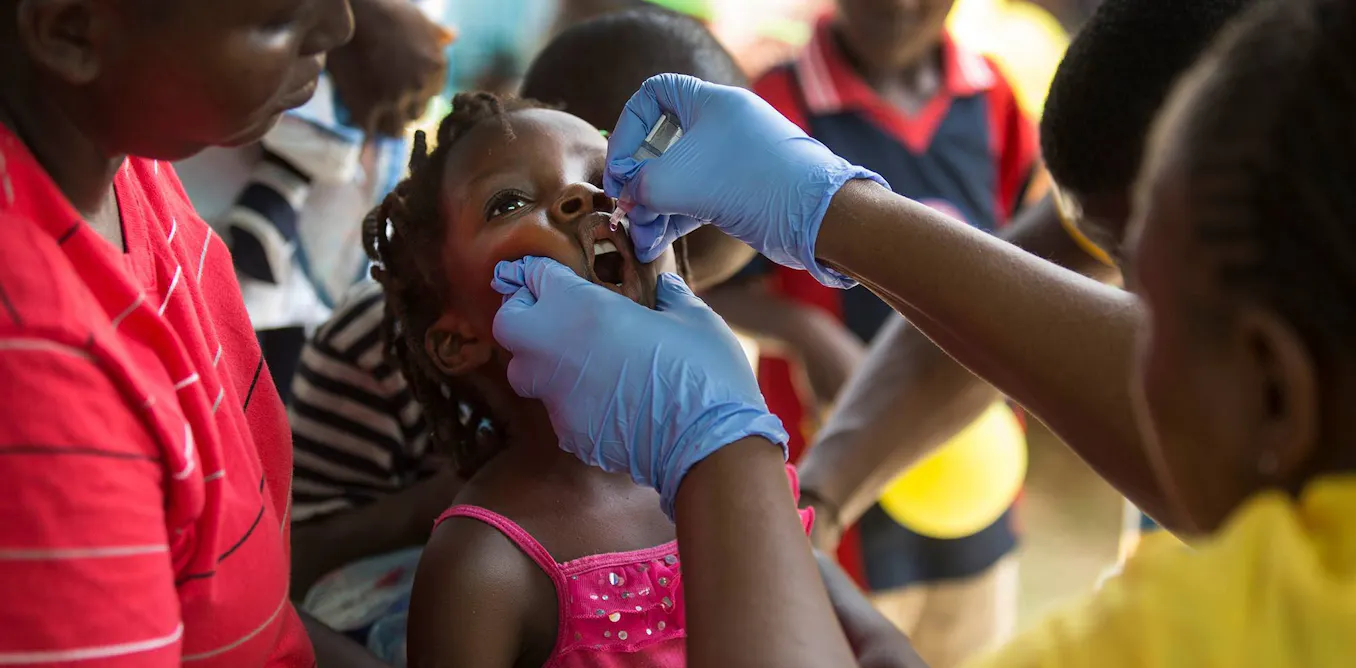
About 13.5 million children worldwide have never received a single vaccine dose, and geospatial tools meant to locate them are applied far more broadly to routine immunisation coverage than to the children.
A review of 102 studies across 68 low- and lower-middle-income countries found that only one in five looked specifically at zero-dose children, even though those countries account for more than 80% of the global zero-dose burden, according to WHO and UNICEF immunisation coverage estimates cited in the research.
The work was carried out by the REACH-OUT team, a project developing cost-effective strategies for delivering vaccines to zero-dose children, whose expertise spans spatial epidemiology, health economics and implementation science.
In a report from The Conversation, the researchers describe how geospatial data and methods are being used to find these children and where the gaps lie.
Reaching zero-dose children begins with putting them on a map.
The first law of geography holds that objects closer to one another are more alike than those further apart, a principle that underpins geospatial health, the study of how where people live shapes their health.
If something is known about one place, the same can often be inferred about its neighbours, including how many unvaccinated children live in areas surveys have not reached.
High national coverage can conceal small pockets of zero-dose children.
Kenya’s Demographic and Health Surveys for 2022 recorded a national zero-dose rate of 2.1% among children aged 12 to 23 months, but two counties, Mandera and Garissa, showed prevalence above 36%.
Finding those children requires first settling who counts as zero dose, and two definitions are in use.
Gavi, the vaccine alliance, defines a zero-dose child as one who has not received even a single vaccine shot, a strict measure that is often hard to implement for lack of appropriate data.
Surveys are conducted every three to five years, while routine health facility data does not link records to individual children, making the children in need hard to track.
The second measure counts children who miss the first dose of the diphtheria, tetanus and pertussis vaccine (DTP1) by their first birthday.
DTP1 is recommended at six weeks, marking a child’s first contact with the routine immunisation system, and it is widely administered and routinely reported through national immunisation systems, which allows the zero-dose burden to be compared across countries.
The populations captured by the two definitions differ substantially: globally, the first measure identifies nearly twice as many children as the second, so a country’s zero-dose burden, and its strategy, will differ depending on which measure is used.
Zero-dose children are often the hardest to reach. They cluster in marginalised settings, including remote rural areas, conflict zones, informal urban settlements, and mobile and migrant families, mostly in low- and lower-middle-income countries.
Finding them takes more than knowing which districts have low coverage; it means locating the settlements and households where they live.
Hidden in the averages
Geospatial modelling for childhood vaccination coverage is advancing quickly, with most of the reviewed studies published after 2022, but the evidence base remains thin.
It is also geographically skewed: most studies came from just three countries, Nigeria, Ethiopia and India, while some countries with a heavy zero-dose burden, such as Sudan and Yemen, were barely represented.
The researchers describe this as a reflection of broader disparities in global health research capacity and priority-setting.
A growing field, but an uneven picture
One of the review’s clearest findings was a heavy reliance on household survey data.
Routine immunisation data from health facilities, collected continuously through systems such as DHIS2, a widely used digital platform for collecting, managing and analysing routine health facility data, was rarely used.
Surveys are valuable but limited. They run every three to five years, a snapshot in time, and are designed for national or regional estimates rather than for pinpointing pockets of unvaccinated children.
Routine data collected continuously at the facility level offers greater local detail but can be undermined by incomplete reporting and unreliable estimates of how many children are eligible for vaccination.
The model is only as good as the data
The reviewed studies often failed to represent the very children most likely to miss out.
A few covered conflict-affected communities, nomadic groups, refugees, cross-border migrants or urban-slum dwellers, populations more likely to live far from health facilities, move frequently, or depend on easily disrupted services.
A model lacking remoteness or conflict data cannot estimate the children affected by them, leaving the children most in need of finding among those the data are least able to see.
Methods matter as much as data. More than half the studies leaned on simpler methods such as clustering and hotspot analysis, which show where zero-dose children have been counted rather than how many live where no survey reached.
Only a handful used geostatistical methods, which integrate types of information to predict where vaccination gaps are likely.
What next?
The researchers set out three steps they say would make the biggest difference.
The first is to combine the strengths of survey and routine data, since each captures only part of the picture and together they can show where children are missed.
Both need strengthening: surveys are financially fragile, currently sustained by an emergency grant after funding collapsed as part of the wider upheaval in global health financing, while routine data must be redesigned to follow individual children rather than monthly totals and paired with better estimates of how many children each facility should be reaching.
The second is to feed the models what they are missing.
Reaching children in conflict zones, informal settlements or on the move means giving models information on conflict, displacement and remoteness, some of which already exists in conflict event databases, displacement tracking and satellite maps of settlements.
The third is to build capacity to generate and use these maps where the burden is high. The maps that matter most, the researchers write, will come from people in the hardest-hit countries: researchers, health workers and community leaders.
Source: The Conversation


Comments