

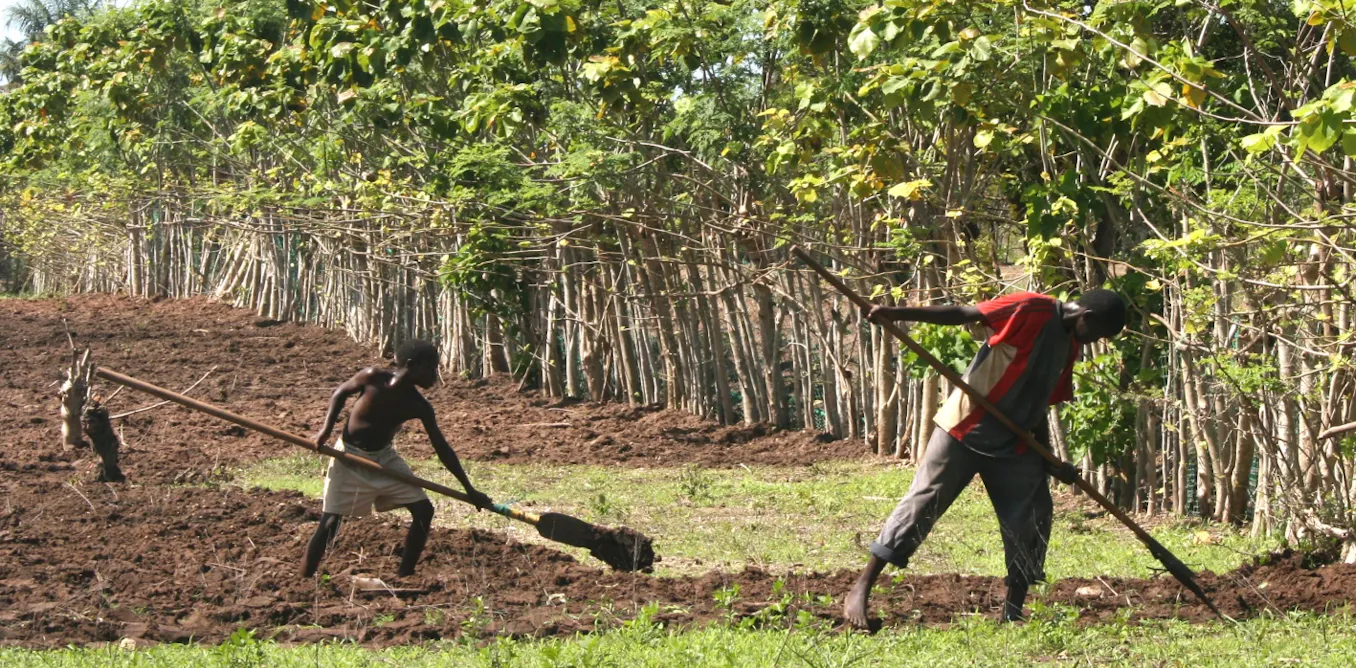
Access to credit alone does not push Senegal’s smallholder rice farmers to plant improved seed varieties, a study finds, with the effect depending on whether those farmers hold secure land rights.
Across the full sample, credit access showed no statistically significant link to either the decision to adopt improved varieties or the share of land planted with them.
The relationship only emerged once households were split by land tenure status.
The sample covered 644 farming households and was restricted to rice production.
Rice accounts for close to two-thirds of Senegal’s cereal imports, and domestic output is held back by the dominance of smallholdings, often under one hectare, along with limited credit access and insecure land tenure.
Among households with secure tenure, credit access was positively and significantly associated with both the decision to adopt improved varieties and the share of land devoted to them.
Among households with insecure tenure, credit access was negatively associated with the adoption decision, while its effect on the land share was not statistically significant.
The authors describe the pattern as a substitution mechanism under constraint: a farmer who is unsure of keeping a plot may devote only a very small area to improved varieties to limit material and financial losses.
The study used a double-hurdle model, which separates the decision to adopt an innovation from the intensity of its use, measured here as the proportion of land sown to improved varieties.
The model was estimated on the full sample and then separately for households with and without secure tenure.
A household was classed as holding secure tenure when the producer had stable, clearly defined and long-term protected rights to the plot; insecure tenure covered rights that were precarious, informal or contestable.
Diagnostic tests, including a Wald test of separability and variance inflation factors, supported the specification.
Credit rationing is widespread in Senegalese agriculture. About 61% of households are affected, with banks and financial institutions either refusing loans or granting less than farmers need, and only a small share of credit comes from formal financial institutions.
Land often cannot serve as collateral because of tenure insecurity, the prevalence of customary rights that are poorly recognised in formal terms, and restrictions on land transactions.
For households with secure tenure, the authors argue, credit works as a liquidity lever: it covers the upfront cost of improved seed within an investment horizon long enough to be supported by land that can be pledged.
For households without secure tenure, the study sets out three non-exclusive explanations for the negative association.
Lenders may target these households for short-term liquidity needs, such as repaying informal debts or smoothing consumption, rather than for technological investment, so the credit is diverted.
Where plots are small or disputed, the opportunity cost of allocating land to improved varieties is high, and credit may instead help maintain a portfolio of lower-risk traditional crops.
And where a farmer is unsure of keeping the land, borrowing itself becomes a risky strategy: a loan taken to test a new technique that fails, or a harvest lost along with the field, can leave the household ruined and in debt.
These mechanisms reinforce one another. Insecure tenure reduces the scope to use land as collateral, which limits access to formal credit and slows adoption of improved varieties, while recourse to costly informal loans can deepen the difficulty.
The authors conclude that credit is neither a neutral instrument nor automatically favourable to adoption, and that treating land security as a mere control variable overlooks the interaction.
They recommend an integrated approach that pairs credit policy with land reform rather than isolated interventions, arguing that improving credit access alone, without securing land rights, risks leaving the most vulnerable households behind.
Land reforms that strengthen official recognition of rights or reduce land disputes, they add, can raise the value of land as collateral and improve the efficiency of credit in financing new agricultural technology.
The study’s author disclosure states that Babacar Ndiaye does not work for, consult, own shares in or receive funding from any company or organisation that would benefit from the article, and has no relevant affiliations beyond his academic appointment.
Source: The Conversation

Comments