

Senegal faces its first diphtheria epidemic in over two decades, with 114 cases and 11 deaths across 31 health districts and 12 of 14 regions as of 20 September 2026, per the Ministry of Health.
The outbreak was first detected in late July 2026 at the regional hospital in Kédougou, in eastern Senegal, where several children under the age of five died with signs suggesting respiratory diphtheria.
The Institut Pasteur de Dakar confirmed the diagnosis on 1 August. Kédougou remains the epicentre with 33 cases, while infections have also been reported in Louga, Dakar, Diourbel and Thiès.
A week before the 20 September count, the toll stood at 76 cases and 9 deaths.
The response coordination unit at Senegal’s Ministry of Health stated that “the epidemic is progressing rapidly,” citing a fatality rate of around 10% — one death for every ten patients.
Writing in The Conversation, infectious disease researcher Alpha Kabinet Keita, who studied a related epidemic in neighbouring Guinea that began in 2023, outlined what the outbreak means for a disease many had assumed was consigned to history.
What diphtheria does to the body
Diphtheria is caused by the bacterium Corynebacterium diphtheriae, which produces a toxin that destroys the tissues of the throat and can enter the bloodstream to reach the heart and nerves.
The disease takes its name from a Greek word meaning membrane, referring to the greyish or whitish layer of dead tissue — the “false membrane” — that forms in the throat.
It mainly affects the nose and throat, and more rarely the skin, where it causes lesions.
Symptoms generally appear two to five days after contamination. At first, nothing distinguishes diphtheria from an ordinary sore throat: sore throat, fever, fatigue and swollen lymph nodes in the neck.
Warning signs follow. Among the 90 patients confirmed by laboratory testing in the Guinean study, 91% had a sore throat, 90% had fever, 89% had difficulty swallowing and 83% presented a whitish membrane.
That membrane, along with breathing difficulty, was among the most telling signs.
The disease can progress very quickly. In Guinea, patients who died succumbed on average two days after admission.
The membrane can block the airways and cause asphyxiation, while the toxin can cause inflammation of the heart or reach the nerves. Without appropriate treatment, diphtheria kills up to 30% of unvaccinated people, with young children most at risk.
How it spreads
The bacterium passes from one person to another through droplets projected when a patient coughs or sneezes, and can also be transmitted through direct contact.
Some people carry the bacterium without being ill — so-called asymptomatic carriers — and can transmit it without knowing. Overcrowding therefore favours contagion in families, schools, markets and transport.
In Guinea, contact with a patient was associated with an approximately three times higher risk of being affected, and the epidemic, which began in Siguiri in Upper Guinea, spread along national road no. 1 following the movement of people.
Treatment and its limits
Diphtheria is treatable provided action is taken early.
Treatment rests on two elements: diphtheria antitoxin, a serum that neutralises the toxin circulating in the blood but does not repair damage already done, and antibiotics, which kill the bacterium, reduce toxin production and prevent the patient from infecting others.
The World Health Organization recommends macrolides such as azithromycin as a priority.
A major difficulty is that antitoxin is in short supply in many countries. According to the WHO, where it is hard to obtain, up to 40% of patients may die.
Close contacts of a patient must also be monitored: they receive antibiotics as a preventive measure, and their vaccination status is checked so that any missing doses can be completed.
Why the disease has returned
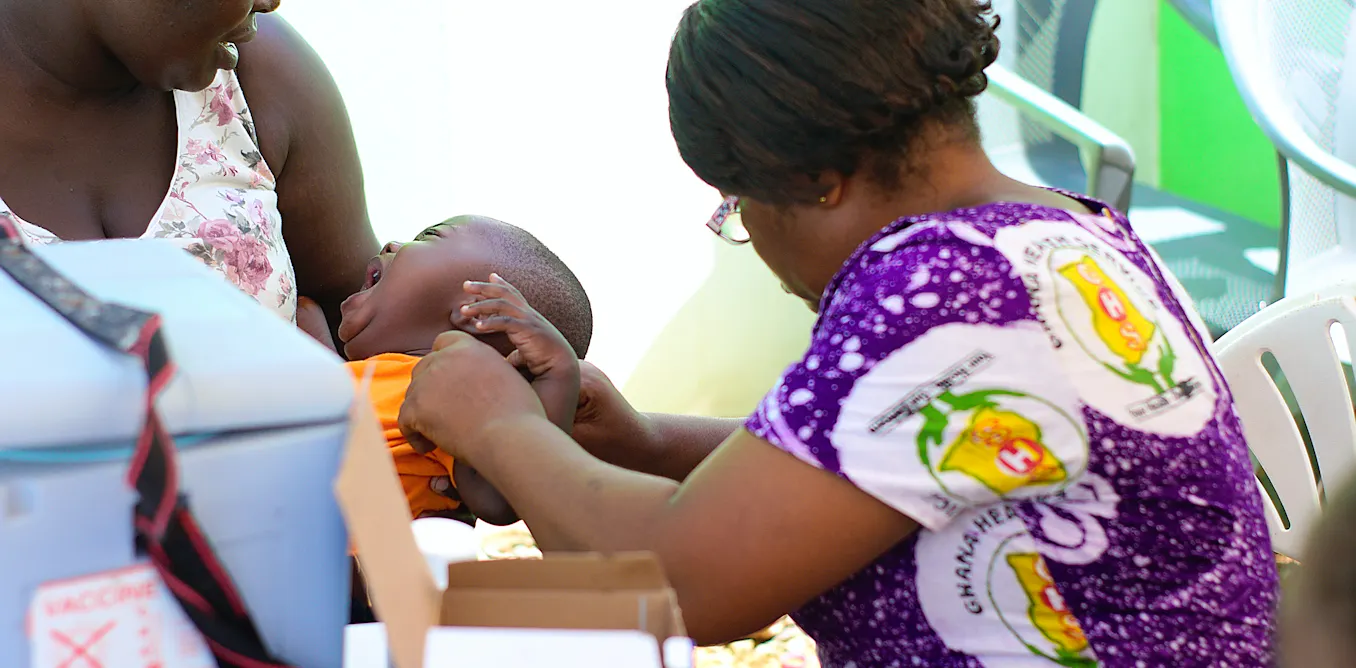
The vaccine is safe and effective. It contains a toxoid — a toxin rendered harmless — which teaches the body to defend itself without making it ill.
In Senegal and Guinea, the standard primary vaccination schedule is integrated into the “hexavalent” vaccine, which protects against six diseases.
It is administered free of charge to infants at 6, 10 and 14 weeks, with a booster dose scheduled from 15 months.
The WHO recommends three doses in early childhood, then three boosters during childhood and adolescence, because protection wanes over time.
Diphtheria is making a comeback because good national vaccination coverage can mask pockets of children who have never been vaccinated — known as “zero dose” — or who are insufficiently vaccinated, especially in rural, border and hard-to-reach areas.
Among Senegalese children aged 15 months to 15 years affected by the epidemic, 67.9% were not vaccinated or had an unknown vaccination status, and only 24.7% had received at least three doses.
In Guinea, out of 90 confirmed patients, only three were vaccinated, and none of the eight children who died were.
In 2025, the WHO recorded more than 20,000 suspected cases and 1,252 deaths in eight African countries, including Guinea, Mali and Mauritania. Families are advised to check their children’s vaccination records and to complete any missing doses.
Source: The Conversation


Comments