

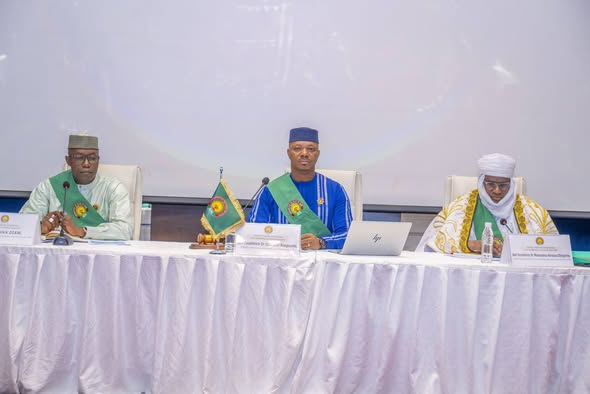
The Confederate Parliament of the Alliance of Sahel States (AES) has begun its first ordinary session in Niamey, bringing together 45 deputies from Mali, Burkina Faso, and Niger. The session, which opened on Wednesday and runs until August 29, follows the installation of the parliament on August 24 and marks a significant step in the institutional development of the confederation.
Each of the three member states has designated 15 representatives from its national parliamentary institution. The Bureau of the Confederate Sessions is presided over by Burkinabè Ousmane Bougouma, with Army Corps General Malick Diaw, president of Mali’s National Transition Council, and Mamoudou Harouna Djingarey, president of Niger’s Consultative Council for Refoundation, serving as key assistants.
Three Committees, Three Priority Areas
The parliament has established three committees to handle its initial workload. Moussa Ag Acharatoumane of Mali chairs the Defense and Security Committee, Sié François d’Assise Coulibaly leads the Diplomacy Committee, and Hadizatou Samna heads the Development Committee.
The first agenda items directly address the daily realities of the confederation. The Defense and Security Committee will examine police cooperation and intelligence sharing. The Diplomacy Committee will focus on the free movement of people and goods across the three countries. The Development Committee will look into the economic model, funding, and viability of media outlets within the AES.
Understanding the Parliament’s Role
The name “Confederate Parliament” might suggest a body with the full powers of a traditional legislative assembly, but its actual mandate is more limited. According to the additional protocol, the parliament deliberates and issues opinions on matters referred to it by the College of Heads of State or on issues concerning the confederation.
Any proposals adopted in Niamey must be submitted to the three heads of state for consideration. The institution can organize working sessions with Confederate ministers and inform the public, but it does not have autonomous power to adopt laws that are directly applicable in the three countries.
This does not render the parliament ineffective. It can harmonize national legislations, highlight administrative obstacles, and exercise a form of political oversight—provided its opinions are made public and accompanied by responses from executive bodies.
Representation and Legitimacy
The 45 members were designated by the parliaments or national bodies acting in their stead, in line with their internal rules. They are not the product of a separate Confederate election. The parliament’s ability to consult populations, local authorities, professionals, and social organizations will be essential to give concrete substance to the representation it claims.
Key Issues on the Table
On free movement, expectations go beyond statements of principle. Citizens will judge integration by crossing borders, recognition of documents, road checks, transport of goods, and the ability to work or trade across the three countries under understandable rules.
In the security domain, intelligence sharing touches on sensitive information. The parliament cannot make everything public, but it can demand clear objectives, examine coordination mechanisms, and track results without disclosing ongoing operations.
Media funding presents a different challenge. Supporting outlets weakened by a narrow advertising market may address a real need, but a credible mechanism must rest on transparent, pluralistic, and verifiable criteria so that support for viability does not become a means of editorial dependence.
Looking Ahead
The Confederate Sessions are scheduled to meet twice a year, in February and August. This leaves several months between ordinary meetings, meaning the real work will happen in the committees, the publication of recommendations, and the follow-up on their implementation between sessions.
The Niamey meeting completes the institutional architecture of the AES. It will gain credibility if it concludes on August 29 with dated proposals, identified officials, and a mechanism allowing citizens to verify what has actually changed.
Source: Journal du Mali

Comments