

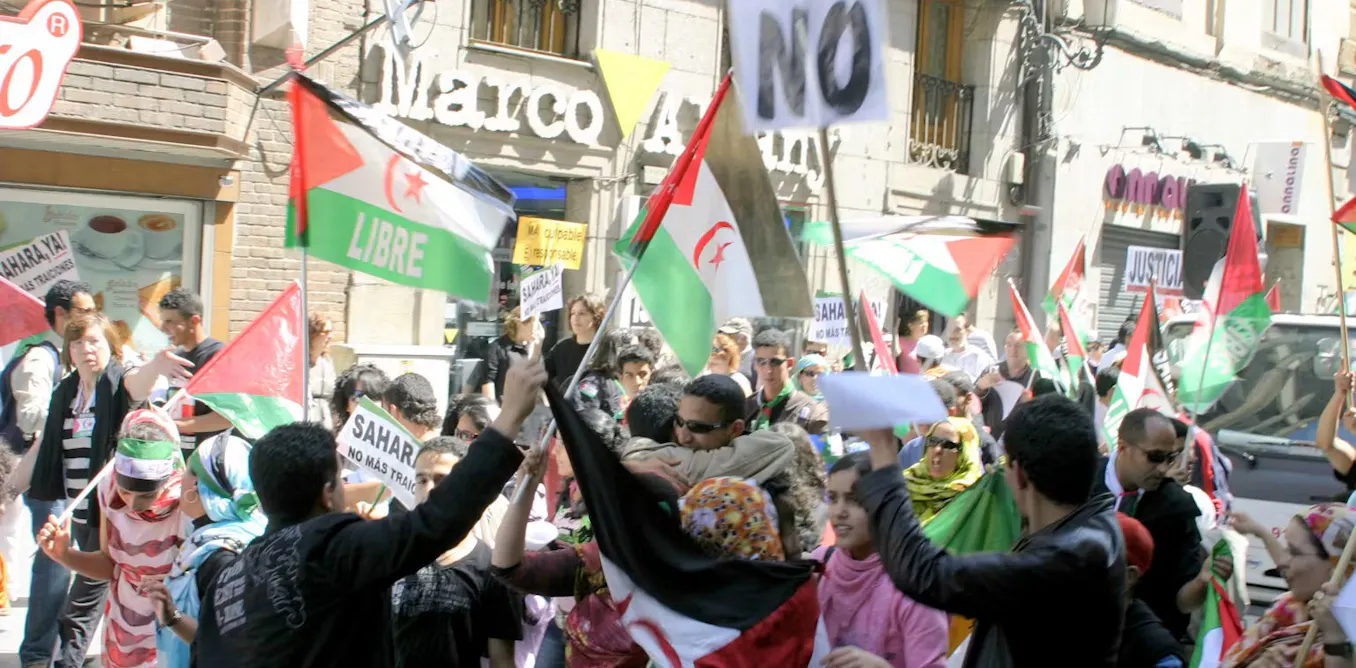
Morocco’s Western Sahara barrier, known as the Berm, runs roughly 2,700 kilometres across the desert — the longest continuous defensive structure after the Great Wall of China.
Built in stages between 1980 and 1987, it divides the territory Morocco has controlled since 1975 from the strip held by the Polisario Front, which the source describes as an Algeria-backed movement representing part of the Sahrawi people and seeking independence since the early 1970s.
The Polisario Front currently controls about 20 percent of the territory.
Alongside the wall lies a mine belt of more than 10 million landmines, often described as one of the largest known minefields in the world.
The contested territory is a former Spanish colony that Madrid ceded in the 1970s without ever holding the self-determination referendum required under international law.
According to the source, the wall allowed Morocco to secure what battlefield victories had not: the most valuable parts of the territory — the coastline, phosphate mines and cities — while pushing Polisario fighters and hundreds of thousands of Sahrawi civilians toward refugee camps in Algeria.
The United Nations has described the situation as the world’s second-longest refugee crisis. French and Israeli military strategists advised on the wall’s construction, the source states.
Three categories of danger are often overlooked amid the diplomatic dispute, according to Joana Castro Pereira, a professor of political science and international relations, and Simón Pardo de Donlebún Versaci, a doctoral researcher, who are associated with a project at the University of Porto exploring biodiversity restoration prospects in the region.
The most direct is the minefield itself. The Landmine and Cluster Munition Monitor, a civil-society research initiative that tracks landmines and other remnants of war, recorded 1,427 victims through 2017 while noting that the total remains unknown.
Many mine accidents go unreported, and mines can be shifted by wind or flash floods into areas that have already been cleared.
Second, the wall disrupts an entire desert ecosystem, not just a human community. Sahrawi pastoral life has always followed the oueds — temporary watercourses that briefly overflow after rain and feed wells, trees and pastures along their banks.
This phenomenon moves people, herds and land together with the seasons within a single relational system.
On one side, the wall cuts the seasonal watercourses the Sahrawis depend on. On the other, the embankment acts as a dam.
Rainwater accumulates against it, and shrubs and grasses grow along its base. This vegetation offers food and shelter, drawing animals toward the mines laid along the wall.
The very conditions that should preserve life can instead lead it toward danger.
Mine victims are not only human: camels are also killed near the wall, while deaths among wild animals can go unnoticed. These deaths constitute harm in themselves, the source argues, not merely damage to a desert landscape.
This dynamic resembles what ecologists call an ecological trap, in which a habitat sends misleading signals about its own safety. The situation at the Berm differs in one crucial respect: here, the trap is created by military infrastructure.
The wall, the desert’s hydrological cycle and the minefields combine into a system that increases risks for wildlife and people.
Third, the wall cuts traditional transhumance routes linking the oueds, while mines and unexploded ordnance restrict Sahrawi herders’ access to water sources that become available at different times of year.
This disrupts a long-standing balance between Sahrawi communities and the desert, maintained through shared seasonal rhythms, grazing practices and ancestral knowledge of routes. It is an interdependent way of life that forced settlement in refugee camps is eroding.
Even dead branches are put to use rather than wasted, reflecting a careful management of limited desert resources that displacement makes increasingly difficult to sustain.
Almost no one can study any of this independently, because the Berm is a closed military zone.
Human Rights Watch has shown the extent of this, the source notes, which explains the absence of reliable figures on the number of animals killed, complete contamination maps and independent assessments of damage — making it far harder to assign responsibility.
The wall still marks the de facto front line of a conflict that has drawn limited international attention. A UN-negotiated ceasefire held for nearly 30 years until November 2020.
Moroccan troops entered a UN-monitored buffer zone to remove a roadblock erected by Sahrawi protesters and restore traffic toward Mauritania. This prompted the Polisario Front to declare the ceasefire over and resume hostilities.
Low-intensity fighting, mainly drone strikes and skirmishes along the wall, has continued since then.
Diplomatically, the balance of power has shifted markedly in Morocco’s favour, with strengthening economic and diplomatic ties across Africa. The United States recognised Moroccan sovereignty over Western Sahara in 2020.
Spain backed Morocco’s autonomy plan — which provides for autonomy of the territory under Moroccan sovereignty — in 2022. France backed the plan in 2024 and the United Kingdom followed in 2025.
In October 2025, the UN Security Council adopted resolution 2797, inviting both parties to negotiate on the basis of Morocco’s autonomy plan without requiring the independence referendum demanded by the Polisario Front.
The resolution also called for a review of the future of the UN peacekeeping mission in the region, the United Nations Mission for the Referendum in Western Sahara (MINURSO), while extending its mandate until October 2026.
The UN mission began in 1991 with a mandate to monitor the ceasefire concluded between Morocco and the Polisario Front.
That review could lead to a reduction or even withdrawal of the UN presence, which would affect activities such as demining support and the recording of landmine-related incidents.
Whatever the political future of the wall, questions remain about who is responsible for managing its lasting consequences for the people, animals and land around it.
Source: The Conversation
Comments