A review of two decades of research on digital agriculture in Africa concluded AI and blockchain tools are expanding across farms, but systems built around them focus on technology, not farmers.
The researchers, who specialise in horticultural science, post-harvest technology, agricultural engineering, crop quality and sustainable food systems, examined studies published between 2005 and 2025 and set out four issues they say need far more attention.
Their findings, reported by The Conversation, describe a gap between the sophistication of the tools and the conditions under which smallholder farmers actually operate.
AI can analyse images and farm data to detect problems or support decisions, while digital traceability systems can record where food comes from and what happens to it along the supply chain.
Horticulture is singled out as an area of particular opportunity because fruits and vegetables are highly perishable, so a decision made at the wrong time can cause substantial losses.
The researchers propose combining AI’s capacity to predict problems with blockchain’s capacity to protect records, with governance layered around both.
Their stated aim is to support more sustainable horticultural production and distribution, ensure smallholder farmers can participate and benefit, and establish clear rules for how information is managed and decisions are made.
Good data comes before smart technology
Blockchain is a shared digital record book that lets approved users store and check information, and records held on it are difficult to alter.
In agriculture that can strengthen traceability: a blockchain can record where a crop was grown, when it was harvested and how it reached the buyer, and approved users can check those records.
The limitation the researchers identify is that blockchain protects information only after it has been recorded. It cannot guarantee the original information was correct.
A sensor measuring temperature, moisture or light may give an incorrect reading, and a farm worker may enter the wrong information. Putting that on a blockchain does not correct it; it may simply create a secure record of inaccurate information.
An AI model trained on poor-quality data, the review notes, could produce an unreliable recommendation.
Farmers need decisions, not more information
Digital tools can generate large volumes of information, but the review found that it is not always useful to farmers.
The researchers give the example of a system that correctly predicts a crop is under stress while the farmer receives the warning too late to act on it.
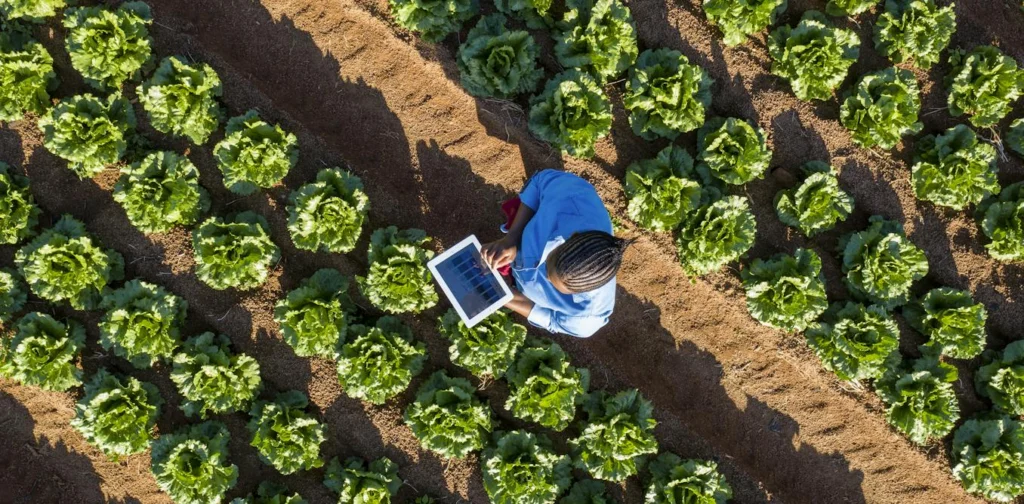
African smallholder farmers also work under very different conditions. Some have smartphones and reliable internet access; others operate where connectivity is weak, mobile data is expensive or digital skills are limited.
The researchers cite the UN Food and Agriculture Organization in identifying these as barriers to digital agriculture. Their conclusion is that technology cannot simply be designed elsewhere and handed to farmers for adoption.
Farmers and other users should be involved in its design, and some services may need to work offline or require local languages, simple text messages or voice-based communication.
The question of who owns farm data
Digital agriculture is creating a valuable resource in its own right.
A farm can generate information about soils, crop performance, pest outbreaks, fertiliser use, water, yields, weather and market transactions, and combining data from thousands of farms can make it more useful, including for training AI models, developing agricultural products, assessing risk or supporting lending and insurance decisions.
That raises the question of who controls and benefits from the data.
The researchers note that agricultural data governance already raises concerns about ownership, privacy, access and the bargaining power of farmers dealing with digital service providers, and that farmers generate valuable data but have limited power over how it is subsequently used.
If farmers provide the information that makes a digital system valuable while having little control over what happens to it, the review warns, digital agriculture could reproduce existing inequalities rather than remove them.
Adoption needs a clear economic reason
A technology may improve traceability, generate sophisticated reports or produce impressive dashboards, but farmers still have to invest time learning the system and may have to pay for devices, connectivity or services.
The researchers argue there must be a clear benefit, and that economic value needs to be part of the design from the beginning.
That benefit could take the form of reducing crop or post-harvest losses, lowering input costs, improving yields, obtaining better prices or gaining access to new markets, which matters particularly for smallholders operating with limited capital.
Cost, inadequate digital skills and weak infrastructure can all restrict adoption.
If exporters, retailers, technology companies or regulators receive most of the benefits while farmers carry much of the cost of supplying the data, the review concludes, sustained adoption becomes difficult.
What the researchers say needs to change
The four issues do not lead the researchers to recommend that Africa turn away from AI, blockchain or other agricultural technologies.
Their proposed framework links data collection, AI, blockchain-based verification, automated decision support and feedback, with governance surrounding all of them.
That governance layer means setting clear rules: who can access farm data, who checks decisions made by AI, who takes responsibility when something goes wrong, and how farmers are protected.
Community-governed data arrangements are one possible response, and farmer groups could help, since smallholders working together may have more say over how their data are used.
Before expanding digital agriculture, the researchers say governments, technology developers and agribusinesses should ask whether the information is reliable, whether farmers can act on the recommendations, who controls the data and whether the technology delivers measurable benefits.
Their conclusion is that Africa does not need more technology for its own sake, and that the next breakthrough may not be another app, algorithm or blockchain but making the technologies already available genuinely useful to the people growing the food.
Source: The Conversation
Comments