
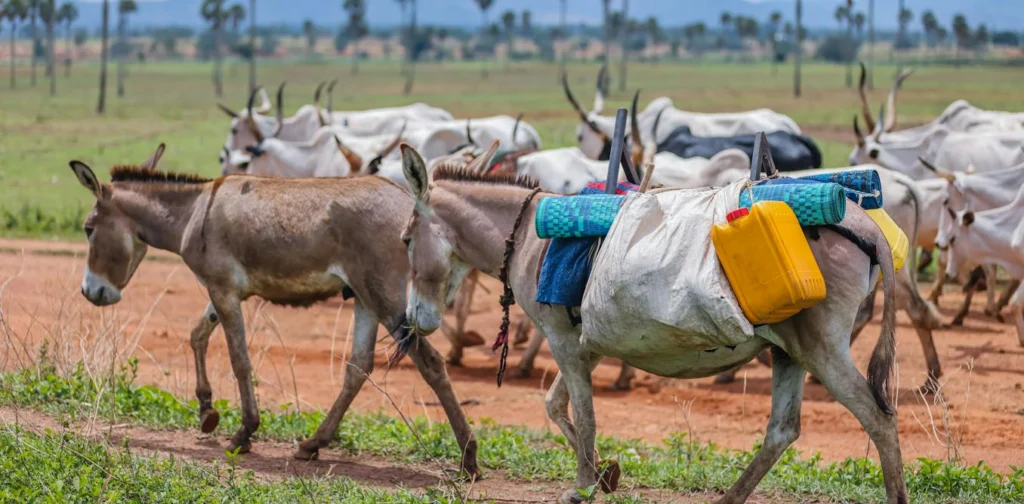
China’s demand for donkey hides, driven by a traditional medicine called ejiao, has grown exponentially over the past 15 years and now draws heavily on Africa, home to about two-thirds of the world’s donkeys.
Economist Lauren Johnston, a specialist on China-Africa trade, examines the trade in her new book, China, Africa and the Market for Donkeys, published by Free Press Publishers in Nairobi.
One donkey hide can fetch more than US$400 in China, according to Johnston’s research. The Donkey Sanctuary, a UK-based welfare organisation, estimates that China imports more than three million donkey hides annually.
What drives the demand
The demand is driven almost exclusively by China, Johnston writes. Ejiao is a donkey hide gelatin-based tonic for the blood that has been used for millennia to treat fatigue, dizziness, dry cough and irregular bleeding, and to support female wellness.
For most of that history it was handmade and consumed by a small circle of imperial elites; only in recent decades did production become industrially scaled.
Johnston, an economist rather than a nutritional scientist, describes the medicine’s reputation as associated with its collagen-rich composition and the bioactive peptides produced during processing, alongside claims about the mineral properties of the water used in production.
She notes that while pharmacological research has identified potentially beneficial properties, the extent to which these translate into clinically established therapeutic effects remains contested, and that a broader question exists as to whether comparable benefits could be obtained from alternative, more sustainable sources of collagen or related compounds.
The market was until recently mainly medicinal. Johnston documents what she calls the stunning commercialisation of ejiao into an array of products, from cakes and drinks to cosmetics and other wellness products.
It sells at accessible prices in pharmacies, both over the counter and by prescription, and for thousands of renminbi at the premium end of the market.
The lead producer, Dong’e Ejiao, spearheaded premium-end price increases greater than those enjoyed by Shanghai and Beijing property owners over the 2000s and 2010s, according to the book.
Demand also exists in Hong Kong, Taiwan, the US, Europe, Australia and south-east Asia.
Africa’s role in the supply chain
Africa is home to the world’s largest donkey population. As the ejiao industry began to run short of hides from around 2010, the continent became a target of the supply chain, both legal and illicit.
Ethiopia, Kenya and Tanzania were among earlier targets, given both their donkey supplies and closer geography to China. But demand for hides, and the returns, grew so great that essentially no donkey in Africa was safe, Johnston writes.
Donkeys have been working animals in Africa for eons, and the market is largely informal. Given the price a hide can achieve, donkeys are being sold even though their work is vital.
The slow breeding rate of the donkey is affecting supply, a cycle Johnston describes as presenting a compounding extinction risk. Porous and remote borders, different regulations and patchy application of regulation have made stemming the trade almost impossible.
The book elaborates Tanzania’s experience.
The country gave up trying to secure a continent-wide formal agreement to halt the trade after its frustrations with donkey smuggling across the Kenyan border especially, its failure to regulate slaughter numbers and standards, and a failure to develop sufficient breeding programmes.
Continental action and its limits
The first Pan-African Donkey Conference in 2022 included representatives from the African Union InterAfrican Bureau for Animal Resources, the government of Tanzania and other government representatives from across the continent, alongside donkey welfare charities, think-tanks and academia.
The event produced the Dar es Salaam Declaration, which called for a 15-year continental moratorium on the slaughter of donkeys for their hides.
The February 2024 37th African Union Summit backed the call and agreed the moratorium, which Johnston describes as an historic moment for the protection of African biodiversity and the rural poor, women especially.
Implementation has been imperfect, she writes, because it requires each member country’s laws to be changed and those laws to be implemented consistently.
Progress is underway but far from enough to save the donkey, let alone the welfare of communities who rely on their work for physical and economic mobility.
Banning trade can also send it underground and across borders: South Africa’s limits sent supply through Lesotho, where abattoir standards are lower.
Why the trade is a problem
Current demand for ejiao requires 4-5 million hides a year, far more than China’s donkey stock can supply, and donkeys are notoriously slow breeders. The gap has been filled by a poorly regulated trade drawing mainly on Africa.
The effect has been that donkeys are often stolen, depriving rural households of animals essential to their livelihoods.
Price is also affecting communities: in South Africa a donkey that would have fetched about US$30 in the late 2010s sold for US$125 by 2022, when the moratorium was imposed.
The impact falls especially on women and girls. Donkeys carry water, firewood and farm produce across much of arid and remote African geographies.
Owning one saves women some five hours of labour a week and children about ten, at least. When a donkey is stolen or priced out of reach, household income, food security and schooling suffer.
The trade also breeds fear, suspicion and conflict within communities, and has been linked to organised crime, inhumane slaughter and biosecurity risks.
Johnston writes that readers of the book will learn as much about China as about the donkey market, which she presents as a lens through which to understand China’s economy, history and global reach.
She also hopes the story might contribute to saving the animal.
Source: The Conversation
Comments