

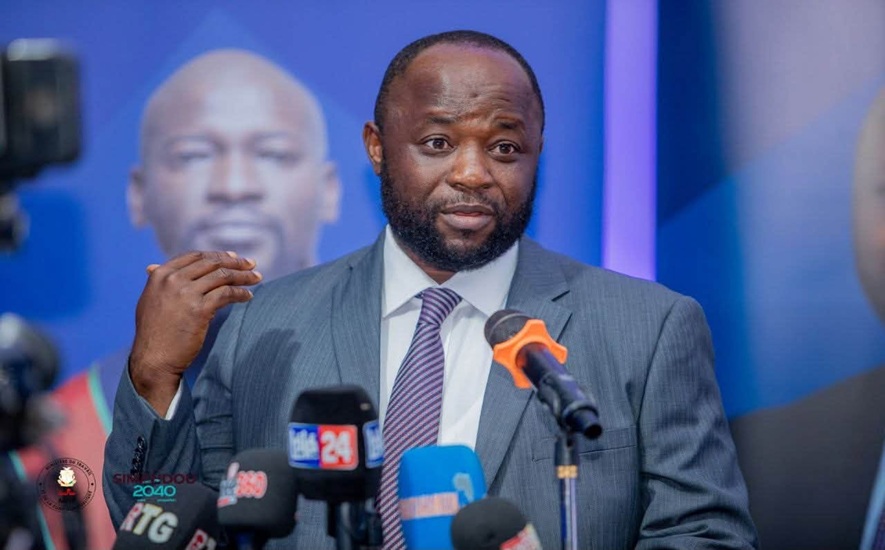
Guinea’s government has a new public face, and it is one already familiar with the inner workings of the state. Faya François Bourouno, who has spent the last two years steering administrative modernization efforts, took on the additional role of Government Spokesperson in late July, a move that places him at the intersection of policy execution and public explanation.
Bourouno was appointed to the spokesperson role by decree on July 30, 2026, succeeding Ousmane Gaoual Diallo. He continues to lead the ministry responsible for administrative modernization, a dual mandate that makes him a central figure in how the Executive’s reform agenda is both implemented and communicated to the public.
A Career Built on Public Sector Management
Bourouno’s path to the spokesperson’s podium has been shaped by a steady progression through Guinea’s administrative ranks. His formal entry into senior administration came in November 2021, when he was appointed Secretary-General of the Ministry of Culture, Tourism, and Handicrafts. In that position, he handled administrative coordination and oversaw files related to heritage promotion and tourism development.
His portfolio shifted significantly in March 2024, when he was appointed Minister of Labor and the Civil Service. That department was later reorganized in February 2026 to focus on the modernization of administration and the civil service, a change that aligned with the government’s broader reform priorities.
His academic background supports this technical trajectory. Bourouno holds a master’s degree in economics and finance from the General Lansana Conté University of Sonfonia, earned after studies from 2004 to 2009. He has also pursued specialized training in public policy evaluation and project management, including a program on public policy impact evaluation in Paris in 2017, development evaluation training at the National School of Public Administration of Quebec in 2018, and a certification in strategic management of public projects in 2022.
Leading the State Reform Agenda
At the helm of the modernization ministry, Bourouno has overseen the State Reform and Public Administration Modernization Program (PREMAP). The initiative, led by Mamady Koma, began with a diagnostic across the country’s regions to assess the strengths, weaknesses, and needs of public structures. The findings pointed to several priorities: simplifying procedures, improving administrative performance, strengthening deconcentration and decentralization, and fostering a results-oriented management approach.
Human resources management has been a major pillar of this transformation. According to the government, more than 20,000 new civil servants have been recruited, and a unified administrative management file has been created and stabilized. The stated goals are to better control workforce numbers, payroll, and data on public employees.
Digital modernization has also accelerated. The ministry is working on developing e-services, ensuring interoperability among public systems, and establishing a one-stop shop for public services. Platforms such as DAMANDA, TELEMO, SONEYA, TRESOR PAY, FUGAS, and GEDA are part of this push toward digital transformation.
In August 2026, the ministry began consolidating the legal framework for public administration, with work focused on the organization and functioning of the administration, the Public Service Charter, and the simplification of administrative procedures.
A New Role in a Delicate Balancing Act
Bourouno’s appointment as spokesperson comes at the end of a career largely devoted to public action and administrative reform. Since taking office, he has already moved to strengthen engagement with the media. A meeting held on August 19 with national and international press announced the establishment of a regular exchange framework, including periodic meetings, contact points, and thematic briefings on key issues of national interest.
The challenge ahead is significant. The role requires making often technical public policies accessible while addressing the questions of public opinion and the media. Bourouno’s profile as a public manager and his governmental experience are assets in this regard, but the task of explaining Executive decisions and supporting communication around reforms will test his ability to translate complex administrative work into clear public messaging.
His trajectory—from state human resources management to digital transformation, and through administrative structural reform—has progressively moved closer to the core of state operations. Now, as spokesperson, he carries the additional responsibility of explaining, defending, and making more transparent to citizens the actions of a government engaged in a vast administrative modernization effort.
Source: Conakryinfos.com

Comments