
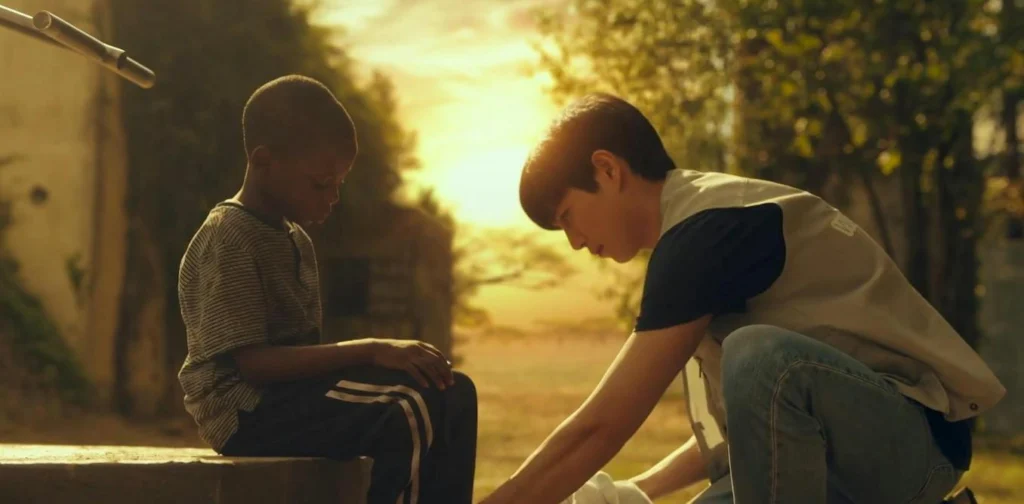
Africa appears in South Korean television dramas less as a place than as a function: somewhere to send a character who needs to be punished, reformed or shown doing good.
That is the pattern traced by Osarugue Otebele, a researcher in cinema and media with a focus on global Black art and cinematic practice, who examined three K-dramas — Shooting Stars (2022), Marry My Husband (2024) and Queen of Tears (2024) — for a study published in The Conversation.
Otebele’s stated aim was not to catalogue why these portrayals are harmful. She set out to understand what they reveal about South Korea, and how they work as a barometer for measuring and projecting the country’s own development.
The three series, in her reading, present the continent in three distinct negative guises: as a continent in need of charity, as a place of rebellion and savagery, and as a place of punishment for a troubled child.
Charity as character-building
In Marry My Husband, the antagonist Oh Yu-ra loses her job at the family company and is sent to “join a volunteer foundation in Africa to build character.”
In Shooting Stars, the charity framing is more explicit still: the opening sequence shows the lead character digging wells in Africa, surrounded by smiling village children.
In both series, South Korea is embodied by the characters dispatched to Africa. Yu-ra is sent as punishment; the Shooting Stars character is an actor whose humanitarian stint helps restore his public image among South Korean audiences.
Africa becomes a space where other people’s image and character are forged, Otebele writes, at the price of being reduced to a set of clichés.
The punishment handed to Yu-ra illustrates how K-dramas turn Africa into a destination for the undesirable and the discredited.
The continent becomes the receptacle for everything that threatens the happiness of the love story and, by extension, the narrative of South Korean nation-building.
A continent without law
Queen of Tears drops the “Asian saviour in Africa” trope and replaces it with something else: Africa as a place suited to youthful excess, devoid of any sense of order or the rule of law.
In the series, the protagonist’s younger brother Soo-cheol recalls his rebellious years: “It reminds me of when I went to Africa. My twenties were marked by debauchery and barbarism.”
When reproached for having spent most of his stay at the hotel, he replies: “I just had to look out the window to get my dose of madness.”
Otebele poses the obvious counter-question — are there no crimes, no criminals, no places or people to save in South Korea? Of course there are, she writes.
Yet the series she examined, she argues, seem to suggest a different answer: compared with Africa, yes.
The framing long predates the dramas she studied. She points to the 2018 film Burning, in which the heroine embarks on a quest for “introspection” and a deeper meaning to life.
In improvised variety shows, personalities of African origin living in South Korea, such as Sam Okyere and Jonathan Yiombi, often appear as hosts or guests — a screen presence that does not shield them from racist reactions.
Okyere was targeted after criticising a video in which South Korean students mimicked a clip that had gone viral in Ghana, his country of origin.
Yiombi faced similar treatment after South Korea’s elimination from the football World Cup, when the Democratic Republic of Congo, his birthplace, beat Uzbekistan and indirectly knocked South Korea out.
What the trope is doing
Otebele draws on the Cameroonian philosopher Achille Mbembe, who in On the Postcolony describes Africa as Europe’s “signifier” — Europe can know and define itself only through how it constructs itself in opposition to Africa.
Her study argues the phenomenon is not confined to the West. The rising influence of Asian powers such as China and South Korea, both developing soft power, offers new channels for long-standing stereotypes about Africa.
South Korea, among the world’s poorest countries in the aftermath of the Korean War (1950–1953), has become a global economic power and gained standing on the world economic and cultural stage.
What lets countries like it define their level of development, Otebele argues, is their capacity to distinguish themselves from Africa.
The depiction of a “savage” Africa, in her account, helps showcase South Korea’s emerging soft power, whose international image is reinforced in particular by its capacity to bring aid to Africa.
K-dramas have grown steadily more popular in Africa, but examined systematically from this angle, the success of Hallyu on the continent comes with a heavy cost in representation.
Despite their enthusiasm for Korean series, African viewers appear able to recognise themselves on screen only through a colonial gaze that serves South Korea’s ambitions on the world stage.
While Africa helps strengthen South Korean cultural capital, it remains confined to the role of a symbol of lack and underdevelopment.
For better or worse, Africa’s presence — both metaphorical and literal — has come to occupy a significant place in the South Korean cultural and aesthetic imagination.
Yet despite the vitality of urban life, the richness of cultures and the dynamism of innovation on the continent, the clichés persist.
That presence, Otebele writes, seems possible only through a preconceived, fantasised image of Africa, depicted as savage, powerless and primitive, still in need — even after independence — of being “civilised.”
That mission no longer falls only to the former Western colonial powers, but also to Asia’s emerging economies.
Source: The Conversation

Comments