
Foragers in northern Malawi hunted close to home, broke open finger bones for marrow, and appear to have drawn a social line with neighbours, archaeologists say.
The two researchers behind the work argue that this combination — intensive local hunting, communal killing practices and a boundary that seems to have been maintained without persistent violence — challenges the idea that cultural boundaries in the distant past formed mainly along coastlines.
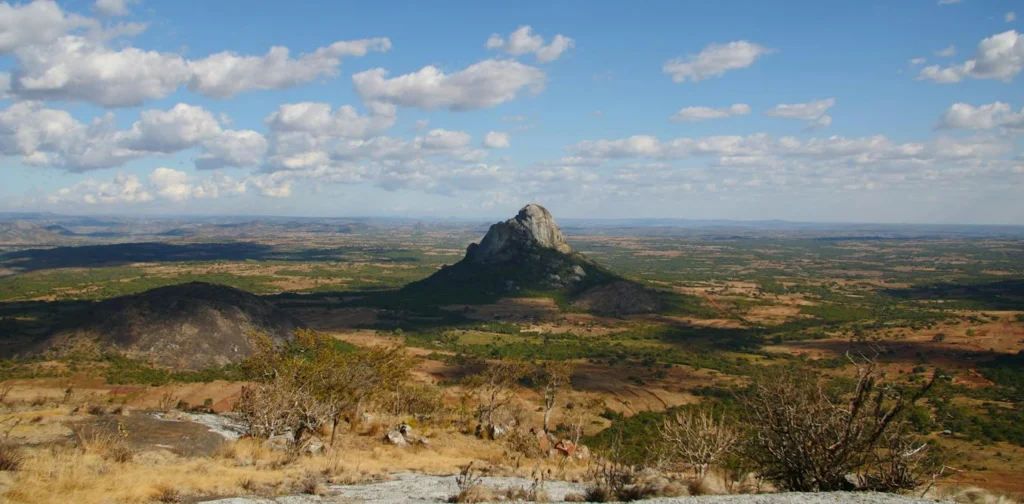
The site, known as Hora 1, sits on a granite mountain rising from open woodland.
In a piece for The Conversation, Alex Bertacchi and Jessica C. Thompson describe rock paintings, quartz stone tools, hearths, human burials and hundreds of thousands of animal bone fragments recovered from excavated layers.
Of that total, the pair report identifying almost 13,000 individual fragments spanning roughly the last 21,000 years of human occupation, and they have published a paper on what the bones say about cultural boundaries and food availability.

Jessica Thompson, CC BY-ND
The central question the authors set out is how ancient foragers balanced two risks: going hungry, and meeting strangers who might not be friendly.
They note that where food is densely clustered and predictable, it can pay to hold and defend territory, citing the Okiek of Kenya’s mountains, whose families control honey-harvesting.
Where food is sparse and unpredictable, boundaries tend to be looser, as with !Kung foragers in the arid Kalahari, who until recently ranged widely in search of game. Both, in the authors’ framing, are different answers to the same problem.

Chelsea Smith, CC BY-NC
Small prey, whole carcasses and marrow
Most of the Hora 1 bones belonged to small animals — tiny antelopes, hares, monkeys and similar creatures — which the authors say suggests that large, meat-rich prey such as zebras, wildebeest and rhinoceroses were not common in the valley in the past.
The fragments came from every part of the body, limbs, torsos and heads alike, which the pair read as a sign that animals were killed near the site and carried back whole rather than butchered in the field.

Ruoyang Tu, CC BY-NC
Chemical comparison of the local geology with traces in the animal teeth matched, the authors report, supporting the conclusion that hunting stayed local across the thousands of years represented in the deposits.

Jacob Davis, CC BY-NC
The bones were also extremely fragmented, on average about the size of a little finger. Many of the smallest and least nutritious elements, the phalanges, had been broken open to extract fatty marrow.
To the authors, that points to food being scarce enough that people spent time on very small returns — and raises the question of why they did not simply range further afield.
Cooperation, and a line between groups
The animals died at a range of ages, from young to adult to old individuals with worn teeth.
The authors say this pattern is consistent with some form of indiscriminate mass hunting, such as nets or traps, and possibly with the use of fire to drive larger animals.
Such practices, they argue, would have required coordinated labour and agreed rules on dividing what was caught — and in-group cooperation of that kind likely came with a sense of shared identity.
Evidence for how far that group’s world extended came, unexpectedly, from ancient DNA.
DNA preserved in human burials at the sites showed that relatedness fell away quickly with distance, and the authors date the emergence of this pattern to about 19,000 years ago, at the end of the ice age.
They describe it as an invisible boundary taking shape in tropical Africa, separating “us and them”.
Taken together, the evidence points to behaviour that was strongly local. But the authors are careful about what kind of boundary it was.
The effort spent recovering every scrap of food, they suggest, indicates prey were not abundant enough to justify actively defending territory.
They also report no evidence at the site for persistent violent encounters or for large, stable settlements of the kind documented near rich food sources such as lakes and oceans.
One possibility they raise is that the boundary was defended symbolically, for instance through collective practices such as a 9,500-year-old funerary pyre the team has described at Hora 1.
The authors note that most cultural groups known from archaeology are identified through durable artefacts that survive well, such as ornaments made from animal teeth and shells or pottery of a particular shape.
Many foragers moved too often to make or carry such heavy objects, and the Malawi work, they write, has turned up signs of ancient cultural boundaries without them.
Their broader claims are that a home territory and a strong sense of in-group belonging can exist without violence toward other groups, and that the continent’s interior, studied far less than its coasts, holds substantial evidence about how human cooperation and competition evolved.
Bertacchi reports funding from the US National Science Foundation; Thompson reports funding for excavations at Hora 1 from the National Geographic Society, the Wenner-Gren Foundation, Emory University and Yale University.
Source: The Conversation

Comments