

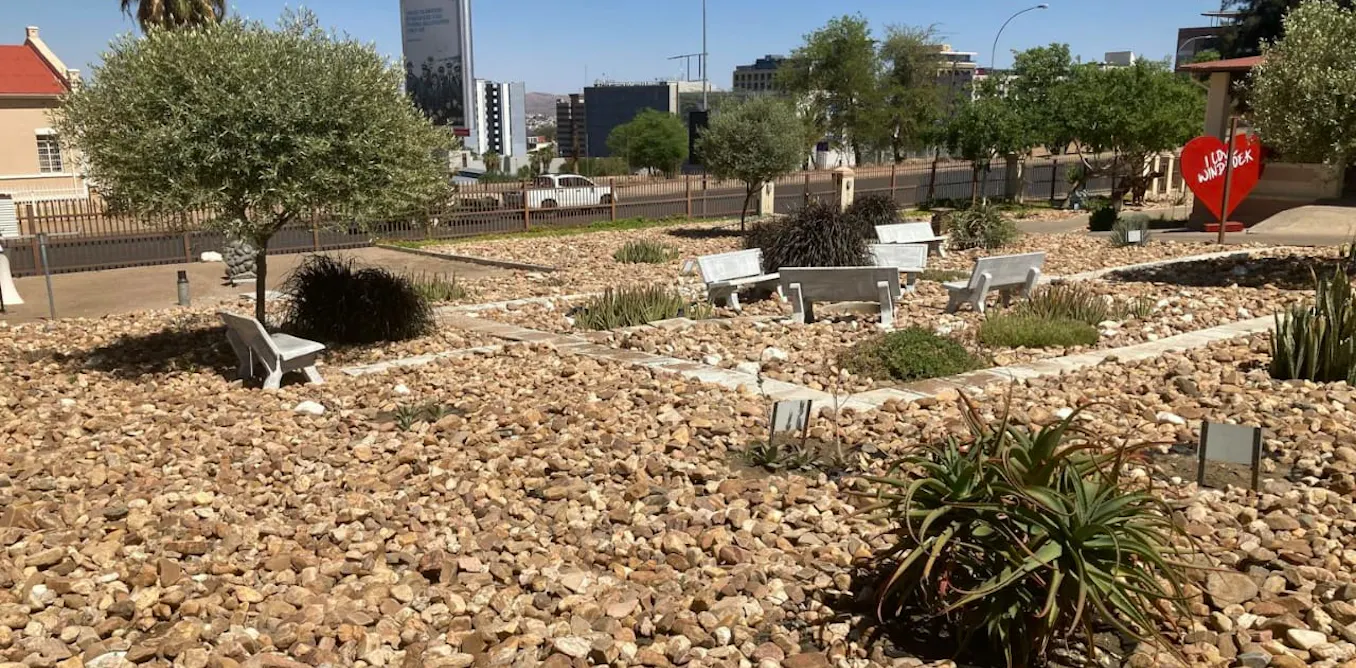
Windhoek sits on hills and valleys that bake under a sun that can push temperatures to 40°C, in a country where rain falls rarely and arrives without warning.
Sparse vegetation, asphalt and concrete hold that heat in, and the informal settlements spreading across the city’s edges are growing faster than the infrastructure beneath them.
It is the kind of place where the standard climate playbook — more trees, greener roofs, cooler streets — runs into an obvious problem: water.
That tension is the subject of a study by two landscape architects, Christina Breed and Gaby Hansen, who argue that Namibian climate policy is well written on paper but oriented toward disaster risk and emergency management rather than the everyday business of making a hot, dry city livable.
Their research, published through The Conversation, examined national climate and resilience policies and interviewed municipal officials, urban planners, academics, architects, landscape architects, environmental specialists and residents involved in permaculture and informal settlement upgrading.
Their conclusion is captured in a phrase they propose as a public campaign slogan for the capital: “Brown is Beautiful.”
What the researchers found
Breed and Hansen write that residents they spoke with value Windhoek’s dry landscape as part of the city’s natural and cultural identity — and that this attachment goes largely unspoken in planning documents.
Nature-based solutions, which use trees, plants, wetlands and other natural systems to cool urban areas, manage flooding and support wildlife, are central to global climate policy.
The researchers argue that arid countries need versions of these approaches built for water scarcity and fragile desert ecosystems, and that Namibia’s policies offer cities little guidance on how to use trees, wetlands and natural watercourses to reduce heat and absorb floodwater.
As a result, they write, Windhoek still leans on what they call grey infrastructure — concrete flood barriers and hard engineering — with an emphasis on managing disasters rather than preparing for worsening heat, drought and flooding.
Their proposed alternative is a set of landscape interventions: bioswales, the vegetated channels that collect and filter rainwater; contour swales, shallow trenches that slow water running down slopes; berms, raised earth banks that channel or hold water; drought-tolerant indigenous plants; and xeriscaping, a style of gardening that needs very little water.
These, they argue, should be designed around Windhoek’s specific terrain and the needs of its communities and wildlife.
The stakes are shaped by demographics. Informal settlements in Windhoek are growing at 6.5% to 7% a year, against 4% in the formal city, according to the study.
One person the researchers interviewed said basic infrastructure cannot keep pace. Sanitation networks often overflow during floods, exposing informal areas to sewage.
Local practice, unconnected
Community-led work is already underway. Permaculture gardens, local water harvesting systems and citizen-led environmental monitoring are spreading in Windhoek, combining ecological principles with local knowledge.
The researchers credit these efforts with improving food security, water conservation, social learning and a sense of belonging.
But they describe the projects as fragmented.
There is no municipal guideline on how to design green spaces so that they cool the city and help it cope with a warming climate, and the study points to a shortage of specific expertise in landscape architecture.
Projects are conceived separately rather than as part of a coordinated, city-wide approach, and the researchers say they need official backing from the city to have a larger impact.
They also identify what they call municipal champions — people inside the city administration who push for nature-based solutions to be built into urban planning.
Their efforts, the researchers write, show that change is possible within government, particularly when those officials share knowledge and work across departments.
One interviewee put the case for reframing the landscape this way:
Brown is alive; there are amazing brown plants and infrastructure. We need to change mindsets so people understand that brown is beautiful.
Highlighting arid-adapted landscaping with indigenous species can recentre this debate.
Breed and Hansen argue that communities, policymakers and researchers should work together on urban planning that is inclusive and suited to Windhoek’s context — an approach they say could extend to informal settlements, where residents face the weather directly and hold detailed knowledge of the local environment and how to survive in hard conditions.
For the city to prepare for a hotter, drier future, they write, systems need to change: nature-based solutions have to move from good ideas to everyday practice in urban planning, officials need the skills and resources to work with nature, and public services, communities and experts need to be brought into the same room.
Breed receives funding from the Danish Ministry of Foreign Affairs. Hansen has declared no relevant affiliations beyond her academic appointment.
Source: The Conversation

Comments