
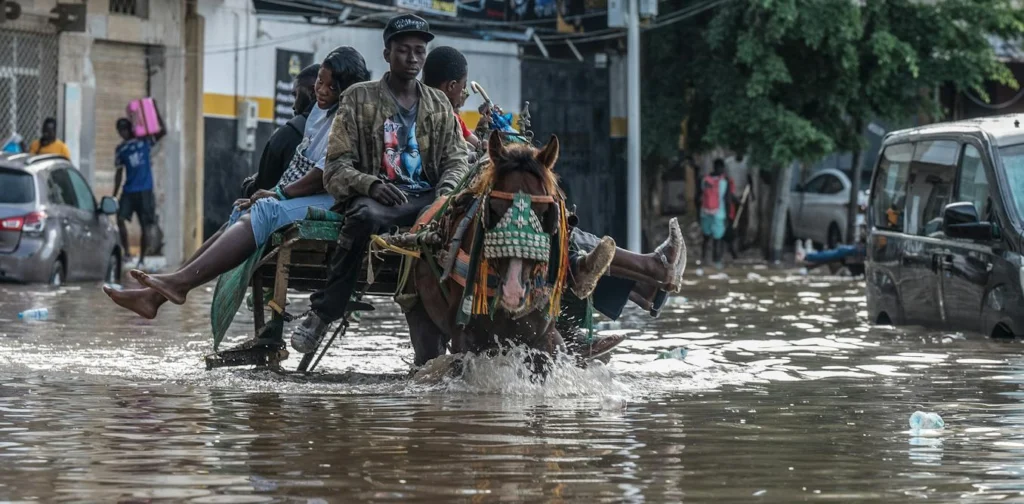
Five West African countries’ climate and disaster policies recognise costs of damaged roads, bridges and harvests but largely leave out cultural erosion, psychological harm and broken community ties, a decade-long policy review finds.
The research, reported by The Conversation, examined climate policies, adaptation plans, laws and disaster-management frameworks from the five countries.
It found that the plans address measurable damage to infrastructure and livelihoods, while losses that are harder to price receive far less attention.
The authors describe these unavoidable or irreversible impacts as “loss and damage” — the term used in climate policy for harm that cannot be prevented through adaptation or fully repaired afterwards.
Floods, droughts, coastal erosion and extreme heat across Africa are affecting livelihoods and public services, and while stronger infrastructure, early-warning systems and resilient farming can reduce some impacts, not all damage can be avoided or fixed.
Different approaches across five countries
The review identified two main gaps. First, the five countries address climate-related losses and damages differently, which the researchers say makes it unclear which agencies should assess the impact of disasters and coordinate support.
Second, the policies often overlook losses to culture, mental health and community ties.
According to the findings, climate policies across all five countries focused largely on repairing damage that can be measured, particularly in agriculture and infrastructure such as roads, bridges and buildings. Displacement, cultural erosion and psychological harm were less recognised.
The researchers argue that official assessments do more than record what happened: they shape government priorities, recovery budgets and requests for international assistance.
Losses that are not documented are therefore less likely to influence recovery decisions or be included in them.
The review offers the example of a coastal community forced to relocate because of erosion.
New housing may meet the immediate need for shelter, but relocation can separate people from their fishing grounds, family networks, burial sites and places connected to their history.
Similar gaps arise in education and health: rebuilding a damaged school does not recover months of lost learning, and disaster assessments that record deaths and physical injuries give far less attention to grief, anxiety and the emotional consequences of losing a home, community bonds or a livelihood.
Community input proposed to widen the picture
The researchers conclude that governments can capture a wider range of losses by combining cost assessments with input from affected communities on non-monetary losses.
They suggest local authorities, women’s organisations, traditional leaders, young people, people with disabilities and civil society groups can help identify losses that official assessments often overlook.
That work, they argue, should begin before disaster strikes.
Communities could map culturally important places, document how local people earn a living and explain which services, relationships and practices support everyday life, with that knowledge then used to prepare for disasters and, where necessary, to relocate communities and help them recover.
The authors say the five countries do not necessarily need to create new institutions.
Existing climate, disaster management, social protection and development agencies could include wider forms of loss in their assessments, and a common way of recording and reporting losses would allow different agencies to work from the same information.
They add that such evidence could strengthen the countries’ access to international support.
The Fund for Responding to Loss and Damage and the Santiago Network, a UN-backed network of organisations and experts, help vulnerable developing countries access technical assistance for climate-related losses, and countries need to provide evidence of what happened, who was affected and what assistance is needed.
That evidence, the researchers say, could include how disasters affect health, education, human mobility, culture and community life.
The research was carried out by Olasunkanmi Habeeb Okunola, an Associate Academic Officer at the United Nations University Institute for Environment and Human Security, and Susan S. Ekoh, a Senior Researcher at the German Institute of Development and Sustainability.
Source: The Conversation
Comments