

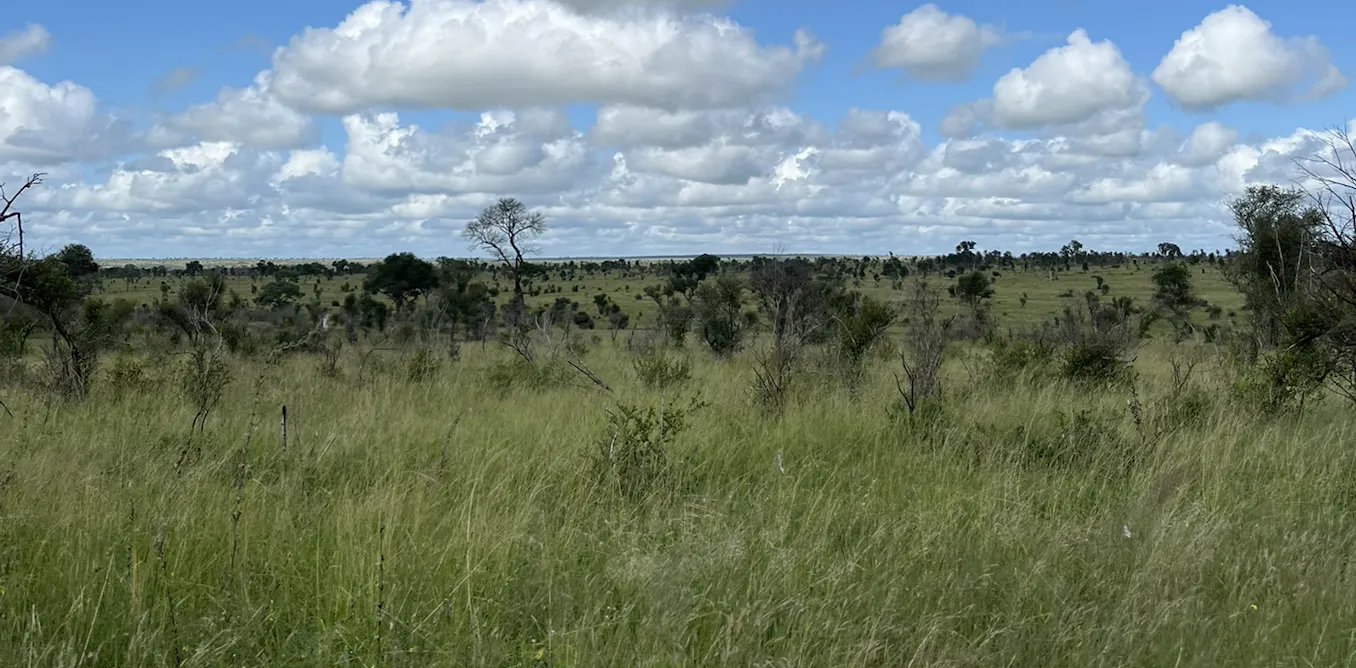
Grass production in South Africa’s Kruger National Park rose 28% between 1989 and 2021, when atmospheric carbon dioxide levels climbed about 18%, research shows.
The finding matters beyond one park. Savannas cover roughly half of Africa, and the grasses at their base feed wildlife and livestock, carry the fires that sweep through them each dry season, and move carbon between land and atmosphere.
For decades, scientists expected the grasses that dominate savanna ground layers to respond weakly to CO2 fertilisation. Most use C4 photosynthesis, a pathway that concentrates CO2 inside the leaf.
Common African species such as red grass (Themeda triandra) and bushveld signal grass (Urochloa mosambicensis) belong to this group. Because C4 plants already pump CO2 internally, the prevailing view was that extra atmospheric CO2 would make little difference to them.
Kimberley Simpson, a plant ecologist who studies how savannas respond to environmental change, worked with an international team of ecologists and ecosystem scientists to test that assumption.
Their research, published in The Conversation, combined three approaches: a review of 70 published experiments comparing wild C4 grass responses under normal and elevated CO2 with plentiful and scarce water, an analysis of yearly grass growth from 533 sites in Kruger National Park, and a computer model projecting how C4 grasses might grow for the rest of this century.
Kruger was chosen not only because C4 grasses dominate its landscape but because it offers a rare dataset built on more than three decades of continuous field monitoring.
The experimental review found that when water was scarce, higher CO2 allowed wild C4 grasses to lose less water while continuing to photosynthesise, gaining more carbon for each unit of water lost.
In water-limited savannas, grasses exposed to higher CO2 produced more above-ground plant material. The effect was much weaker when water was plentiful.
The field data showed the same pattern. Using the amount of grass above ground in the first year after a fire as the best estimate of annual growth, the researchers found production increased by 28% across the three decades.
Even after accounting for changes in rainfall, fire and other environmental factors, grass production still showed an upward trend, closely matching the experimental findings.
As expected, the percentage increase was greatest in Kruger’s driest savannas, where saving water was predicted to make the biggest difference.
The researchers also found that taller, more productive grass species became increasingly prominent, suggesting rising CO2 may be affecting both how much grass grows and which species dominate.
Modelling suggested the response could continue through the 21st century. Higher temperatures and increasing dryness weakened the CO2 effect but did not eliminate it, with C4 grass production looking set to increase as atmospheric CO2 continues to rise.
More grass does not automatically mean better grazing. Higher CO2 levels can change the balance of carbon and nitrogen in plants and potentially make them less nutritious, so quantity is not necessarily the same as quality.
More growth could also mean more material available to burn, and could change how grasses and trees compete and how carbon moves between plants, soils and the atmosphere.
On carbon storage, the researchers are explicit about the limits of their findings. More grass growth means plants take up more carbon while growing, but uptake is not the same as long-term storage.
Savanna grasses are eaten, decompose and burn, returning much of the carbon in their leaves and stems to the atmosphere.
Long-term storage in grasslands occurs mainly below ground, particularly in soils, and the review of experiments found no consistent increase in the amount of roots under higher CO2 levels.
The team therefore cannot conclude that the extra grass growth offsets global warming.
What the study does show, the researchers argue, is that rising CO2 is directly reshaping ecosystems like grasslands, not only through warming and shifts in rainfall.
Scientists and land managers should therefore no longer predict savanna change from rainfall and temperature alone.
For managers, that means tracking how much grass grows, which species are present, grazing pressure and the amount of material available to burn over the long term.
Fire and grazing plans based on past patterns may need rethinking if the amount and type of grass growing under similar rainfall conditions are changing.
The team’s next question is what happens to the extra grass.
Answering it will require long-term monitoring and experiments to trace whether the growth ends up as food for animals, goes up in smoke during a fire, or turns into soil organic matter, which in turn determines effects on wildlife and livestock, savanna fires and carbon storage.
Source: The Conversation

Comments