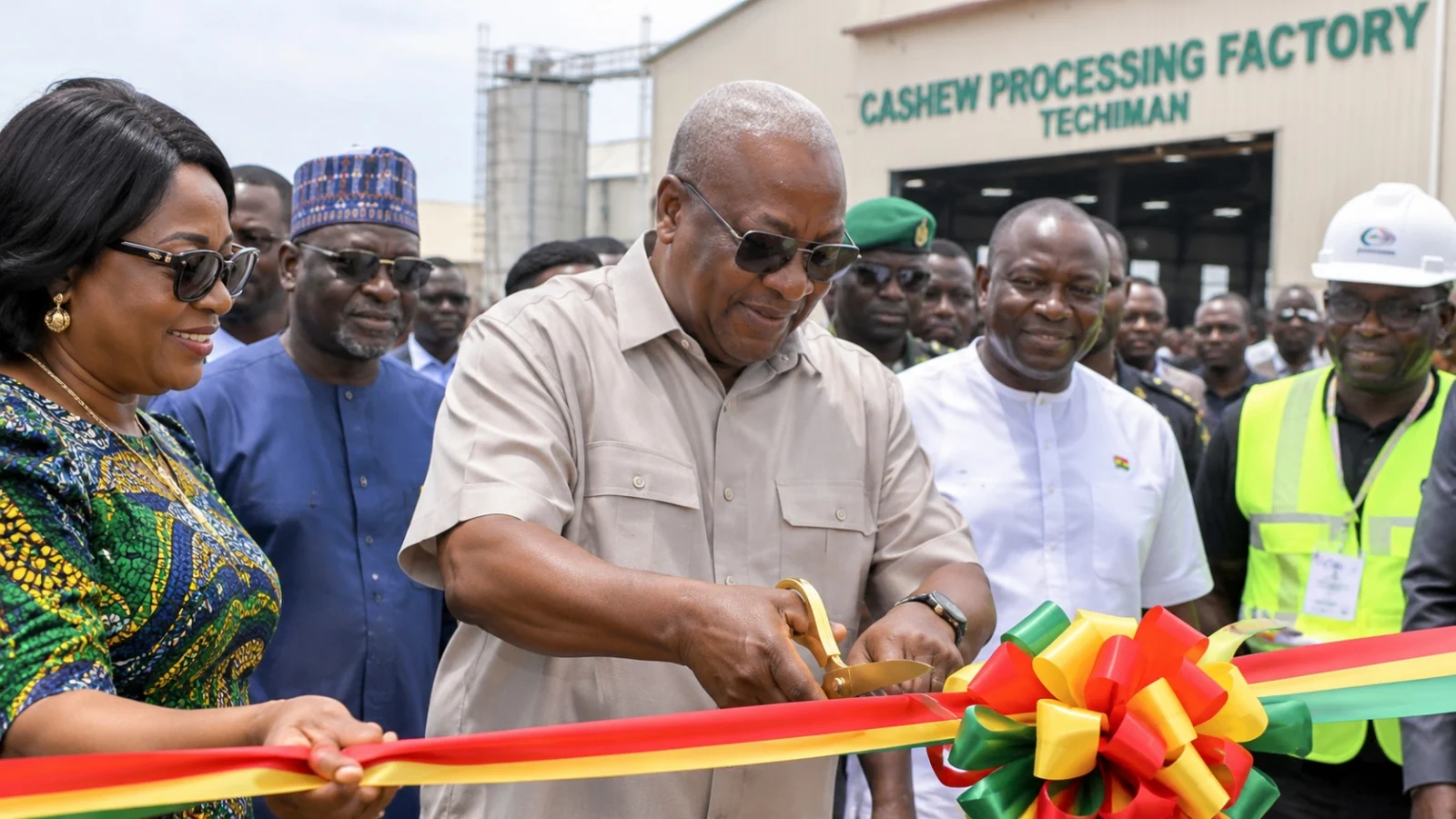
President John Dramani Mahama said at the Monday, November 16, 2026, commissioning in Techiman of Ghana’s newest cashew processing plant, which can handle 33,000 metric tonnes of raw nuts a year, that its financing covers only 60 to 80 days.
Mahama put the full-year buying requirement at more than $100 million.
The NADKANSCO Cashew Processing Limited facility was financed with approximately $12 million from the Ghana Export-Import Bank, more than $3 million of which went into automated processing equipment, according to the bank’s chief executive, Sylvester Adinam Mensah.
NADKANSCO Managing Director Belinda Akorfa Adokpa said the company could earn Ghana $40 million in foreign exchange every year at the onset if it operates year-round.
Export restrictions and a levy on raw nuts
To keep factories like this one supplied, Mahama announced plans to restrict raw cashew nut exports during the first three months of the harvesting season, modelled on a policy he attributed to Côte d’Ivoire.
He also announced plans for a levy on raw cashew exports to fund local processors.
The measures target a persistent imbalance. Ghana produced more than 262,000 metric tonnes of raw cashew nuts last year but processed only about 17,000 metric tonnes domestically, according to the figures Mahama cited.
He said the country had exported large quantities of cashew for years with limited local processing, and that exporting raw agricultural produce costs Ghana employment and income that local processing could generate.
Mahama framed the restriction and levy as part of a wider push to move Ghana from trading to manufacturing, saying the country is “a country of manufacturers, not traders.”
He said Ghana has enough pure water factories and needs factories that process raw materials for export, naming maize, rice and mangoes as commodities with significant processing potential.
Supply chain being built farmer by farmer
The factory’s raw material base is still being assembled.
NADKANSCO has trained 1,247 farmers in four weeks to supply cashew to the plant, and with EXIM Bank funding plans to train an additional 1,000 farmers under phase one of capacity building, followed by a further 2,000 across eight districts under phase two.
Company projections put the eventual workforce at 1,500 direct jobs and about 3,000 indirect jobs for farmers, aggregators, transportation and traders.
The plant’s current direct employment of nearly 1,000 and indirect support of 3,000 livelihoods were stated by the president at the commissioning.
Financing record beyond Techiman
The cashew plant is not the only EXIM Bank-backed project cited.
The bank provided additional financing to complete a stalled factory project in Savelugu, which now employs more than 2,000 people, about 80 per cent of them women and young school leavers.
Mahama said his government planned to invest $10 billion of its own resources in eight strategic sectors under a new economy agenda, with agriculture and agribusiness, including tree crops, among the priority areas.
He also outlined tax measures for manufacturers: businesses operating multiple shifts could benefit from accelerated depreciation of plants and equipment over two years, while companies expanding or establishing new factories would get deferred payment of import duties and levies on equipment for one year, spread over the following two years.
He urged Ghanaian investors to take advantage of agro-processing and manufacturing opportunities rather than leaving industrialisation to foreign investors, saying Ghanaians have the resources to build the factories being constructed.
He said he wants to see more companies like NADKANSCO processing cashew and other products such as maize flour, rice and mango juice.
Comments