

For over a decade, traceability schemes, regional rules and corporate audits have been presented as the answer to the trade in conflict minerals from eastern Democratic Republic of Congo.
Writing for The Conversation, Thierry Vircoulon, an associate researcher at the French Institute of International Relations, sets out the case that certification has become, at best, one tool among many for improving mining governance — and not the remedy for conflict minerals that it is often sold as.
Une politique complexe
The problem itself is not new. In the early 2000s, the debate over “conflict minerals” gradually displaced the earlier campaign against “conflict diamonds,” both of them built on the same underlying link between resource extraction and the financing of war.
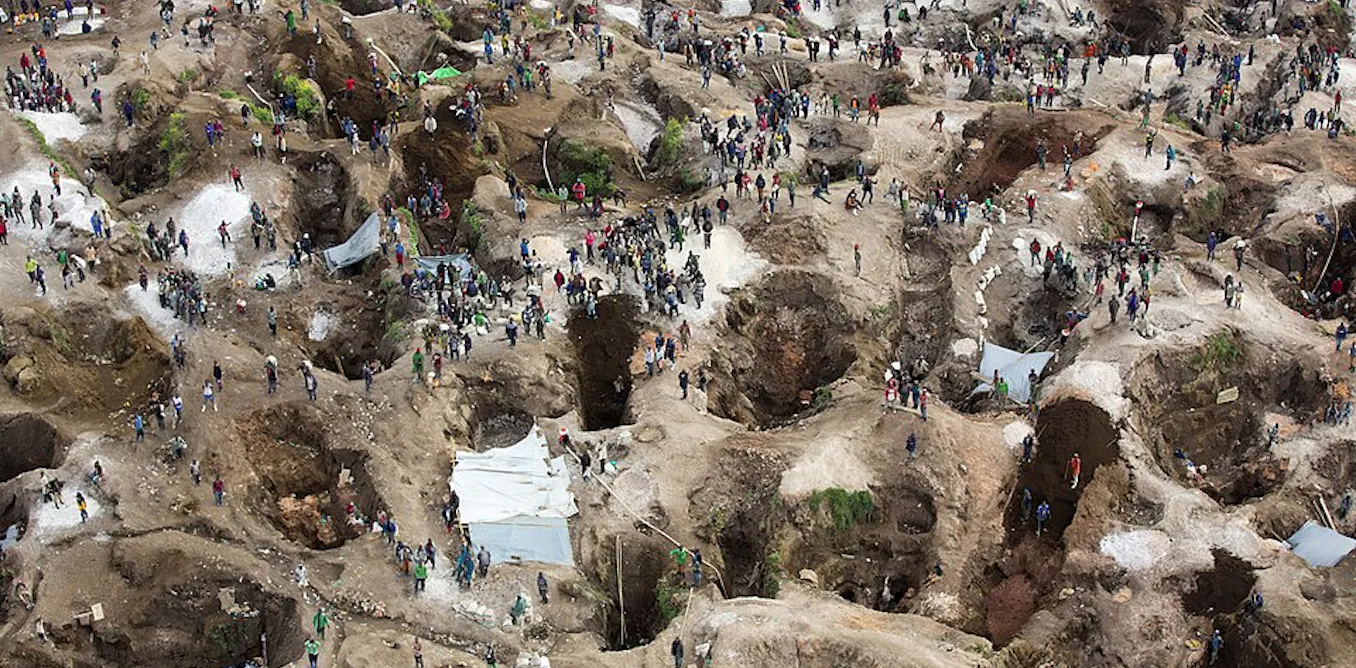
Research carried out in the DRC since 2003 documented how armed groups and the Congolese army financed themselves through artisanal extraction of the “3T” minerals — coltan, cassiterite and wolframite — along with gold.
Dug from artisanal mines in the east of the country, those minerals functioned simultaneously as a means and an end of war for the actors involved.
The response took shape over the following decade. In 2008, electronics industry organisations created the Responsible Minerals Initiative.
In 2009, the International Tin Supply Chain Initiative was established to develop traceability and responsible export of 3T minerals from eastern DRC.
In 2010, the Organisation for Economic Co-operation and Development published a due diligence methodology for mineral supply chains from conflict-affected and high-risk areas, setting out the steps companies can take to identify, prevent and mitigate associated risks.
That same year, states belonging to the International Conference on the Great Lakes Region agreed to establish a regional certification mechanism.
The United States and later the European Union adopted regulations obliging certain companies to disclose the origin of the minerals they use.
La mise en œuvre d’un mécanisme de certification
The ICGLR’s regional initiative against the illegal exploitation of natural resources, adopted in 2010, bundled together a certification mechanism, harmonisation of legislation, a database on mineral flows, formalisation of artisanal mining, promotion of the Extractive Industries Transparency Initiative and an early-warning mechanism.
Its certification scheme, adopted in 2011, sorts mining sites into categories according to their security and social situation. A fourth category — blue sites — was added in 2021.
Red sites are those with armed group presence, security forces involved in mining, or children under 15 or pregnant women working on site; production and export are prohibited.
Yellow sites are judged partially satisfactory, with extraction temporarily authorised for six months pending improvement. Green sites are under state control without serious human rights violations, with production authorised for a year subject to renewal.
Blue sites have not yet been inspected, or their qualification has expired, but present no known problem in principle; they may produce for up to 36 months before inspection.
La certification ITSCI
Created in 2009 in the DRC and later extended to Rwanda, Burundi and Uganda, ITSCI operates the principal traceability system for 3T minerals in the Great Lakes.
It covers roughly 3,000 mining sites in the region and tracks minerals through batch tagging and certification of their origin.
It trains auditors, supervises the tagging of mineral lots and assists companies in putting a due diligence policy in place, and it publishes alerts and information on mining production.
Its funding rests on member contributions but also on the volumes of certified minerals. It brings together companies from both upstream and downstream of the chain, and its headquarters are in London.
La certification RMI
The Responsible Minerals Initiative has a wider geographic and mineral reach than ITSCI, covering gold, the 3T minerals, cobalt and mica, and extending beyond the Great Lakes.
It supplies companies with a due diligence methodology, risk assessment tools, databases, risk maps and grievance mechanisms. To be certified by the RMI, companies must be audited by independent bodies selected by the initiative, which assess their due diligence policies.
Because smelters and refineries are key actors in supply chains, they are the RMI’s preferred target.
On paper, the combined efforts of the ICGLR, states, ITSCI and the RMI amount to a system of multiple certifications meant to guarantee responsible sourcing, organised around a division of labour. The ICGLR sets the rules.
States license mines and exports. ITSCI handles traceability for the 3T minerals.
The RMI verifies that international companies’ sourcing policies comply with international standards.
Les failles de l’approvisionnement responsable
The first weakness he identifies concerns how artisanal mines in the DRC are classified. The introduction of the blue category in 2021 allows uninspected mining sites to produce and export.
That category was created because the Congolese administration lacks the human and financial resources for field inspections, but it reduces the system’s reliability by authorising an exception to the principle that sites should be inspected.
More seriously, according to Vircoulon, militia members benefited from extraction at certain certified mining sites.
Citing the United Nations, he writes that they were active in the Rubaya mining zone in 2023 and 2024 while it was classified as a green site and its production was therefore authorised.
Such situations, he argues, reveal at minimum a lack of rigour and at worst corruption among those responsible for certification.
The second weakness is smuggling between the DRC and its neighbours, Rwanda in particular. Because Rwandan production is treated as clean, Congolese minerals from conflict zones are introduced into Rwanda and mixed with its output.
Vircoulon writes that this smuggling largely explains the growth in Rwandan exports of 3T minerals and gold. The Rwandan government denies the smuggling, but the United States has denounced it and sanctioned three Rwandan mining companies in 2026.
Several international companies have stopped sourcing from the DRC and Rwanda as a precaution.
Certification systems run by ITSCI and the RMI depend heavily on the independence and integrity of auditors, and Vircoulon notes that the problem of conflicts of interest — the risk of collusion between auditors and the companies they audit, or of self-censorship by auditors — cannot be ignored given recent scandals.
Certification bodies face two contradictory objectives, he writes: a financial one, to certify a large number of mining sites and companies, and a reputational one, to carry out rigorous audits.
ITSCI’s funding, for instance, depends largely on the volumes of minerals whose origin is certified, a situation that may make certification bodies hesitate before refusing a certification or suspending an existing one.
Finally, Vircoulon describes certification as becoming a lucrative and competitive market.
The battle between certifiers, he writes, has only just begun.
Trois problèmes persistants
In Vircoulon’s account, certification initiatives in the Great Lakes set out to reduce the flow of conflict minerals onto the international market and, in doing so, to reduce conflict itself.
Faced with their inability to fully achieve that objective — financing of armed groups and of the Congolese army through the mineral trade continues, as do the conflicts, as the second M23 rebellion illustrates — the rhetoric around them has become more modest.
It now confines itself to guaranteeing companies a responsible supply of 3T minerals from the Great Lakes. The pacification objective has given way to an industrial one.
Genuine traceability and certification efforts still run up against three problems, he writes: corruption in the administrations responsible for applying the mine certification and mineral export system, which is notorious in the DRC and does not spare other states in the region; smuggling that allows conflict minerals to be sold as clean minerals from countries neighbouring the DRC; and conflicts of interest that can influence audits, all the more so as certification turns into a lucrative market.
His conclusion is that certification is at best one tool within a broader mining governance policy, and cannot be the remedy for the conflict minerals problem.
Marc-André Lagrange contributed to the writing of the article.
Source: The Conversation
“,
“excerpt”: “A researcher at the French Institute of International Relations argues that overlapping mineral certification schemes in the Great Lakes region have not stopped conflict minerals from being traded. Thierry Vircoulon points to uninspected mine classifications, smuggling through Rwanda and auditor conflicts of interest as persistent weaknesses. He concludes certification is at best one tool of mining governance, not a remedy for the conflict minerals problem.”
}
Comments