

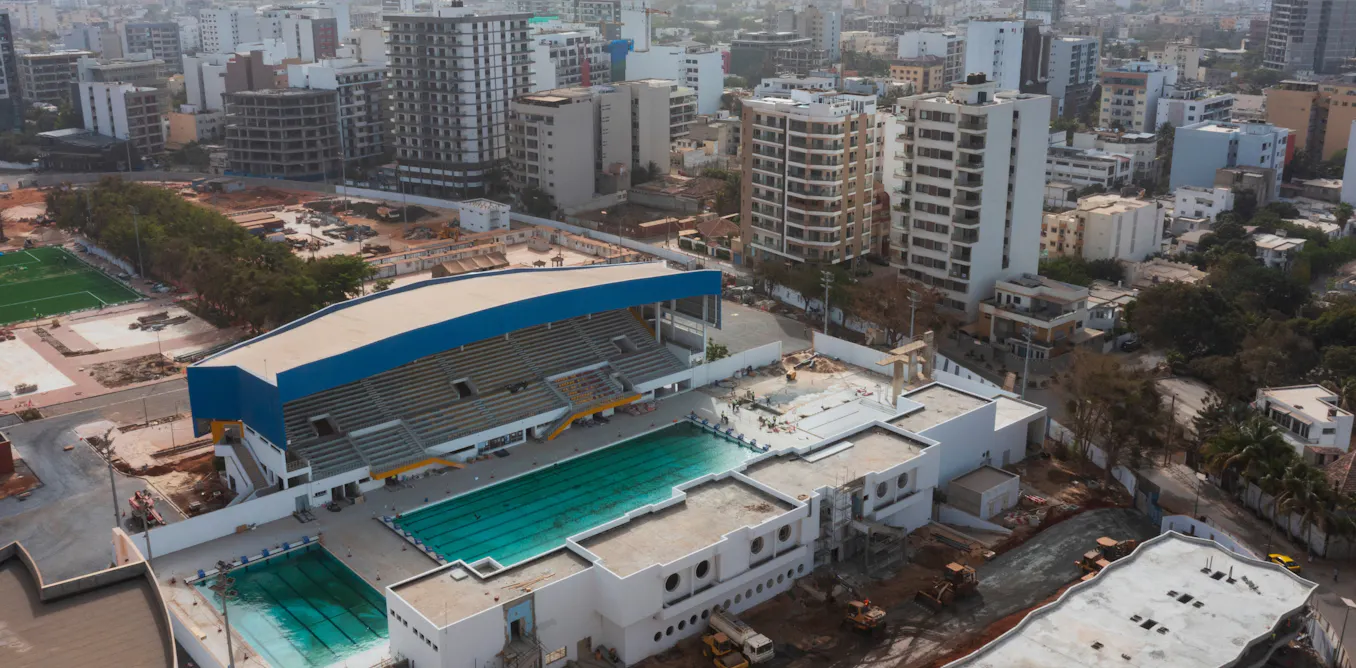
Senegal has built and rehabilitated sports infrastructure in Dakar, Diamniadio and Saly for the Youth Olympic Games it hosts from 31 October to 13 November 2026.
The facilities raise a question that outlasts the competition itself: how the State should finance, manage and maintain them once the Games are over.
Two researchers who study the problem argue the Games could shift the Senegalese model. Djibril Diouf specialises in public-private partnerships, and Amadou Moctar Ndiouck in the law and management of sports infrastructure.
In an interview published by The Conversation, they set out the respective roles they see for the State, local authorities and the private sector in financing sports facilities, and the conditions needed to keep those facilities in use, maintained and socially profitable after the Games.
Can the investments made for the Youth Olympic Games durably change the financing model for sports infrastructure in Senegal?
For the Youth Olympic Games, the State has favoured a model of massive direct financing backed by partners including the West African Economic and Monetary Union (Uemoa) and the French Development Agency (AFD).
The scale of the funds those partners have mobilised influences the financing model, the researchers say.
But even where the model rests on public financing or public-private partnerships, they argue it can incorporate the sustainable management of sports infrastructure, and that the legacy of the Games could bring private actors into that picture.
What role should the State give to the private sector in the financing and management of sports infrastructure after the YOG?
Senegalese law assigns a role in creating sports infrastructure to the State and local authorities.
That runs from the 1984 sports charter to articles 36 to 51 of the new sports code, adopted by Senegal’s National Assembly on 11 May 2026.
Under that framework, the State and local authorities have an obligation to build sports facilities for the benefit of sports stakeholders.
In practice, the researchers say, the absence of proactive public policies on infrastructure construction – except when a sporting event comes around – leaves recourse to the private sector necessary.
They point to public-private partnership as an opening that brings innovative solutions to creating sports infrastructure, a model used for the toll highway and the Blaise Diagne International Airport in Dakar.
In their view it can be used to strengthen private-sector participation in creating and managing public sports facilities while ensuring their financial and social profitability.
Private involvement, they argue, helps mobilise private funds to make up for shortfalls in public financing.
On the management side, it can supply technical expertise that fosters financial management, helping keep facilities to international standards while allowing all populations to access them.
How can we prevent the infrastructure rehabilitated for the YOG from becoming, after the Games, costly facilities to maintain?
The rehabilitated infrastructure is concentrated in Dakar, Diamniadio and Saly, and the researchers say a uniform maintenance model will not fit all three. The realities differ.
At the Iba Mar Diop stadium in Dakar, they propose involving Cheikh Anta Diop University through the National Higher Institute of Popular Education and Sport (INSEPS), which has been headquartered on the site since 1982.
Making both the stadium and the Olympic pool there available to INSEPS would contribute to that, and service functions developed in this context could ease maintenance and financial profitability.
For Diamniadio, they suggest the Office for the Management of Sports Infrastructure (OGIS), attached to the Ministry of Sports, could validly take charge of infrastructure far from urban centres, which draw the public only for major sporting events.
OGIS is a public establishment of an industrial and commercial nature, placing it in the commercial sector, and the researchers say it can contribute to the financial and social profitability of sports infrastructure.
In Saly, the infrastructure sits on a tourist and seaside site. There, the researchers consider private-sector involvement very likely to be more advantageous, bringing what they describe as a professional touch that provides quality of service and promotes sustainability.
Beyond major sporting events, what financing model would allow Senegal to develop infrastructure accessible to all?
The financing model built on direct public investment and public-private partnership focuses on large-scale infrastructure capable of hosting major sporting events.
Since 2025, however, the Ministry of Sports has run an experimental local infrastructure programme, creating 25 multi-purpose courts in 25 communes of Senegal.
The researchers welcome the initiative, arguing that just as large-scale infrastructure is necessary for major events, local infrastructure is vital and must be valued.
Physical and sporting activities take different forms across localities – competition, leisure, health among them – and the researchers say the State and local authorities must support them through their respective budgets.
They also note that in bilateral international cooperation, certain countries such as China and Russia favour the construction and rehabilitation of sports infrastructure in countries of the South, particularly as part of their projects for Senegal.
Source: The Conversation
Comments