

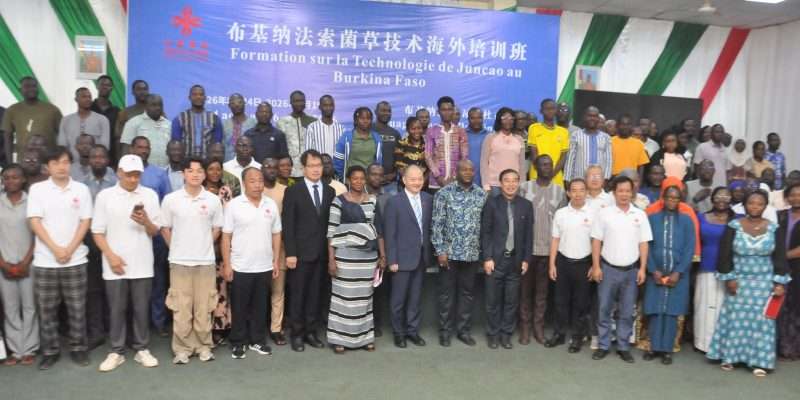
Second cohort begins three-week Juncao training in Ouagadougou
Burkina Faso’s Ministry of Agriculture has launched a second training session on Juncao technology, a Chinese agricultural innovation that uses grass instead of wood to produce fodder and edible mushrooms.
The session began on August 24, 2026, in Ouagadougou and will run until September 16, according to the ministry.
Around 100 agents from the department in charge of Agriculture are participating in the three-week program, which is organized in collaboration with Fujian Agriculture and Forestry University and the Directorate General of Plant Production of the Burkinabè Ministry of Agriculture.
The training follows a first session held in 2024.
Participants will learn from experts at the Chinese university, gaining theoretical and practical knowledge to apply Juncao techniques to fodder production and edible mushroom cultivation in Burkina Faso.
Juncao technology: a grass-based approach
Juncao technology is a Chinese innovation that replaces wood with grass, combining light, heat, and water resources to create a production cycle linking plants, animals, and mushrooms.
The technology offers economic, social, and environmental benefits, contributing to ecological, food, and energy security.
Cécile Sarambé, Director of Continuing Education at the National School of Livestock and Animal Health of Burkina (ENESA), said the 2024 experience with Juncao was “productive and well-suited to Burkina Faso’s climatic conditions.”
She believes the technique can improve the availability of quality fodder for livestock and provide an additional income source for farmers through mushroom cultivation.
Lin Hui, Director of the Juncao Center at Fujian Agriculture and Forestry University, added that fodder and mushroom production will help reduce pressure on natural pastures and strengthen the resilience of the livestock sector against climate risks while supporting family farms.

China-Burkina Faso agricultural cooperation deepens
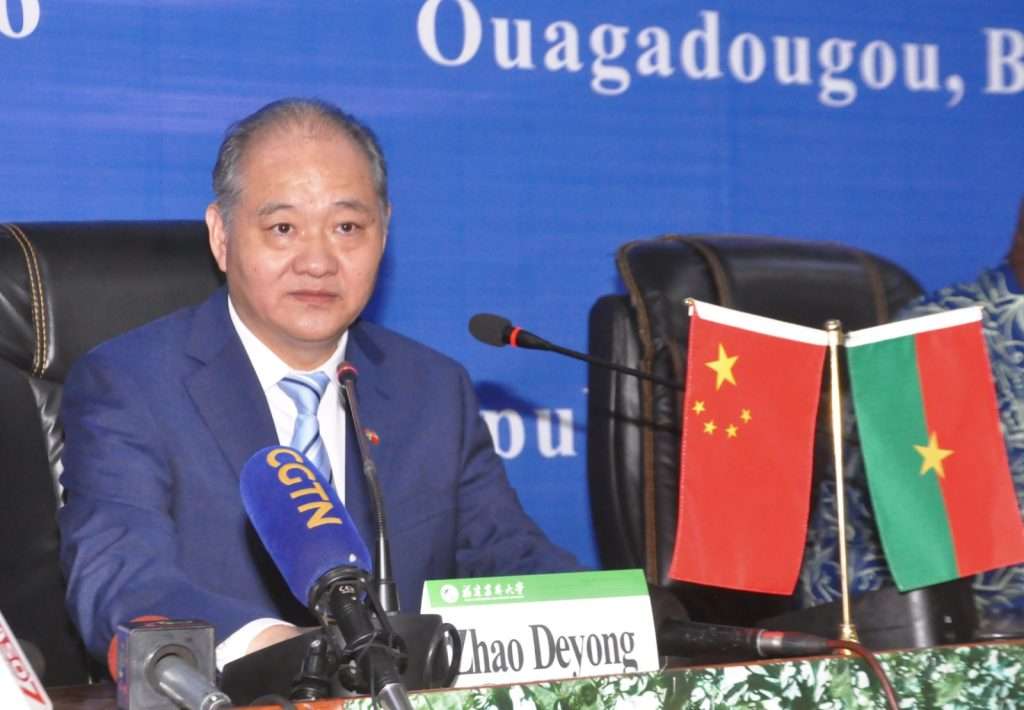
The training reflects strengthening ties between China and Burkina Faso in agriculture. China’s Ambassador to Burkina, Zhao Deyong, said agriculture and food security are at the forefront of relations between Ouagadougou and Beijing.
He cited agricultural missions China has sent to Faso in recent years to work alongside Burkinabè experts in rice and millet, aiming to improve farmers’ production levels.
This year, China has invited dozens of Burkinabè agricultural technicians to participate in seminars in China, focusing on agricultural product trade, cotton cultivation, and integrated use of technologies related to cereal crops.
Gaoussou Sanon, Secretary General of the Ministry of Agriculture, confirmed that this second training session is the fruit of “the good and perfect collaboration between Burkina Faso and the People’s Republic of China.”
He advocated for the sustainability of the initiative, saying the knowledge gained will be disseminated across all regions of the country.
Juncao’s global reach
Juncao technology has been shared with the world for over three decades. Since its inclusion in 1994 among the United Nations’ South-South cooperation projects, it has been adopted in many developing countries.
According to Lin Hui, more than 400 international training sessions have strengthened the knowledge of over 17,000 technical staff from 118 countries.
Juncao also represents more than 60 foreign assistance, training, and international cooperation projects implemented over the past 30 years, and has enabled China to establish cooperative relationships with governments, research institutions, and companies in more than 40 countries.
Source: L'economiste du faso

2 comments