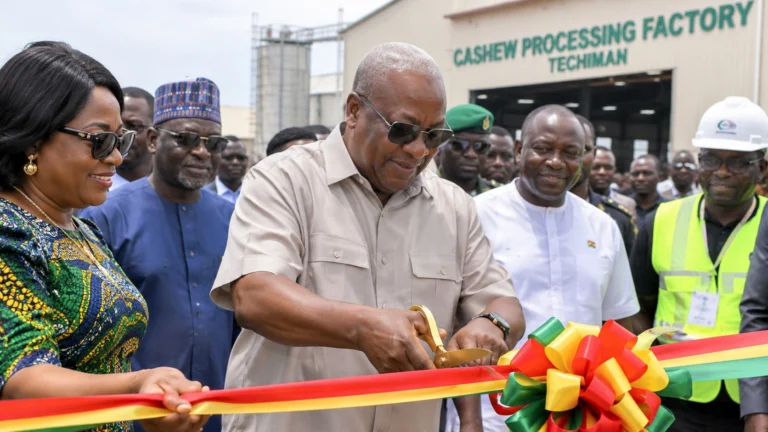
Ghana’s newest cashew processing factory can run only 60 to 80 days on current financing, even as the government moves to restrict raw nut exports and impose a levy on them to support local processors.
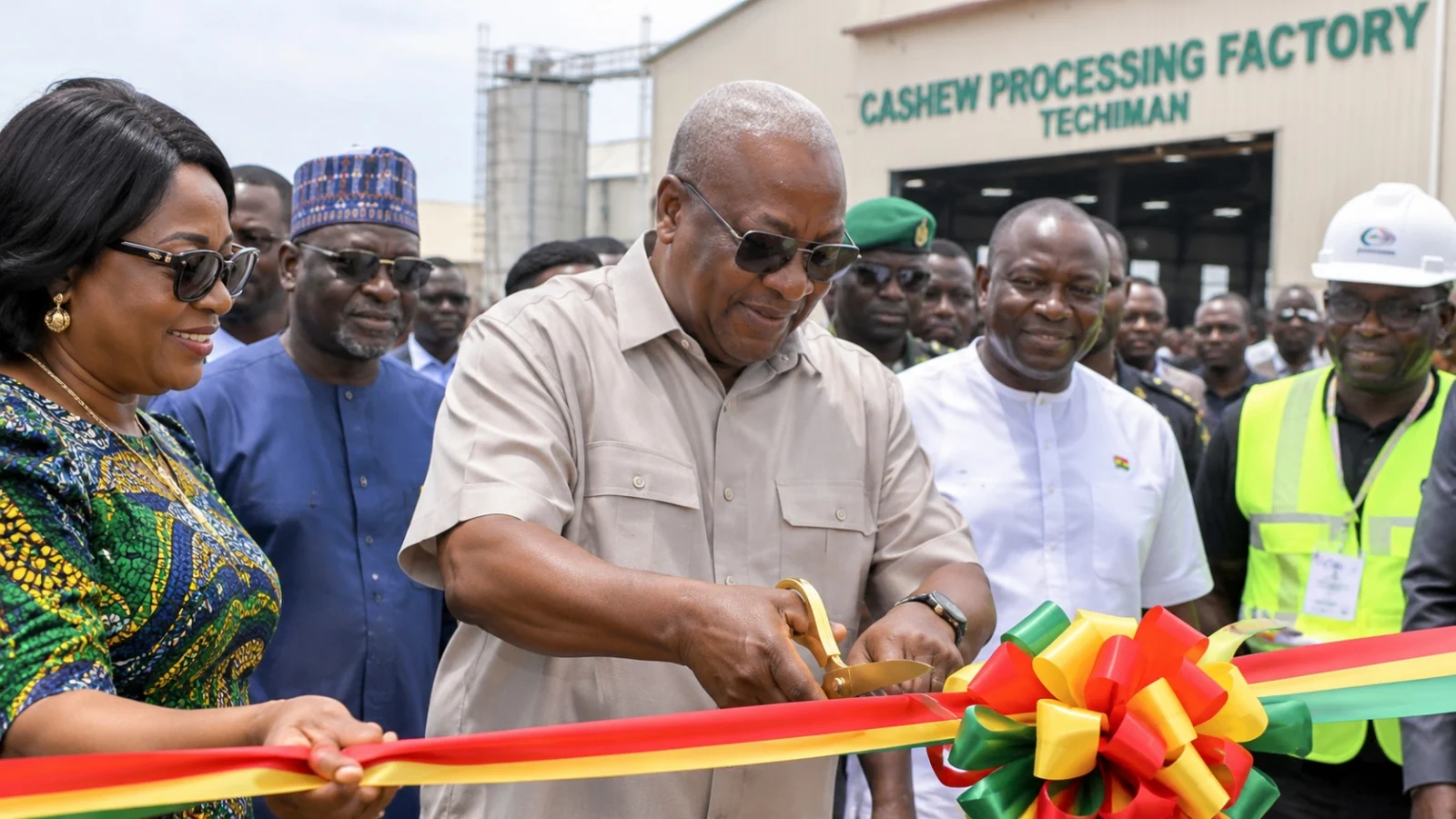
President John Dramani Mahama, who commissioned the NADKANSCO Cashew Processing Limited factory in Techiman in the Bono East Region, said more than $100 million would be needed to buy enough cashew to keep the plant running all year.
The facility received approximately $12 million from the Ghana Export-Import Bank, according to the bank’s chief executive, Sylvester Adinam Mensah.
More than $3 million of that went into acquiring the factory’s automated processing equipment.
The plant can process up to 33,000 metric tonnes of raw cashew nuts annually.
Ghana produced more than 262,000 metric tonnes of raw cashew nuts last year but processed only about 17,000 metric tonnes domestically, according to the figures cited at the commissioning.
Export restrictions and a levy
Mahama announced plans to restrict raw cashew nut exports during the first three months of the harvesting season, modelled on a policy implemented by Côte d’Ivoire.
He also announced plans to introduce a levy on raw cashew exports to fund local processors.
The president said exporting raw agricultural produce costs Ghana employment and income that local processing could generate. He identified maize, rice and mangoes as commodities with significant potential for local processing.
Agriculture and agribusiness, including tree crops, are among the priority areas of the new economy agenda, under which the government plans to invest $10 billion of its own resources in eight strategic sectors.
Mahama said industrialisation is central to that agenda, aimed at creating jobs, especially for young people.
Jobs and farmer training
The NADKANSCO facility has employed nearly 1,000 people directly and supported another 3,000 livelihoods indirectly, according to the figures presented.
The company says the factory will create 1,500 direct jobs and about 3,000 indirect jobs for farmers, aggregators, transportation and traders.
NADKANSCO Managing Director Belinda Akorfa Adokpa said the company could earn Ghana $40 million in foreign exchange every year at the onset if it operates year-round.
Whether the plant can operate year-round appears to depend on the financing gap Mahama described.
On supply, NADKANSCO has trained 1,247 farmers in four weeks to supply cashew to the factory.
With funding from EXIM Bank, the company plans to train an additional 1,000 farmers under phase one of capacity building, and a further 2,000 farmers across eight districts under phase two.
Incentives for processors
The government is also offering incentives to companies expanding or establishing new factories: deferred payment of import duties and levies on equipment for one year, spread over the following two years.
Businesses operating multiple shifts could benefit from accelerated depreciation of plants and equipment over two years.
The EXIM Bank’s involvement extends beyond Techiman.
It provided additional financing to complete a stalled factory project in Savelugu, which now employs more than 2,000 people, about 80 per cent of them women and young school leavers, according to the figures cited.
The commissioning took place against a wider government push on trade and migration.
Speaking at the 2026 Metropolis International Migration Conference at the University of Ghana in Accra on Wednesday, Mahama said the African Continental Free Trade Area, if fully implemented, has the potential to lift millions of Africans out of extreme poverty, and called for linking free movement of people to trade, employment and continental integration.
He cited Ghana’s labour exchange agreements with several Caribbean countries as a model that has enabled Ghanaian health professionals to work abroad under fixed-term contracts, and said similar agreements with Middle Eastern countries have facilitated recruitment of Ghanaian drivers, security personnel and construction workers.
He also said Ghana faces migration pressures, including an influx of refugees fleeing violent extremism in the Sahel, and that many displaced persons in Ghana have lost their livelihoods and resorted to begging, while their children remain out of school.
He condemned the brutalisation of foreign nationals in South Africa, saying migration challenges cannot be solved through vigilantism or mob violence, and acknowledged South Africa’s sovereign right to manage its borders while saying such efforts must respect human rights and follow lawful processes.
He urged African nations to fully implement the African Union Free Movement Protocol and Agenda 2063, and said there is a persistent gap between government commitments and the experiences of travellers at border posts.
Comments