

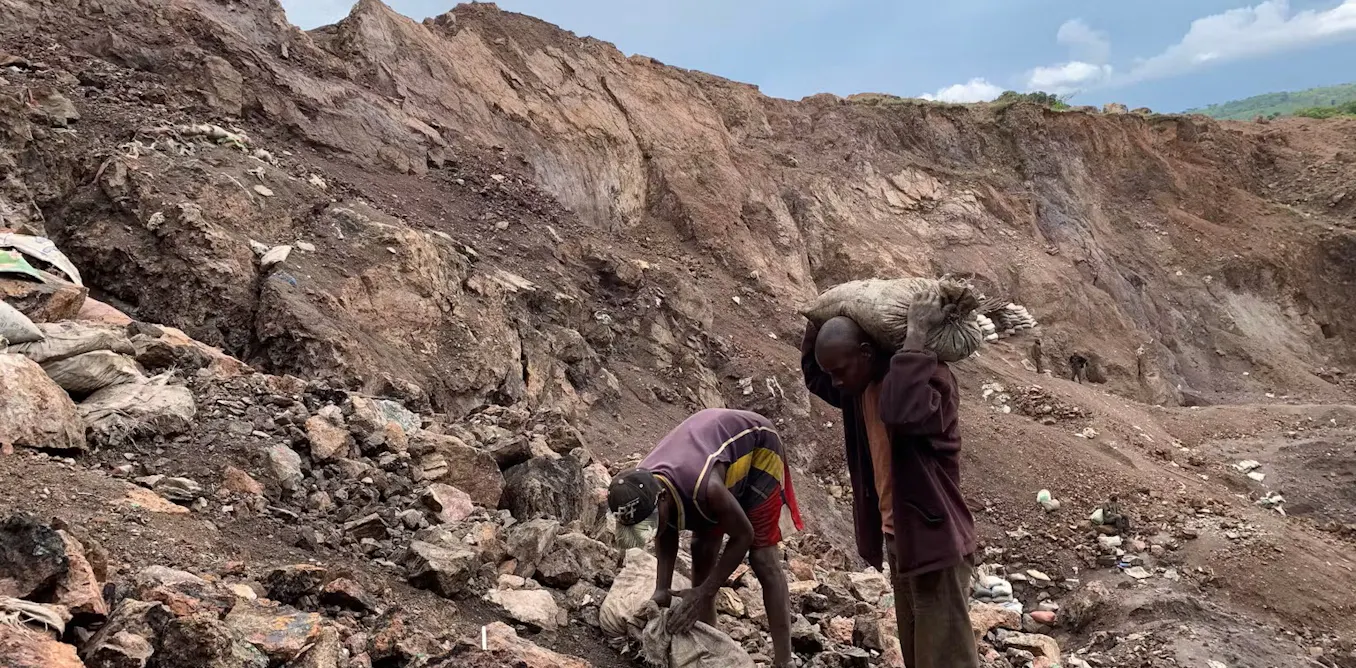
Between 2,000 and 5,000 tonnes of natural uranium were likely shipped out of the Democratic Republic of Congo inside cobalt hydroxide cargoes between 2000 and 2024, research estimates.
The study, published in July 2026, is the first to systematically combine two factors: the natural geological presence of uranium alongside cobalt in the country’s copper belt, and the similar behaviour of the two elements during chemical processing.
Less than 10 percent of that material appears to have been declared publicly to the International Atomic Energy Agency, the body responsible for uranium accounting and safeguards. Most of it went to China, which dominates the global cobalt market.
In the weeks after publication, the DRC launched an analytical verification campaign to test the uranium content of cobalt cargoes destined for export. Congolese authorities will also consult the IAEA.
The research was led by Ryan A. Manzuk, a geologist who works with geographic and spatial data, including regional cobalt statistics. The findings were reported by The Conversation.
Why uranium travels with cobalt
The specific risk does not come from clandestine access to deposits or from smuggling. It arises from a geological coincidence.
Cobalt is essential to smartphones, laptops and many modern technologies. Southern DRC supplies 70 percent of the world’s cobalt.
The ores feeding that production sit close to several high-concentration uranium deposits, such as Shinkolobwe, which are scattered across the region.
Those deposits formed roughly 600 million years ago, before the first animals walked on land. Over the past few million years, rainwater has carried uranium away from them and spread it across the copper belt.
Heterogenite, the main mineral supplying cobalt, can adsorb – that is, retain – uranium when it passes nearby.
The result is that the same minerals making up most of the global supply often contain high levels of uranium.
The researchers reviewed existing studies showing that uranium and cobalt behave similarly during the ore treatment practised in the DRC.
A large share of the uranium extracted from the ground during cobalt mining can therefore remain in the final product ready for export.
Refineries can follow well-defined procedures to remove uranium from cobalt. Discussion of those techniques only began in earnest around 2020 and they are not common.
Compiling DRC import records for the chemicals needed for uranium removal, the researchers found that only three of the 31 operations studied appeared to apply uranium-removal measures systematically.
Scale of the accounting gap
The sheer size of the DRC’s cobalt industry creates a uranium accounting problem regardless of ore grades or separation strategies. The country exported more than 200,000 tonnes of cobalt in 2024.
Each cargo is supposed to be checked for radioactivity on arrival at ports or at border crossings, and flagged if a Geiger counter – which detects and measures radiation – shows too high a level. That system requires functioning equipment.
Cargoes with high uranium content are known to escape regulatory control.
Even if DRC mines systematically applied uranium-removal strategies to keep cobalt products within international radioactivity limits for maritime transport, enough uranium could still reach China to allow the manufacture of roughly 12 nuclear weapons a year, based on the researchers’ calculations and the size of the DRC cobalt industry.
The findings also point to a broader risk for populations and ecosystems near the mines.
Workers are exposed to the uranium while working in the mines. The researchers estimate that 1,000 to 4,000 tonnes of uranium were released in highly mobile forms into mining residue ponds, where material from mining operations is stored.
That poses a health and environmental safety risk for neighbouring communities.
Earlier studies have shown that some mining populations and communities living near mines in the DRC displayed signs of uranium exposure, visible in blood and urine analyses.
The research indicates that this risk needs to be considered across the entire copper belt.
What the researchers recommend
The first step is to systematically measure the uranium content of cobalt-based products, which the researchers describe as essential to establishing transparency.
That would involve an independent body taking representative samples from cobalt cargoes and measuring the precise amount of uranium present to build a common register.
Beyond analysing outgoing cargoes, the researchers also recommend monitoring radiation exposure among workers in the DRC cobalt industry.
Their findings indicate that even ores with modest uranium content pose a potential exposure risk, because concentrations can end up high during processing.
Policies are also needed to require treatment of cobalt-based products to remove uranium, and then to require its storage in stable forms in residue areas isolated from public water supply networks.
The DRC has officially declared no uranium exports for decades. The Shinkolobwe mine, the main uranium source for the Manhattan Project between 1942 and 1947, has been officially closed to exploitation since 2004.
Two atomic bombs were dropped on the Japanese cities of Hiroshima and Nagasaki in 1945.
Source: The Conversation
Comments